Uncategorized

Polar Bears

226

Polar Bears: Back to 3

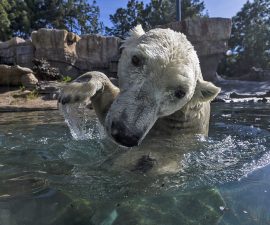
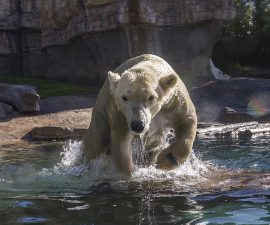
Chinook enjoys some ice time in July.

Over the past week, Chinook has been more active and has been spending lots of time outside in our polar bear management yard instead of her bedrooms and den. On this past Sunday, we removed the den, and she seemed not to care. So this morning we reintroduced our fabulous threesome! After a brief greeting, all three settled on exhibit: Chinook in the mulch by the road, Kalluk on the point, and Tatqiq at the edge of the pool. All seem to be pleased with each other’s company. Chinook did go up to the doors after 30 minutes to see if we were around, but after sniffing and listening she went back out to her mulch bed.

The immediate future will be about continuing the ultrasound exams for a few weeks just to see any changes. Then as we approach the end of winter, we expect to see Kalluk’s behavior change, letting us know breeding season will be upon us shortly, and then. . .we all know the routine. So uncross you fingers and rest your hopes, at least until next fall!

JoAnne Simerson is a senior keeper at the San Diego Zoo. Read her previous post, Polar Bears: No Easy Answers.

52

Polar Bears: Getting Ready

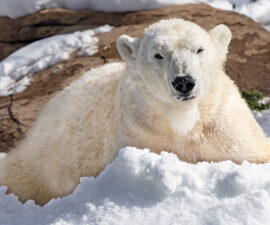
Chinook enjoys snow day July 2011.

As you may already know, we are anxiously waiting to see if polar bear Chinook will have cubs this fall (see post Polar Bears: Dare to Hope). While we don’t have absolute confirmation yet that she is pregnant, her behavior and hormonal profiles look good, and we are hopeful. Of course, “hope” is just part of what we need right now: we also need to get ready!

For most of this year we have been monitoring and analyzing Chinook’s behavior and hormones, and these studies have provided great insight into her reproductive cycle. But our research effort really shifts into high gear during the postpartum period. If Chinook has cubs, we will be monitoring the behavior of mother and offspring and closely studying their acoustic communication. As part of a broader study of maternal-care patterns in polar bears (supported in part by Polar Bears International), every move that Chinook makes will be recorded on our den camera, and every squawk, moan, and hum emitted by her cubs will also be recorded, analyzed spectrographically, and correlated with both the cubs’ and Chinook’s behavior.

But what’s most important to the success of this research, and to the successful rearing and care of mother and cubs, is that all of our work is done without disturbing the bears. This requires thoughtful planning and making sure everything is in place BEFORE Chinook decides to go into her den to prepare for a birth. Every piece of equipment must be tested beforehand, because we can’t go back in and fix anything once Chinook has settled in. At this point, we are almost ready, and yes, we are very, very hopeful!

Megan Owen is a conservation program specialist at the San Diego Zoo Institute for Conservation Research. Read her previous post, Panda Su Lin: Cub.

58

Polar Bears: Dare to Hope

Chinook gives Kalluk's scruff a playful tug.

We’ve all experienced wanting something so bad that it hurts. People will tell you all kinds of things to make the waiting a bit less painful. You begin to fill your head with all the knowledge you can to know if it will really happen or not. And then comes the superstitions: don’t step on a crack, don’t talk about it, fingers and toes crossed. But no matter what, it just takes time to get the really special things that you want! What am I talking about? Wondering if polar bear Chinook is going to have cubs, of course! Is there anything else on our minds? Dare we hope?

As you know, Chinook and Kalluk marked Valentine’s Day 2011 by marking the start of the polar bear breeding season. If you were to ask Kalluk, he would tell you it was a successful season. The good news is that Chinook did not go back into season. This is very good, as we believe that when a female polar bear ovulates and there is fertilization, in most instances she will not cycle again that year. This is a good knowledge point.  Chinook, as many of you have observed, has also been putting on weight. This would not be due to carrying cubs, as they are barely over a pound at birth, but would make sense that her metabolism would compensate to hold as much as possible to nurse and provide for cubs—another good point of knowledge.

Polar bears experience delayed implantation, so we would expect to see Chinook changing behaviorally once the fertilized egg implants, around 60 days before birth. Yes, she is beginning to seclude herself away from Kalluk and Tatqiq. If gestation is 195 to 265 days for a polar bears, then from the 10 days of breeding, Chinook would be due between August 28 and November 16. Panic—it’s already September! Breathe, breathe. With such a long gestation, she could be implanting right now with a due date of early November.  Most polar bear births in North American zoos have occurred in the first week of November, the earliest was on October 13. Good things to know!

We have been collecting fecal samples for hormone analysis with the research branch of the Cincinnati Zoo and urine samples for hormone analysis with the Memphis Zoo. So far, nothing conclusive from the urine analyses, but the fecal analyses look positive for pregnancy. . .or pseudopregnancy. BUT—and yes, a big but—Chinook’s hormone profile is consistent with profiles of other polar bears that have given birth! Dare we hope?

So with knowledge in place, we’re avoiding walking under ladders, stepping on cracks, saying anything to jinx it, and above all, fingers and toes crossed. You better believe we are daring to hope that this time will be for sure!

JoAnne Simerson is a senior keeper at the San Diego Zoo. Read her previous post, Little Polar Bear: Lessons.

31

Little Polar Bear Orphan

Qannik at rest in her new home at the Louisville Zoo. Photo by Andrew Fore.

A Little Polar Bear’s Travels

Everyone was worried when word first came out about an orphaned polar bear cub in Alaska two months ago. Luckily for the cub, many folks had been preparing for this exact day for the past few years. Understanding that with the warming of the Arctic, the resulting sea ice loss would put pressures on polar bear survival, ideas, plans, and communication avenues were established between conservation groups like Polar Bears International, government agencies like the U.S. Fish and Wildlife Service, and zoo professionals from North America to safely and expertly respond to rescue a polar bear orphan.

Qannik peeks out of her travel crate at the airport. Photo by Andrew Fore.

The cub was named Qannik (ken-ik), an Inupiaq word for snowflake. She was underweight at 15 pounds (6.8 kilograms) when rescued, but now, after two months of adjustment and care at the Alaska Zoo, the 60-pound (27 kg) cub was flown on a 747 jet, compliments of UPS, to her new home in Kentucky at the Louisville Zoo’s new Glacier Run! It’s hard to believe 10 years ago we were going through the same experience when the San Diego Zoo’s Kalluk and Tatqiq were rescued on the ice of Alaska at three months old. Along with the excitement are worries about how to make sure we give the best care ever! Back then we had many folks to call on for advice. It is now our turn to share what we learned back then. We compiled everything from formula amounts, recipes, how many feedings per day, weights at what age (I forgot that Kalluk gained five pounds in one day!), training records, veterinary records— everything we could put together—and sent it all to Louisville.

JoAnne greets Qannik at her new home. Photo by Andrew Fore.

I arrived in Louisville the day before Qannik to help with last-minute preparations.  Part of the Louisville Zoo staff had headed to Alaska to begin getting to know Qannik and becoming familiar to her. They and her caretakers from Alaska escorted her on the plane to Louisville. During the flight she slept often and was treated with frozen popsicles made of her formula—definitely a big hit! How often when we fly we want our luggage to be the first off? If you’re a polar bear cub, it’s no problem! Qannik was the first one off the plane. We then placed her in a van and drove back to the Louisville Zoo. How many of you have been in a van with a polar bear cub? She traveled easily—no complaints, just lots of sniffing.

Next she was carried into the bedroom area and the crate door opened. She immediately came out and explored—well, explored after she had a bowl of formula and small chunks of Alaskan salmon! After a bit of a romp and roll through the fresh hay, she crawled into the den and fell asleep.

To be continued. . .

JoAnne Simerson is a senior keeper at the San Diego Zoo. Read her previous post, Polar Bears: What Happened?

152

Polar Bears: What Happened?

Chinook pauses between doing her morning laps.

On February14, 2011, and for 10 days after, Chinook and Kalluk were inseparable. They slept together, ate together, swam together, and yes, bred. We can confirm that at this point we will be getting ready for the possibility of polar bear cubs this fall. However, this year breeding came early, and it’s possible we may see Chinook cycle again. It is interesting, as several other zoos with breeding polar bears have experienced this early breeding as well.

The gestation period for polar bears is 195 to 265 days, so before you get out the calendars and calculators, that gives us a due time of August 28 to November 16! To try to get as much information as possible along the way, we are collecting fecal samples and urine samples for hormone assay, and we will again do ultrasound exams with Chinook as we approach implantation and birth time. As you know, she does seem to greatly enjoy her belly-rubbing ultrasound sessions!

Kalluk is still showing a heightened level of testosterone with his behavior and inconsistent appetite. For males in the wild, this lack of eating is proving to be of concern as we lose more ice. In the wild, male polar bears begin searching for receptive females early in the spring. Once they breed with a female, she goes off to hunt and store as much fat as possible while he goes off in search of another receptive female. As the ice disappears earlier in summer, the males are losing precious time to hunt.

Kalluk doesn’t have this worry, as finding food is never an issue. Over the past weeks it has been difficult to get him to acknowledge food, but yesterday he ate 20 pounds (9 kilograms) of meat in one sitting. Kalluk is also beginning to actually sleep; during breeding season, he is so intent on where Chinook is that he rarely does anything more than a quick nap. Both eating and sleeping are good signs that we may be heading back to normal!

Chinook also has some resting to do. Kalluk is twice her size and very attentive to her every move. She is now spending a great deal of time snoozing in our mulch piles or taking long, luxurious swims in the pool. Two days ago Chinook and Kalluk had a great romping play-and- dive session, another sign that “normal” may be right around the corner.

Tatqiq seems to have a great understanding of what breeding season means to her. She is patiently waiting until her friends lose their romantic interests and regain their playful spirits and once again join her in a good romp around the exhibit. Until then, she is greatly enjoying having all the carrots to herself and is busy hunting gophers in Polar Bear Park.

JoAnne Simerson is a senior keeper at the San Diego Zoo. Read her previous post, Polar Bear Dance, where she has responded to questions sent there.

110

Polar Bear Dance

Kalluk is more than ready for love!

Some of you have noticed our male polar bear, Kalluk, and his “dance” of frustration in the past few days. We only see this from him during breeding season, typically at the beginning of the season as hormone levels are building, and then just before breeding when Chinook is not submitting, and then after the breeding cycle is done and Chinook is again not submitting.

We have observed that male polar bears go into a breeding set hormonally before the females do, and it lasts longer as well. In the wild, a male would breed with a female and then go find another willing mate; thus, a good reason for their season to last longer. The frustrated walk has been observed in the wild with both polar bears and brown bears in some situations.

Luckily, it would appear that in honor of Valentine’s Day Chinook is ready to breed, and our boy is finally losing some of his frustration!

JoAnne Simerson is a senior keeper at the San Diego Zoo. Read her previous post, Polar Bears White and Brown.

31

Polar Bears White and Brown

Chinook?

It has been a really busy beginning to 2011. Chinook let us know in December that cubs were not on the way (see post Polar Bears: What December Brings), and she was ready to join her buddies Kalluk and Tatqiq in life at Polar Bear Plunge. As keepers this is sometimes a worrisome time: not sure if the relationships from the past will still be there. Of course, after some initial greeting time, the famous three were up to their old antics. It is also the time of the year that the girls seem to be best friends, and Kalluk spends more time practicing his basketball skills!

Is that really you?

We used some of this time to do annual maintenance on the front pool: steam cleaning, replacement of lights, fresh mulch, etc. This meant that all three bears would be inside the bedrooms and yard—all together! With great affection, you must know that these three are beyond messy! Besides providing them with loads of boxes, burlap, and hay, they also felt it necessary to bring in fresh mulch from the yard into the bedrooms and the indoor pool—every day! Once back out to the main exhibit, Chinook definitely showed off that she truly is the queen of the mulch roll! Good thing Kalluk has a good sense of smell, as it appeared he was wondering where the brown bear came from!

Recently, Kalluk and Chinook have begun their great flirtation we see around breeding time. It seems a bit early this year, but they seem to be greatly enjoying each other’s company more than past years. Could this be a good sign? Tatqiq is now a bit of a loner and just stays away when the three are together. She has learned that this, too, will pass, and soon her silly, amorous buddies will be interested in playing again.

We are still collecting fecal samples from Chinook in hopes of being able to get a hormonal assay to determine pregnancy; we are now also collecting urine samples. Any information we can achieve will help us better understand polar bear reproduction.

We have also placed on the Wish List a request to give the polar bears snow. Take a look! If we reach our amount, we’ll be sure to give you notice to watch the fun on Polar Cam. Until then, keep doing your part to conserve and help the polar bears in the Arctic. Unfortunately, for all our cold weather down here it has been a very warm winter for our ice bears of the north!

JoAnne Simerson is a senior keeper at the San Diego Zoo.

23

Polar Bears: Message of Hope

For all of us who love polar bears and who have been actively involved in conservation efforts, 2010 would appear to have been a continuation of the trends of recent years:  Climate change-driven sea ice losses were dramatic and reached record lows, carbon dioxide (CO2) emissions continued to mount, and polar bear populations continued to be impacted by these factors and other, more localized, unusual weather patterns.  All told, the mantra of polar bear conservation didn’t change in 2010:  We must continue to reduce our energy use and resulting CO2 emissions, or the polar bear will be lost. While many of us have worked hard at reducing our carbon footprint, this sobering reality tells us that we all have to do more, and we all have to share our passion for polar bears and their conservation with others.

In 2010, new efforts to protect the polar bear were mounted: conservation advocacy and legislation made dynamic strides (a U.S. Fish and Wildlife Service “Critical Habitat” designation for denning areas in Alaska) and suffered some hard losses (the Center for Biological Diversity’s petition to list the polar bear as “Endangered” failed to pass). So, while the overarching conservation message and strategy haven’t greatly changed in the last year, this seeming “status quo” belies a very active conservation effort, including the coalescing of years of scientific research, responsible for an ever-improving understanding of polar bears and their relationship with, and dependence upon, their Arctic sea ice habitat.

The recent publication in the prestigious scientific journal Nature by Polar Bears International scientist Steve Amstrup, Ph.D., garnered much attention because it put forth a suggestion, founded in a rigorous scientific analysis, that there is hope for the polar bear.  Based on years of data collected on polar bears and their sea ice habitat, Dr. Amstrup and colleagues showed that if people change their habits and reduce the amount of CO2 they release into the atmosphere, there is hope for the polar bear. If we reduce global CO2 emissions, we may see a reversal of the current trends of sea ice loss. Of course, it is important to realize that the smallest word in that last sentence is the most powerful: “IF.”  “If” we make these changes, the best data available show that we can reverse the trends of overall sea ice losses documented in the past two decades. If we make these changes, the polar bear will continue to roam vast and remote expanses Arctic sea ice.

As an organization, San Diego Zoo Global has focused on the concept of hope and its importance to successful wildlife conservation efforts (see the Zoo’s Ten Reasons for Hope). Without hope, people give up. And when people give up, when they feel that they cannot make a difference, wildlife and wild lands are lost. Along with our conservation partner, Polar Bears International, we are asking polar bear lovers to explore all the opportunities that they have to reduce their carbon footprints by making small changes in their daily lives and household energy use. We need to do these things if we are to save the polar bear. We have the power to make a difference.

Megan Owen is a conservation program specialist at the San Diego Zoo Institute for Conservation Research. Read her previous post, Su Lin, Zhen Zhen Update.

Calculate your own carbon footprint.
Watch the San Diego Zoo’s polar bears daily on Polar Cam.

53

Polar Bears: What December Brings

A young male polar bear is trapped in ice slush.

I’ve just returned from my annual trip to Churchill in Manitoba, Canada, to work with Polar Bears International. This was my 10th year of doing so, and, as many of you know, I have seen dramatic changes in the environment and animals that live there in just this decade. This year has provided the shortest ice season in recorded time: the polar bears lost a full nine weeks of hunting time. The water and air temperatures for November and December continue to be above normal, delaying the formation of ice again this year. The polar bears have been hunting during low tide and have been fortunate to occasionally find harbor seals resting among the rocks. The bears must be vigilant that they return to the shore before the tide rushes in.

The bear at rest after escaping the slush.

I watched with great awe as a young male polar bear learned the hard way that the fast-moving tide with newly formed slush ice can be a life-or-death moment. This moment lasted over two hours for him. At great distance we saw this bear struggling to swim back in to safety. The combination of current and heavy ice slush proved to be an admirable preventer. At times his head disappeared under the surface as he rested. Just as I thought the worst, his head would come up again, and he would make a supreme effort to pick his massive paw, covered in ice, out of the water and push himself forward.

The exhausted bear

Eventually, he made it to ice he could crawl across. At well over two hours of enormous effort he reached solid ice. He lay still for a few minutes and then joyously began to dry off, giving an amazingly animated show of rubbing and rolling. Off he then went to cruise the coastline, still in the hunt for food and survival. He seemed to be teaching us that this is now everyday life for our ice bears when the ice is not forming as it should. How many are not making it back to solid footing? This young male polar bear’s effort to survive makes our effort to conserve seem so minimal.

After resting, he dries off in the snow.

The forecast for the Hudson Bay: a thin ledge of ice should be formed by mid- December.

What does December bring for our polar bears in San Diego? Unfortunately, it does not look like the pitter patter of tiny paws will be filling our ears. Although we were all so hopeful, it looks like we’ll be repeating this process next year. Our girl Chinook has become very active and is spending lots of time playing in back and looking longingly over at her two buddies Kalluk and Tatqiq. We did another ultrasound exam this week and found a very healthy girl but no sign of cubs. So we are now looking to reintroduce our fabulous trio very soon. Putting such large bears together does not come without risk. The introductions and the time they spend together will be determined by their behavior. But if the interactions they have been having in the back area are any indicator, our three will be very happy to have each other to cavort with. We have some fun new balls for play, and we will continue to rotate the three in combinations throughout the day.

Of course, Kalluk and Tatqiq will have to now share their mulch piles with Chinook—please excuse the dirt-filled water! (Thanks, Water Quality Team for keeping the filtration running so well!) Keep watching Polar Cam to stay up to date on how it’s going. Just think, breeding season is just around the corner. Here we go again!

JoAnne Simerson is a senior keeper at the San Diego Zoo. Read her previous post, Polar Bears: The Latest.

Note: Be sure to click on each image to enlarge it!

Join JoAnne on the next San Diego Zoo WorldWild Tour to Churchill this fall!

2

Teen Arctic Ambassador: Day 2

The second wild polar bear Rachel saw

Rachel is the San Diego Zoo’s 2010 Teen Arctic Ambassador. She is sharing what she learns at Polar Bears International’s Teen Leadership Camp. Read her previous post, Teen Arctic Ambassador: Day 1.

Imagine yourself in one of the most isolated places on Earth, where trees struggle to grow against the harsh arctic conditions. The wind blows across the ancient permafrost layers, and the majestic apex predator, the polar bear, roams free.

Our adventure began in Winnipeg, Manitoba, Canada, where teens from around the world met up to begin our mission of environmental stewardship. Our initial action project was focused on societal influence, where we participated in the 350.org 10/10/10 campaign to raise awareness about the dangers of atmospheric carbon levels above 350 parts per million. After listening to previous Arctic Ambassadors, we realized our full potential to make a difference to our planet’s environment. With those enthusiastic thoughts, we went to bed early, eager to begin our adventures in Churchill, the Polar Bear Capital of the World.

This morning we woke up 4:30 to catch our flight to Churchill. We were too excited to catch up on any sleep or jetlag on the flight and instead enjoyed a spectacular sunrise. Upon arrival, we were greeted with the fresh arctic morning chill and were escorted to our Tundra Buggy® for the day. Before we knew it, we were encountering our first wild polar pear.

Most of the Teen Arctic Ambassadors

This experience can be described with a myriad of emotions such as: enlightening, awe-inspiring, beautiful, connected, inspirational, overwhelming. Words just cannot describe the power and magnitude of this encounter. Arctic biodiversity also included sightings of ptarmigan, snow buntings, falcons, and snow geese.
This experience could not have been possible without the generous support from Four Points Sheraton, Winnipeg, Calm Air, Frontiers North Adventures, and Parks Canada.

Happy Canadian Thanksgiving!

From the Orange Team: Grant, Gus, Olivia, Simon, Brian, and Rachel. Read posts from the other teen ambassadors.