Plants

Plants

0

Focusing on Plants

Zoo InternQuest is a seven-week career exploration program for San Diego County high school juniors and seniors. Students have the unique opportunity to meet professionals working for the San Diego Zoo, Safari Park, and Institute for Conservation Research, learn about their jobs, and then blog about their experience online. Follow their adventures here!

When you go to the Zoo, the first attraction you head toward may not be the landscape. You may head straight through Elephant Odyssey to check out the lions or massive Asian elephants. But if you go straight to the animals, you could miss some of the elaborate ficus plants, olive trees, or sunflowers that spot the trails. Though the animals are the main attraction at the Zoo, the plants are pretty important, too.

Michael Letzring is the plant collections manager at the Zoo, and last week he spent a few hours with InternQuest, teaching us about the Zoo’s landscape and why it’s so amazing. Mr. Letzring has a degree in landscape and horticulture from Mesa College and 31 years of experience working in his field. He started his own landscape company, has worked in a nursery, and has been at the Zoo for 15 years. Although he loves animals, he is even more passionate about plants and where they come from. Mr. Letzring has been very invested in the Zoo’s conservation efforts over the past decade and a half.

As we wound through Elephant Odyssey, Mr. Letzring pointed out the diversity of the trees, flowers, bushes, and cacti that line the pathways. He talked about everything from the African thorny acacia to the stout bottle tree and why these specific trees were planted by certain enclosures (i.e., African thorny acacia would typically be by the giraffes or elephants since it would occur in their natural habitats). Yet the most impressive part of the tour, one might argue, was Mr. Letzring’s incredible memory. He knew each plant’s name, almost all of their Latin names, and lots of facts about them.

As our group walked along, passing the animals’ enclosures and instead focusing on the unique flora, Mr. Letzring described some of the most rewarding aspects of his job. He focused the first part of his answer on conservation. As the plant collections manager at the San Diego Zoo, he really enjoys being able to show visitors all of the different kinds of plants that grow in the world, especially the endangered ones. In fact, Mr. Letzring was excited to show us the Zoo’s Madagascar Forest, where some very unique trees, specific to the island nation, grow. He explained that most of the plants in Madagascar, including the triangle palm that can be seen at the Zoo, are endangered due to deforestation for local farmland. Not only does Mr. Letzring get involved with conservation here at the Zoo, he also supports the Zoo’s conservation mission in other places. Every year or so, Mr. Letzring travels to Molokai to remove exotic weeds and plant native flora, helping to preserve some of Hawaii’s unique, endangered plants.

At the Zoo, Mr. Letzring maintains a very busy schedule. His typical day of work includes briefing the Horticulture Department and then attending to each plant-related project that the Zoo is working on. For example, Mr. Letzring is responsible for heading the relocation of plants during construction of new exhibits. This includes moving plants from enclosures to other parts of the Zoo—a massive project, especially when it includes large trees. He also determines how and where to use plant donations, which can be quite large and extensive. On top of that, he oversees the Zoo’s quarantine station, which isolates exotic plants before they enter the country or the Zoo. Mr. Letzring is currently busy with the Zoo’s koala project, which requires the relocation of many different plant species. In all, Mr. Letzring’s multi-faceted job does not have a typical day of work.

Mr. Letzring explained to us what challenges him most in his career. Instead of answering, “relocating the trees with 12-foot circumferences,” he said that his biggest challenge is being successful in planting exotic plants that wouldn’t normally grow in our climate. He strives to prove that nonnative species can thrive here so that he can present their uniqueness to guests. Hopefully, that will inspire people to preserve these plants and learn how to take care of them.

As our tour came to a close and we neared the end of Elephant Odyssey’s wild, plant-lined path, Mr. Letzring gave us some advice for anyone interested in horticulture: first, go to school and get a degree in horticulture or landscaping; then, work at a nursery. And with that, he gave us each exotic fruit from plants around the Zoo, which included obtuse bananas, dragonfruit, and custard apple fruit. The refreshing, juicy fruit was nice after a long trek, and quite a new experience since the custard apple had light green spikes everywhere (which you can see in the above picture). It was very cool to learn about the landscape at the Zoo, and next time I come here I will definitely reconsider the importance of the windy, spiny cacti growing on the side of the path!

Caroline, Careers Team
Week Two, Winter Session 2012

0

Stopping to Smell Flowers with Zoo Horticulture

Zoo InternQuest is a seven-week career exploration program for San Diego County high school juniors and seniors. Students have the unique opportunity to meet professionals working for the San Diego Zoo, Safari Park, and Institute for Conservation Research, learn about their jobs, and then blog about their experience online. Follow their adventures here!

The San Diego Zoo is a world-famous organization. Its impressive collection is one of the most diverse among the world’s zoos. Each year millions of visitors from around the globe come to the Zoo for a chance to see animals like the giant panda, California condor, and Queensland koala that make the Zoo so particularly unique. What is less well-known about the Zoo is that its plant collection is actually even larger than its animal one. The diverse horticulture (the science of plant cultivation) around the Zoo is one of the most remarkable dimensions of the Zoo experience.

This week, the InternQuest team had the opportunity to experience this aspect of the Zoo firsthand. Mike Letzring, the Zoo’s plant collections manager, lead us on a tour through Elephant Odyssey with not elephants but plants as our sole focus. Having walked around Elephant Odyssey many times since it opened in 2009, I was surprised at all of the new things I discovered throughout the day.

Mr. Letzring is an ideal guide—with 31 years of experience in horticulture, his knowledge is extensive, and his passion is clear. He describes himself as “sort of a fanatic with plants,” and tells us, “I wanted to know everything [about plants] I possibly could.” From our point of view, it really seems like he’s been successful. As we walk through Elephant Odyssey, he points out everything from the extremely drought-tolerant Texas “zig-zag tree” to the African “sausage tree” that relies on bats for pollination, providing detailed presentations on both species.

Elephant Odyssey features elephants, jaguars, lions, camels, pronghorn, and countless other animals to compare them to their prehistoric counterparts that once lived in Southern California. So what’s the point behind the extensive plant collection, featuring species from all over the world? I ask Mr. Letzring what he wants guests to take away from the vegetation element of Elephant Odyssey. He tells us, “I want to show everyone the uniqueness of plants and where they come from… I want to broaden everybody’s education of what’s out there so they take care of it.” In this way, Elephant Odyssey can expose the everyday individual to some plant life they would be hard-pressed to find anywhere else. The Zoo is, quite literally, a plant museum. Each year it goes through an extensive effort to catalog its collection to gain official accreditation through the AAM, the American Association of Museums. As Mr. Letzring said, the idea behind showcasing the world’s foliage to Zoo guests—globe-trotters and average citizens alike—is to increase appreciation for plant diversity.

The truth is, many plants need this support from regular people like us, because many of the plants we see are as rare as they are beautiful. Take the flowering Erythrina trees, for example. Our intern team comes across one of these so-called “coral trees,” and Mr. Letzring informs us that 30 to 40 species of Erythrina are on the “Red List,” which means they are in danger of becoming extinct. Mr. Letzring himself has been to Hawaii to help with the coral tree conservation effort during a collaboration project between San Diego Zoo Global and several botanical gardens in Hawaii. Clearly, the plants’ own displays at the Zoo aren’t simply there to create an eye-pleasing environment—they are there to give everybody a rare look at conservation in action.

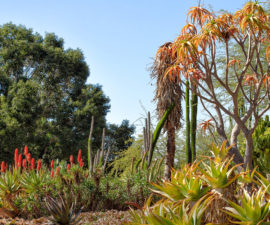
The plants of Elephant Odyssey are many things: some are rare, some are common; some are old and some are new; some are native and some are exotic. One thing nearly all of them are is drought-tolerant. A primary goal of creating Elephant Odyssey was to build a section of the Zoo that demonstrated exemplary water-conservation through its selection of greenery. The best part is, there’s a lot we can apply to our own backyard. Aloe, for example, is a plant exhibited all throughout Elephant Odyssey (we even find a section specifically devoted to aloes from across the world). For Southern California gardeners, this plant is a great option. It flowers November through March and is a hummingbird favorite. Overall, Elephant Odyssey is a great source of inspiration for beautiful, drought-tolerant landscaping.

When it comes to plant diversity, as Mr. Letzring puts it, “inside the Zoo… the sky could be the limit.” So next time you visit the Zoo, or even simply go outside, appreciate the plant diversity that surrounds you, and stop to smell the flowers.

Sierra, Real World Team
Week Two, Winter 2012

1

Conserving Threatened Palms

The threatened palm Brahea aculeata

The descriptor “tropical forests” usually conjures images of lush green forests with high canopies brimming with life—or at least for me it did. But as I look across the lands of the Sierra de Alamos-Rio Cuchujaqui Protected Area in Sonora, Mexico, I see large, columnar cacti peeking out from the fading green and pale brown of surrounding trees. Yet this, too, is considered a tropical forest—a tropical deciduous forest. Here the lush green foliage bursts forth with the summer monsoons and extends through mid-fall and hurricane season. As winter approaches, the trees drop their leaves, though not because of the cold temperatures, as with temperate forests, but due to the dry climate. By March, there is nary a leaf in sight, and the hillsides have taken on a red-brown-gray referred to locally as mojino. Many of the adaptations we associate with desert plants developed here to survive the harsh, dry season. The green that remains is found along the arroyos and in the stems of the tall cacti. That’s not to say there is no color, for during the dry season there is always something flowering. Blooming amapas Tabebuia impetiginosa add a splash of color to the fading greens and brown as we drive to the protected area.

A hawk perches on an amapas tree. Click on the photo to enlarge.

But the image of a forest brimming with life still fits, even if the first view doesn’t confirm it. Thousands of plant species live here, many are found only here. The Sierra’s tropical deciduous forest supports a rich array of fauna as well. With over 450 resident and migratory bird species, and many recognized as threatened or endangered, Birdlife International has designated the Sierra de Alamos as an Important Bird Area. The area also provides essential habitat and corridors for charismatic megafauna such as jaguars, ocelots, and margays. Many tropical amphibian and reptile species reach their northern range limits here, while desert species, such as the Gila monster, also extend into the region.

The protected area where we are working represents the northernmost stretch of tropical deciduous forest in the Americas, and possibly the most intact. Once extending from here in southern Sonora to Panama, and usually with only a width of around 30 miles, only 15 percent of the tropical deciduous forest in North America remains. And only about 1 percent of that is in protected areas. Though rather unusual for a protected area, the majority of lands in the Sierra de Alamos-Rio Cuchujaqui Protected Area remain in private hands; the reserve limits activities such as mining and land clearing, but cattle ranching still dominates the land, and overgrazing prevents a large risk. As part of the Applied Plant Ecology Division of the San Diego Zoo Institute for Conservation Research, I’m here as part of a research team focusing on a threatened palm, Brahea aculeata, and how various management practices (i.e. cattle grazing) affect the palm population.

Nature and Culture International (NCI), a nongovernmental organization partnering with San Diego Zoo Global in several locations in Latin America, represents an important resource for our project. They own land, have staff who serve as excellent field assistants and guides, and have strong relationships with ranchers in the area. Seeing the importance in conserving this little-known corner of the tropics, NCI has taken on the task of adding more stringent protection by purchasing the ranches along the main watershed. With just a few years’ break from cattle, it is easy to distinguish NCI lands from neighboring ranches; willows and other riparian vegetation really do flourish without the constant munch of cows. Hoping to widen its impact beyond the landholdings, NCI is working with us on some land-management issues in the area. We hope to base management practices in science and share them with the neighboring ranches. Building on this partnership, we hope to conserve this special part of Mexico, the tropical deciduous forest and the wonderful wildlife it contains.

Christa Horn is a senior research technician in the Applied Plant Ecology Division of the San Diego Zoo Institute for Conservation Research. Read her previous post, Observing Nature as a Child.

For more information on NCI and San Diego Zoo Global’s partnership…

For more information on the tropical deciduous forest of Sonora and NCI…

4

Wake Up, Seeds! Germination Testing

Germinating seeds

Germination testing is used to determine the correct method for bringing seeds out of dormancy. A seed typically consists of the embryonic plant with its food reserve wrapped in a seed coat, which acts as a protective layer between the embryo and outside elements. Some scientists define germination as the emergence of the radical (the first root), but at the Native Seed Bank here at the San Diego Zoo Safari Park, we define it as the emergence of the radical and the emergence of at least one cotyledon (first leaf). This is because some seeds may have enough energy to produce the tip of a root but then lack the ability to develop further.

Most seeds enter a dormant stage in nature, and we can extend this state for decades by lowering their moisture content and storing them at cold temperatures for our Native Seed Bank. However, when seeds enter this phase in their life cycle, it can be very difficult to get them to “wake up” again. In nature, seed germination is triggered by factors such as fire, water, and temperature changes. To test the germination ability of seeds placed in storage, we try different dormancy-breaking mechanisms to determine which protocol is effective. Scientists look at things like the species’ natural habitat and what triggers have worked with closely related species. The process is further complicated by the fact that species require different combinations depending on how long they have been in storage. For example, a trigger that works for seeds stored for 10 years may not work for seeds stored for 50 years. Another complicating variable is that even within the same species, different populations may have been reproductively isolated enough so that their seeds have different requirements.

Some of the Native Seed Banks many seeds awaiting study

At the Safari Park, all seed lots placed into the Seed Bank are testable once they have been stored for at least one month. Twenty or so seed lots that have been placed in storage around the same time period are then removed and soaked in water overnight before different triggers are tested on them. For some seed lots, this initial soaking is the only stimulus they need, but others have additional requirements.

Some of the other tests we perform include:

Cold Stratification:
Here we expose seeds to changes in temperature by placing them in moist, cold conditions that alter them in physiological ways so that they are able to germinate when warmer conditions follow. This simulates winter followed by spring. The same is true for warm stratification, which allows seeds to germinate in response to cooling temperatures similar to what they would naturally encounter in the fall.

Smoke Water:
In nature, one environmental condition that triggers germination is fire. Either heat, the chemicals released by burned plant matter, or a combination of the two causes seeds to come out of dormancy. To mimic the chemicals released by burned plants, we collect samples of different chaparral species and turn them into charcoal, which is then mixed in water along with the actual smoke, to give us “smoke water.” In some cases, when this water is absorbed through the seed coat, it triggers the seed to grow.

Hot Water Soak and Boiling Water Dip:

There are some species that need to have their seed coat damaged before they can absorb enough water to germinate. One way this occurs in nature is by the high acidity found in animal stomachs (to which seeds are exposed when they are ingested). Instead of soaking seeds in acid, (which can damage the seeds in the wrong concentrations), we use a hot water bath or a boiling water dip. This allows the seed coat to become permeable without damaging the embryo within.

Discovering the correct combinations is like working a time-consuming, yet fascinating, puzzle. Despite all the details that have to be taken into account, germination testing is an extremely important area of study. After all, what’s the point of seed banks if we are unable to germinate the seeds?

Lauren Anderson is an intern at the San Diego Zoo Institute for Conservation Research through the Bureau of Land Management’s Seeds of Success Program. Read her previous post, Native Seed Bank.

0

Seeds Make the World Go Round

There is a whole world of wonder inside a fig most people know little of, from fig wasps to seeds.

Every day I get blown away by certain characteristics of plants. There is no lack of drama or intrigue here. From succulents that look like rocks to flowers that smell like carrion to attract pollinators, the botanical world never seems to disappoint. It would be nice to think that plants do this for the pure pleasure of us humans. But this is, of course, not the case. Their reason is simple: survival. I thought it would be fun to look at some of the various ways plants distribute their seeds. Seed development and dispersal methods take high priority and have had a timeless trial-and-error process resulting in ingenious systems for prolonging the species, something us humans could learn a thing or two from!

We all have memories as kids blowing dandelions into the wind. What we were doing was spreading their seeds. Many primitive and early plants used the wind to spread pollen and seeds, and some still do. As more and more creatures roamed the Earth, plants exploited animals to help pollinate their flowers and distribute seeds. (Plant pollination is another fascinating topic that can be explored in a future blog; for now we will stick with the seeds.) With the help of the increasing numbers of fauna, the floral world really began to blossom.

As with most members of the bean family (fabaceae), Scotia brachypetala's seeds are hard and typical looking. However, many can be very colorful!

If you want something to go somewhere, wrap it in a delicious package. That is exactly what fruit does. The fruit attracts animals to take it off to another part of the forest with the seeds inside where they can be tossed aside to germinate. That is the tastiest method of seed dispersal, but many others exist. Take, for example, seeds that have barbs or hooks. They attach to a passing animal and get a free ride for a distance and fall off. Nuts are often collected by squirrels and buried, later to be forgotten about and so become trees. Winged seeds use propeller-like motion to glide away from their parent plant. And even some seed pods explode when touched by raindrops, sending their seeds a good distance away!

The bottom line is that plants need their seeds to be put in a good position to germinate and carry on the species. By these clever techniques, they achieve this. It is an area in the natural world often overlooked but should not be forgotten.

Seth Menser is a senior horticulturist at the San Diego Zoo. Read his previous post, Biomimicry: Nature Deals with Fire.

3

Native Seed Bank

Lauren processes native yucca seeds.

When I tell people I collect seeds for seed banking, the first question I’m asked is if the collections are stored in the Svalbard Global Seed Vault, which is located on the Norwegian island of Spitsbergen. While it’s awesome that so many people know about that bank, please know that it is used primarily for agricultural species. Native plant species, especially those that are not threatened or endangered, receive much less attention. There are very few native seed banks around the world, and San Diego County happens to have one of them.

Seedlots await processing. Note the cut out in the wall, showing the building is made of straw bales.

The seed bank here at the San Diego Zoo Safari Park houses more than 500 different plant populations. It is a straw-bale, solar-powered structure that has all sorts of interesting contraptions used for seed processing. The seed bank is located at the back of the Safari Park and is the first permitted straw-bale building in San Diego County. Cleaning and storing seeds is time consuming and often tricky, but it can also be very rewarding. Our goal is to collect multiple populations of the same species, as each population may have adaptations unique to its location. San Diego County is home to over 1,500 different native plant species, so that adds up to a lot of seed collections!

When we first find a population that we want to collect, we take clippings of the plant and press them to preserve the specimens as herbarium vouchers. It is best to take a sample that has both flowers and leaves so that a specialist can verify the species. Our herbarium vouchers are sent to the San Diego Natural History Museum for verification. Data on the location, soil color, slope, habitat, and associated species are also collected. After theses initial steps are taken, we monitor the population until enough of the seeds ripen for a collection. We often have to compete with herbivores and rough weather to collect the seeds before they are lost.

Lauren at work conserving seeds native to San Diego County.

Once the collection is made, it is taken back to the seed bank and processed. The steps involved in processing the collections generally depend on each particular species. The seed and plant material is often rubbed over screens of various sizes until the seed is separated from its various shells, pods, leaves, pappi, and stems. Once separated, it is run through air separators so that lighter material is blown off and/or the seeds are lifted away from the heavier debris. Even after all of these techniques are used, we are often left with seed that is still mixed with extra plant material. When this happens, our only option left is to clean the seed by hand. With larger seeds this can be fairly easy, but with the small seeds it often involves a microscope, tweezers, and a lot of patience!

Clean seed lots are placed in the drying room to lower their moisture level. Once the seeds reach a moisture content of five to nine percent, they can be placed in long-term storage in a hefty freezer. Five hundred of the seeds are counted out into groups of 100 and then weighed. We then weigh the entire collection of seed in order to estimate the total number of seeds. At least 10,000 seeds are placed in storage at a time. If there are extra, they are set aside for future restoration and research. The seed is sealed in double-layered foil bags and frozen. It has been proven through germination testing that frozen seeds remain viable for decades.

Lauren Anderson is an intern at the San Diego Zoo Institute for Conservation Research through the Bureau of Land Management’s Seeds of Success Program. Read her previous post, Exploring Anza-Borrego Desert.

1

Exploring Anza-Borrego Desert

Lauren takes in the view at Anza-Borrego.

Lauren Anderson and Miguel Kaminsky are interns at the San Diego Zoo Institute for Conservation Research through the Bureau of Land Management’s Seeds of Success Program. As part of the internship, they make collections of seeds from plant species vital to Southern California habitats. The seeds will be preserved and studied, and eventually help restore habitats damaged by fire or during development projects.

From day one at the Institute I’ve heard people talk about how beautiful the Anza-Borrego Desert is. This year’s Seeds of Success collections focused more on the areas surrounding Ramona. While the properties we scouted in the Ramona area were very diverse and interesting, they were all composed of the same types of plant communities. This was the first week we’ve been able to make it out to the desert transition areas leading into Anza-Borrego, and it offered the chance to explore something new.

Roadrunner

When planning to explore a new property, the first step is to find one that has access. For our internship, we are only allowed to make seed collections on Bureau of Land Management (BLM) lands, and they don’t always have roads. We look at layers of BLM land on GIS and then choose one that looks reasonable to access. To do this, we largely depend on images from Google Earth. The only problem with this is that it can be difficult to determine if something is a dry creek or a little-used road. But for this desert adventure we were fairly sure that we could get within walking distance of the site.

Another part of scouting that is always fun is navigating back roads. The first dirt road we turned off on was well kept, the second one was less so, and on the third road I felt the tires sink a few inches into soft ground. We managed not to get the truck stuck, which was a very good thing since we didn’t have cell phone reception and faced having to hike several miles to a main road if we did.

The site itself was a combination of hills and dry-wash ravines with an amazing number of different plant species. Anza-Borrego definitely lived up to the hype. After exploring for a couple of hours, we determined that we could make three collections starting next week when the seeds would likely be mature enough to collect. Really exciting, and a reason to come back to enjoy Anza’s beauty!

0

What’s the Difference between a Species and a Variety?

Wild buckwheat Eriogonum fasciculatum

Miguel Kaminsky and Lauren Anderson are interns at the San Diego Zoo Institute for Conservation Research through the Bureau of Land Management’s Seeds of Success Program. As part of the internship, they make collections of seeds from plant species vital to southern California habitats. The seeds will be preserved and studied and eventually help restore habitats damaged by fire or during development projects.

This internship has provided a lot of new experiences and opportunities for learning. Specifically, events during the collection of wild buckwheat Eriogonum fasciculatum seeds at El Capitan Open Space Preserve compelled me to review some basic biological concepts regarding speciation. The whole exercise began when Lauren and I went on a seemingly routine mission to collect Eriogonum seeds. By the time we each filled a quarter of a bucket with seeds and associated material, Lauren pointed out extensive variation in the leaf morphology of the plants we were collecting. Some plants had linear, light green leaves while others had much wider, blue-green leaves with an almost woolly layer of flattened hairs. To make matters more confusing, some plants had shoots exhibiting both leaf types. This made us think there was hybridization of some sort going on, so we decided to do some further research before packaging this collection to ensure we had seeds from just one species.

Upon consulting a plant atlas, we learned that there are three varieties of Eriogonum fasciculatum in the area we were sampling.  These are var. fasciculatum, var. foliolosum, and var. polifolium.  Var. polifolium has the wider, oblong, woolly leaves while var. foliolosum has the linear leaves that aren’t nearly as woolly on their upper surface. In turn, we inferred that the individuals we encountered were  vars. foliolosum, polifolium, and mixes of the two.

Although we determined the collection was not useful to us because we needed seeds with a varietal lineage free of comingling, this left me with some fundamental questions. Why aren’t these morphologically distinct populations classified as different species? What is the difference between a species and a variety?

Lauren Riesberg, in her extensive writings addressing speciation and hybridization, cited Mayr’s definition of a species as “groups of interbreeding natural populations reproductively isolated from other such groups.” However, species that are not geographically isolated have been known to interbreed and produce hybrid offspring. Wikipedia defines a variety as a genetically, and in turn, morphologically distinct subset of a species that is geographically isolated from other populations within that species. However, when the geographic barrier is removed, this subset interbreeds with the rest of the species, resulting in an influx of genes that erodes the variety’s distinct features, thus reintegrating it into the greater species group. With this in mind, I distinguish species and varieties based on the fact that a hybrid of two species produces offspring with reduced fertility, such as malformed pollen grains, while a hybrid of two subspecific varieties produces offspring that show no such deformities and reflects the traits of the original species.

El Capitan Open Space Preserve

In light of these considerations, I came to the conclusion that the El Capitan Open Space Preserve is a very special place in the origins and family history of Eriogonum fasciculatum. According to “Flora of North America,” Eriogonum fasciculatum var. folilosum came about from an ancient hybridization event between vars. fasciculatum and polifolium. This event likely happened at places much like the El Capitan Open Space Preserve, where these populations intermingle. Eventually, isolated populations of these varieties might inbreed to the point that they become reproductively isolated from the parent varieties, giving rise to new species through divergent evolution.

El Capitan offers a living snapshot into the evolutionary history that drives speciation. In conclusion, this experience reminds me that speciation is a dynamic process taking place in our backyards, in present times, while we go about our daily lives.

0

Plants: Take A Step Back

Zoo InternQuest is a seven-week career exploration program for San Diego County high school juniors and seniors. Students have the unique opportunity to meet professionals working for the San Diego Zoo, Safari Park, and Institute for Conservation Research, learn about their jobs, and then blog about their experience online. Follow their adventures here on the Zoo’s website!

Plants may be overlooked by visitors at the San Diego Zoo, but once you take a step back, you can capture the full effect of your surroundings. Beauty abounds in all corners of the Zoo, and today we realized that while taking a tour with Horticulture Collections Manager Mike Letzring and Senior Horticulturist Judy Bell.

Walking through a bamboo-covered path, we learned this rapid growing grass not only adds to the ambiance but is used to feed some of the animals, like the giant panda.

Southern pitcher plants are carnivorous plants getting most or all of their nutrients from digesting animals and insects. Unsuspecting victims crawl into the tubes and never come out.

The interns dined on a feast of fruit fit for a king. These two fruits, the dragon fruit and banana apple, are grown on Zoo grounds. They were something that I, and probably some of the other interns, have never tried before. They appear unusual on the outside but were delicious.

This is what a bird would see if it were flying over a cycad. These ancient plants have been around since the age of dinosaurs . The orange center is the cone, which makes it more closely related to conifers than palms. The Zoo is home to one of the largest collections of cycads in the world.

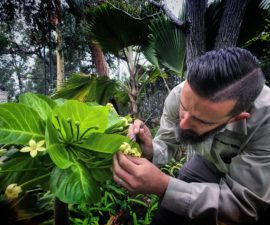
Teghan is smelling one of the ginger flowers that are growing at the Zoo. The animals aren’t the only things to look at—take time to smell the roses.

This isn’t the usual picture most of us get when we think of bananas. These are apple bananas that are grown here at the Zoo. This is what real, natural bananas look like. The ones at the store have been hybridized so they are more appealing to consumers.

Natural beauties are in abundance at the Zoo. There is something at every corner waiting to be discovered; it’s the little things you find that can make your day complete.

0

Plants: Covering the Globe

Zoo InternQuest is a seven-week career exploration program for San Diego County high school juniors and seniors. Students have the unique opportunity to meet professionals working for the San Diego Zoo, Safari Park, and Institute for Conservation Research, learn about their jobs, and then blog about their experience online. Follow their adventures here!

Horticulture, the science of cultivating plants, is directly connected to our everyday life. Plants supply vast amounts of resources such as oxygen, crops, structure, medicine, and much, much more. Michael Letzring, horticulture collections manager, and Judy Bell, senior horticulturalist, welcomed us into their world of horticulture. We had the chance to get an inside look at just a mere sample of the rare and valuable plant collection at the San Diego Zoo.

Have you ever noticed the big palm trees in the flamingo exhibit near the front of the Zoo? They are called fishtail palm trees and are just one of the many unique plants here at the Zoo. A fishtail palm produces sap that has a high sugar content and is used to make syrup and alcoholic beverages. This palm is unique in the fact that its fruit is poisonous and inedible. This is because of the acid in juices of the fruit. The fruit can actually burn your skin if you touch it! An average fishtail palm can live 30 to 35 years and grow between 30 to 50 feet high. The palms’ native range is from sea level to the mountain slopes in India and Burma. Wow, who would ever have thought that there was so much information to learn about a single plant? I was amazed, and it left me eager to learn more about horticulture.

Believe it or not, plants are susceptible to disease just like animals and humans. It’s our responsibility to help preserve the precious plant life on our planet, and the San Diego Zoo is helping to do just that. Ms. Bell told us about the amazing “seed bank” project the San Diego Zoo Institute of Conservation Research is doing to help protect native plant life in San Diego County. A seed is collected, cleaned, and then stored in either long-term or short-term collections. Over a time period seeds will be randomly tested for germination to make sure they are still viable. The Institute is hoping to collect 400 native plant species in San Diego County over the next 3 years.

While touring some beautiful areas of the San Diego Zoo with Mr. Letzring and Ms. Bell, we were shown how many of the enclosures have been built around the natural growing foliage such as the large trees that are used to support the netting located around the monkey enclosures. Many bushes and shrubs have been left in place to provide décor, natural barriers, and a sense of “home” for the animals.

The next time you visit the San Diego Zoo, take a moment to not only see the animals but take some time to look at fantastic greenery around you! People are often told to take a moment to stop and smell the roses. Well, I say take a moment to look at the trees and enjoy the beauty of the abundant plant life around you. It is simply beautiful.

Sierra, Real World (week 2)