Uncategorized

tree kangaroos

0

Marsupial Nightlife

A female wombat looks into a palm roll

A female wombat looks into a palm roll

While doing marsupial observations at the San Diego Zoo, I often hear people really excited to see the wombats. They rush over, looking from the deck at the tree kangaroos. Nope, no wombats in sight… maybe they are in the front! Rushing to the front, the wombats are consistently found doing one thing and one thing alone: sleeping. This is usually disappointing for many zoo visitors; however, they are doing exactly what they would be doing in the wild. Wombats are nocturnal, which means they spend the day sleeping but wake up in the evening to forage, travel, and perform other necessary behaviors.

I realized this, too, in my enrichment study (see post, Puzzles for Tree Kangaroos). On the days that enrichment was provided in the morning, I would be more likely to observe interaction than if the enrichment was set out in the afternoon. However, most of the interaction with the enrichment items took place when I wasn’t even around. How do I know this? Well, before I would leave after a day’s observations, I would take a mental note of what the enrichment item looked like and where in the exhibit it was located. Then, as soon as I returned to the Zoo in the morning, for another day of observation, I would check out the wombat exhibit to see what the enrichment looked like after being left in the exhibit overnight.

A mulch pile with wallaby footprints in it after being left in the exhibit overnight

A mulch pile with wallaby footprints in it after being left in the exhibit overnight

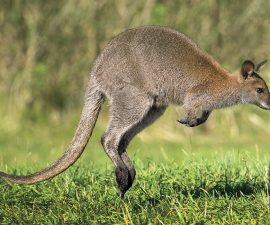
What I would usually find is that the enrichment item had not survived the night. In other words, the palm rolls would be in pieces spread throughout the exhibit, and the mulch piles would be decimated to a thin layer. I heard similar reports from keepers about the wallabies. I would observe little interaction during the day; however, overnight the wallabies would eat all of the food out of puzzle feeders and leave evidence (usually in the form of lots of poop) that they were spending quite a bit of time around the enrichment items.

A wombat walks on a palm roll after breaking it apart.

A wombat walks on a palm roll after breaking it apart.

What does this mean for my enrichment study? I can confidently say that our marsupials ARE interacting with the enrichment. BUT, it is very important that we keep the nocturnal nature of these creatures in mind when providing them with these enrichments or challenges and give them the opportunity to have access to the items when they will be awake and ready to interact.

So, if you find yourself at an exhibit with sleepy animals, don’t be upset or discouraged! It would be very stressful for them to be pulling lots of “all day-ers,” so it is best for them to be active at similar times to when they would be in the wild.

I know it is disappointing, but this is the last marsupial enrichment post from me. I’m finishing up my internship and will be headed back to Idaho to finish my degree and graduate! Wish me luck, and don’t forget to visit the marsupials next time you venture to the San Diego Zoo!

Lauren Kline is a Bonner Summer Student Intern in the Behavioral Biology Division at the San Diego Zoo’s Institute for Conservation Research. We wish her the best of luck as she continues her studies!

0

Puzzles for Tree Kangaroos

A tree kangaroo works a puzzle feeder.

A tree kangaroo works a puzzle feeder.

Part of my enrichment study is to encourage naturalistic behaviors of the marsupials I am watching (see post, Monkeying Around…with Marsupials!). For example, animals in the wild don’t have their food provided for them at regular times each day. Instead, they have to go out and find food for themselves. Some days, food may be easy to get while other days they may have to search longer, dig, or even use tools to get what they need. And other days they may not even find food at all. This is not a bad thing, however, because having a challenge builds the knowledge and skill set of an animal and can make it that much more successful the next time it has a hard time finding food.

To imitate this type of feeding, the tree kangaroos at the San Diego Zoo were presented with a similar challenge. They were presented with a new enrichment item, a puzzle feeder, in which their folivore biscuits and browse (the leafy part of an animal’s diet) were hidden. Getting out the food required a much more complex thought process than getting food presented in a specific feeding location. But the tree kangaroos took up the challenge and succeeded! Because the browse was sticking out of the feeder and was visible, they quickly realized that the large gourds (the puzzle feeders) in their exhibit were more than just “decorations.” Soon after investigating the gourds and extracting some of the browse, they realized an even greater treasure to be gained: folivore biscuits!

A tree kangaroo uses the rope to pull up the gourd puzzle feeder.

A tree kangaroo uses the rope to pull up the gourd puzzle feeder.

Their investigation of the puzzle feeders quickly advanced from simple sniffing and pulling at browse branches to gripping the feeder holes with one hand and extracting biscuits with another. One of the most impressive methods of investigation involved using the rope that the feeder was suspended by to pull the feeder to them. After pulling the feeder up on the log, they had better access and could more deftly extract their favorite treats.

This enrichment was a learning experience for both the tree kangaroos and me. The tree kangaroos had the opportunity to discover new skills that can be used to acquire desired items that are more difficult to access. I learned that even though this enrichment was challenging, tree kangaroos use trial and error to figure out which behaviors worked and which didn’t to get what they need. In the end, the tree kangaroos were not puzzled at all!

At this point, I’m half way through my data collection, and I’ll check back before I leave to update you on some final results of my marsupial enrichment study. It’s fascinating to me how an animal enrichment study has now enriched my understanding of animals!

Lauren Kline is a Bonner Summer Student Intern in the Behavioral Biology Division at the San Diego Zoo’s Institute for Conservation Research.

11

Koalapalooza: A Joey Is Named

After months of anticipation and careful planning, San Diego Zoo Discovery Days: Koalapalooza finally arrived: These four exciting days were filled with news interviews and keeper talks featuring not only koalas but our other special marsupials as well, including tree kangaroos, wallabies, and the closest relative to the koala, the wombats. We were so excited to have a long weekend dedicated to our favorite animal, the koala, but I must admit we were a little nervous!

The guest turnout was amazing and topped expectations. Other departments crucial to our koala program had booths set up. One booth featured our conservation researchers, who shared the important work they are doing to help us learn more about koalas and aid in conservation efforts in Australia; kids could even learn how to radio track and locate stuffed koalas around the Zoo, just like we would when looking for wild ones in Australia. Another booth highlighted our extremely important browse department, which grows all the eucalyptus, the only food a koala will eat. This is not an easy job, because our koalas eat a lot of eucalyptus! Guests could also speak to our veterinary staff about koalas; these are very specialized animals are different from other mammals when it comes to veterinary care, but our staff is excellent!

Our educators and animal trainers brought out more animals, and keepers in other areas of the Zoo gave special talks. There were different opportunities to donate to koala conservation, including an online auction, fun activities for kids, as well an Aussie barbeque meal and music. I even got a koala painted on my face!

One of the highlights of the event was our Name the Joey contest. Our almost 10-month-old joey needed a name! We thought it was definitely time to stop calling her our own personal nicknames (like Sweetheart and Cutie pie) and give her a permanent identity. It was tough decision making, but we narrowed down the long list of great submissions from Zoo guests and supporters to five beautiful choices. “Sooky”, meaning “soft” or “tame,” won by a fairly large margin. Thank you all so much for submitting names and voting at Koalapalooza. Now our precocious little girl has a name!

Kuna and Amy

Kuna and Amy

My absolute favorite part of the event was taking a koala to the Zoo’s front plaza where guests could see him up close. It is so extraordinary for me to be able to share with people what I have learned from the koalas I have worked with for about seven years now. As Kuna did what he does best (munch away on leaves and look totally adorable), I got to share all kinds of koala facts and answer questions. I also shared little personality traits and amusing attributes that make us laugh, sometimes cry, and grasp the individuality and specialness that each koala possesses. Kuna helped, too. As most koalas are too shy and reserved to be comfortable in a crowd, Kuna showed his individuality and kind spirit with a relaxed and curious personality, which I’m sure made most guests develop a soft spot for koalas (if they didn’t have one already). It’s these qualities that ultimately give us the never-ending passion we have for our job as well as our dedication to doing everything we can to help this irreplaceable species in the wild.

In the end, Koalapalooza was a huge success! Not only did we raise $5,200 for conservation, we were able to interact with Zoo guests directly. The koala keepers would like to thank every guest who attended Koalapalooza or participated in the online voting. On a personal level, your involvement means so incredibly much to us! We know that these are trying times for many people, and I really want to let participants know how much we appreciate any and all of your support. We couldn’t do it without you! I sincerely hope everyone had a wonderful time at Koalapalooza. We would love to see you again at our next Discovery Days event, Bear Bonanza, in March!

Amy Alfrey is a senior keeper at the San Diego Zoo.

Read a blog and watch an interview with Amy

Read the latest blog from a koala researcher