Uncategorized

tiger

5

Big Cat Preferences, Part 3

Thanks to our dedicated animal care staff, we have now completed all the initial preference trials (see Big Cat Preferences and Big Cat Preferences, Part 2) with lions, tigers, and cheetahs. Our findings reveal that there are both species and individual differences in enrichment preference, which will help us make educated decisions when providing enrichment for our felids. Ensuring the highest quality of care for every animal in the collection is our top priority, and this is just one project leading toward that goal.

The next phase of this project is being completed by Erin Lane, our Neeper Endowed Fellow, with the assistance of some of our wonderful volunteers. The project includes examining the effects of enrichment (scents and objects) on the 24-hour behavior of lions. We have installed cameras throughout the San Diego Zoo Safari Park’s lion exhibit to observe what the effects of the enrichment are both during the day and at night. This will also provide some insight into the activity budgets of the animals. For example, throughout the day a person might spend about 8 hours sleeping (33%), 1 hour commuting to and from work (4.2%), 9 hours working (37.5%), 2 hours cooking/eating (8.3%), 3 hours watching tv (12.5%), and 1 hour exercising (4.2%). We want to know what percentage of time the lions eat, sleep, rest, socialize, and play. This information will help us make sure that our enrichment program is keeping the animals active and healthy.

We will also be recording different behaviors such as scent marking, sniffing, and clawing to make sure we are providing opportunities for these behaviors, which are part of their natural behavior. Keep in mind that lions in the wild typically sleep between 16 and 20 hours a day (66.6% to 83.3%), and we hope our lions spend their time in a similar fashion. If you have been to the Safari Park’s Lion Camp before, you probably already know that they spend a good portion of their time sleeping just the way a lion should. The question is: how much?

Lance Miller is a scientist for the San Diego Zoo Institute for Conservation Research.

26

Cologne, Perfume Needed for Cats!

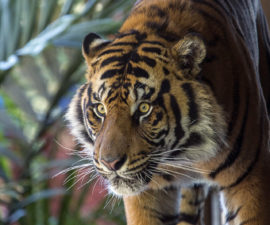
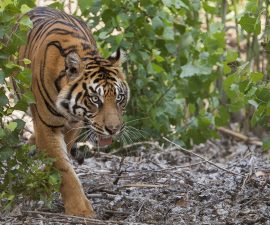
A tiger sniffs scent left by a cub.

Environmental enrichment is utilized within zoological institutions to ensure animals are physically and psychologically healthy. The goal of an enrichment program is to promote species-typical behavior while allowing some control for animals within their environment. The Behavioral Biology Division of the San Diego Zoo Institute for Conservation Research is currently conducting a research project examining individual and species enrichment preferences for large felids (lions, tigers, and cheetahs) at the San Diego Zoo Safari Park (see post, Big Cat Preferences, Part 2). Based on some preliminary results, we are interested in learning more about different scents (perfumes) that attract the animals and promote the behavior of exploration.

The research project will include examining the behavior of our large felids when presented with a variety of colognes and perfumes. The goal of these scents is to increase our cats’ exploration and activity levels. At the same time, we will send samples of these scents to a chemist to determine their chemical make-up to learn the properties that animals respond to the most. Through this research, we hope to discover the elements of these scents that encourage species-typical behavior so that we can continue to enrich the lives of the animals within our facilities. In addition, information gained from this study can be used to enrich felids at other zoological institutions. With the link between animal welfare and reproductive success, it is important to ensure the highest levels of care for the animals within zoological institutions as many of these species are conservation dependent.

We can’t do this alone. We’re once again calling upon the generosity of our fans and fellow conservationists to help us in this cause by donating old or unused cologne and perfume. If you have colognes and perfumes that you would like to donate to the study, please send them to:

San Diego Zoo Institute for Conservation Research
Attn: Lance Miller
15600 San Pasqual Valley Road
Escondido, California 92027

Thanks so much for your support. Your generosity will improve the lives of our animals and help us work for a better future for the wildlife of our planet!

Lance Miller is a scientist for the San Diego Zoo Institute for Conservation Research.

Update: You may also bring your perfume and cologne donations to the Zoo or the Safari Park! Just take them to our Guest Services window. We are also accepting monetary donations for the study through our Animal Care Wish List.

Update from Lance, January 31, 2011: I would like to say thank you again to everyone in the San Diego region and throughout the United States who has sent in perfumes and colognes.  The cats will ultimately benefit from all your kind donations as we continue to learn more about environmental enrichment for these amazing animals.

22

Firsts for Tiger Cubs

Kucing

Kucing

The three Sumatran tigers born at the Wild Animal Park on November 13, 2008, are getting bigger every day. It has been incredible to have the opportunity to watch the cubs grow into individuals (see previous blog, Tiger Cubs at the Wild Animal Park). While the little girl, Damai, has stayed true to her ferocious attitude, her brothers have both developed personalities a little different than we first predicted. In fact, if the cubs did not have distinctive markings, it may be easy to question whether the boys were mixed up!

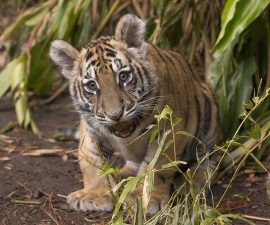
It seems that Harimau Kayu and Kucing have virtually traded personalities. Harimau may have been the most adventurous at first, but maybe he didn’t find the rest of the world up to his liking. He is by far the most reserved and cautious cub. Kucing, on the other hand, has found that an explorer’s lifestyle suits him just fine! He seems to have no fear and will investigate anything new.

The cubs received their first check-ups by the Park’s veterinarians and all received a clean bill of health. They were all implanted with a microchip to permanently identify them, received their first set of vaccinations and a dewormer medication (just in case), and had blood samples taken. If you could forget the part about the 16-pound tiger in your lap you may just imagine that you were at the veterinarian with your 8-week-old kitten! Just like a kitten, the tiger cubs will need two more sets of booster vaccinations at 12 and 16 weeks of age.

Harimau Kayu

Harimau Kayu

The cubs have also taken their first tastes of meat! Damai was the first to give mom’s meal a try when she decided she wanted to chew on the bone as well. Kucing quickly followed his sister’s lead and found that beef was somewhat tasty. Harimau Kayu was the last to sample the grown-up food, but he too has decided it tastes pretty good. While the cubs are all still dependent on their mother’s milk for nourishment, they have sampled beef, beef heart, and the carnivore diet we give to our big cats (a ground beef-based product which is the main diet of the adult tigers).

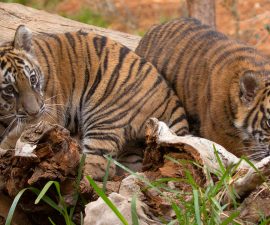
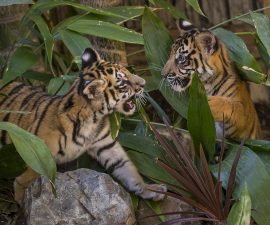
Growing stronger and braver has also led to another development…the love of play! Kucing and Damai are the most active and can regularly be seen engaged in a wrestling match. Harimau Kayu often will stay off to the side and watch his siblings play, but sometimes he will get dragged in. On occasion we have even seen all three cubs plan a (not-so) sneaky attack on mom! The cubs will not only play with each other; they are fascinated with the enrichment items and toys that the keepers put in their rooms every day. We try to give them new things all the time to play with, and they have caught on. Some of their favorite toys are cardboard boxes and palm fronds. They already love tearing things apart and chewing on things, so hay inside a paper bag is a big hit as well. The keepers also have some special toys that the cubs get to play with while we are in the room; these are toys, like small balls and ropes, that mom, Delta, cannot have access to. By making time spent with the keepers so much fun, the cubs are becoming more trusting of us, and all are relaxed and play when we are present.

As the cubs continue to grow and mature, I will be sure to keep you updated. The cubs are still too small to go out into the exhibit, but be sure to check back in the months to come for reports of their outings!

Kym Nelson is a senior keeper at the Wild Animal Park.

Update: The tiger cubs are now on exhibit from 9 a.m. to 4 p.m. on Saturdays, Sundays, and Wednesdays.

17

Tiger Cubs at the Wild Animal Park

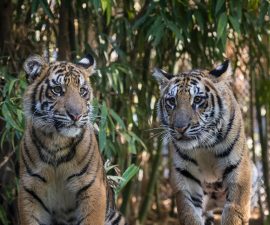
Delta's three newest cubs

Delta's three newest cubs

The tiger keepers at the Wild Animal Park are so excited to share the news of our newest little additions. On November 13, our female Sumatran tiger, Delta, gave birth to three cubs! Damai is the little girl and her name means “peace” in Indonesian; her two brothers are Kucing, meaning “cat,” and Harimau Kayu, meaning “tiger woods.”

This is Delta’s second litter (see Kym’s blog, Tiger Cubs Find a New Home), and she is proving to be a seasoned professional at mothering. After careful behavioral observations by her keepers, combined with hormone analysis by our researchers, Delta was bred to male Utan on July 31 and August 1. The average gestation for a Sumatran tiger is 104 days and Delta stayed close to this expected timeline, giving birth on day 105. For several days leading up to the birth, Delta was kept inside the tiger house, and keepers stayed with her 24 hours a day, monitoring her for any signs of labor via a camera system so as not to disturb her. She was provided with a den box filled with soft bedding hay as well as some extra heaters for warmth. Delta decided our efforts were satisfactory and chose to have her cubs in the box as we had hoped.

Sumatran tiger cubs are very small at birth, weighing only 2 to 3 pounds (0.9 to 1.3 kilograms) and their eyes remain closed for the first 7 to 10 days. We monitored the cubs and Delta for the first few days without interference. This allowed Delta to become comfortable with the cubs and regain her appetite. For the first several days, Delta was so occupied with being a mother that she did not leave the cubs alone while she ate. On November 19, the keepers separated Delta from her cubs for the first time, and we were able to physically meet the cubs. While Delta was eating in an adjacent room, we were able to sex the cubs and get weights on them all. The walls on the den box are about 12 inches (30 centimeters) high, and for the first several weeks sufficed as a barrier to the cubs, but they have since found their way out!

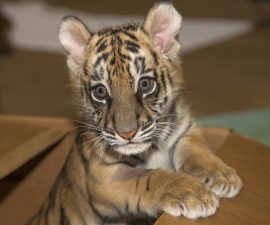
At one month of age, all of the cubs are mobile and climb freely in and out of the den box. Harimau Kayu is the most agile of the cubs and the most adventurous! He was the first out of the den and has explored the entire bedroom on increasingly steady legs. Damai has definitely taken after her mother: from one week of age she has had a ferocious temperament. She is definitely a little tiger! Kucing is our little rock: he stays close to his mom and his siblings, never straying too far on his own. They are growing at a steady rate of about 1.5 pounds (0.6 kilograms) per week; Damai is the smallest at 10.1 pounds (4.59 kilograms), followed by Kucing at 10.5 pounds (4.77 kilograms) and Harimau Kayu, the largest, at 10.6 pounds (4.83 kilograms).

The cubs are still far too small to go out into the exhibit and will remain in the safety and comfort of the house for the next couple of months. I will be sure to keep you posted on their progress!

Kym Nelson is a senior keeper at the Wild Animal Park.

Read Kym’s previous blog, A Strange New World for Kamau the Lion.

13

Tiger Cubs at 6 Months

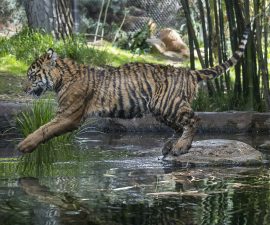
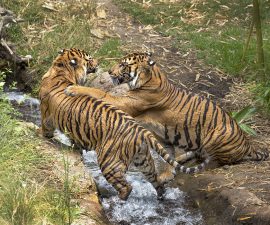
The three Malayan tiger cubs at the San Diego Zoo are now six months old and quite the handful (see previous blog, A Tiger Cub’s Day). Menderu (which is Malayan for “roar”) is a male and the largest, weighing 80 pounds (36 kilograms). His two sisters aren’t much smaller; Jin (which means “spirit”) weighs 72 pounds (33 kilograms), while Seri (meaning “brightness”) is the smallest at 70 pounds (32 kilograms). But just because Menderu is the biggest doesn’t mean that he is in charge of his sisters! They are quite capable of holding their own against him.

The cubs and their mother, Mek, are usually on exhibit in Tiger River from 9 a.m. to 1 p.m. every day, unless we have a medical reason for holding them off. They are typical kids who alternate between playing, annoying mom, and napping. The cubs also spend quite a bit of time by our gate yelling at us to feed them! Mek is no longer nursing them, which is typical for this age. They are currently getting 2.8 pounds (1,300 grams) of carnivore meat daily, plus bones twice a week and a rabbit once a week. We increase their meat amount as they grow. We have also started a training program with them that allows us to feed them calmly and separately while looking at various body parts to make sure that they are healthy.

We were able to handle the cubs until they were three and a half months old. However, once they realized that they were carnivores and had a say in if we handled them, we were forced to stop. They can be very cranky cubs at times!

We spend a fair amount of time a day finding things for the cubs to play with in their bedrooms. They enjoy anything they can tear up; phone books, boxes, and heads of lettuce seem to be fun to destroy. Whole fruits and vegetables make good balls, too. Watching them destroy things is quite amusing; however, I dread cleaning it up the next day! Good thing that they are so adorable.

So, stop by and check out our “kids.” They are growing fast and will be hard to distinguish from their mom in another six months.

Rochelle Willison is a senior keeper at the San Diego Zoo.

Watch video of the cubs enjoying their Halloween treats: