Uncategorized

San Diego Zoo Safari Park

1

Gorilla Snacks

Kale is one of the many leafy green items fed to the Zoo and Safari Park gorillas.

Kale is one of the many leafy green items fed to the Zoo and Safari Park gorillas.

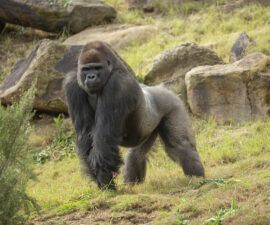
Primarily herbivorous, gorillas eat the leaves and stems of herbs, shrubs, and vines. In agricultural areas, they may raid farms, eating and trampling crops. They will also eat rotten wood. The fleshy fruits of close to a hundred seasonally fruiting tree species make up a large part of their diet. Gorillas get some protein from invertebrates found on leaves and fruits. In the wild, gorillas spend much of the morning and evening feeding in a small area. However, since lowland gorillas rely heavily on fruit, they sometimes travel up to about a half mile or more in search of fruiting trees.

Although they don’t have to travel far at the San Diego Zoo Safari Park to find a meal, the gorillas do get a wide variety of fruits, vegetables, low-carb biscuits, and browse (plant material). Browse varieties include acacia, ginger, bamboo, grewia, tipuana, eugenia, and ficus, all grown at the Safari Park. The items are all offered on a rotating basis so they don’t get the same food every day. The gorillas are fed five to six times a day, and food is distributed throughout their bedrooms and exhibit to encourage foraging.

Two of their meals are fed inside the night bedroom. Although the keepers do not go in the bedrooms with the gorillas, we do have limited contact through the bars. This allows us the opportunity to develop relationships with each of the gorillas. Hand feeding creates a bond with each gorilla and facilitates health assessments and distribution of medications. Operant conditioning, a training technique using positive reinforcement and rewards, is also used to further enhance the rapport between the gorillas and the keepers. The gorillas enjoy the individual attention!

Each day the gorilla troop at the Safari Park consumes approximately 5 pounds of fruit (such as apples, oranges, pears), 43 pounds of greens (such as kale, romaine lettuce, spinach), 16.5 pounds of veggies (such as jicama, onions, broccoli), and 7 to 10 branches of browse. Snack food is offered in limited quantities on a rotating basis and may include air-popped popcorn, sunflower seeds, tamarind pods, raisins, prunes, applesauce, peanuts, and popsicles made with fruit juice/nectar.

Peggy Sexton is a lead keeper at the San Diego Zoo Safari Park. Read her previous post, Introducing Gorillas to a New Troop.

2

Bowling for Rhinos

A southern white rhino calf trots next to Mom at the Safari Park.

A southern white rhino calf trots next to Mom at the Safari Park.

In 1967, several keepers in San Diego got together to form what is now a nationwide nonprofit organization called the American Association of Zoo Keepers (AAZK). AAZK has over 2,500 members throughout the US and Canada and includes animal care professionals and people interested in conservation and improving animal care. The San Diego chapter of AAZK (SDAAZK) has over 80 members and supporters who work at several of the local animal facilities like the San Diego Zoo, San Diego Zoo Safari Park, SeaWorld, California Wolf Center, Project Wildlife, and Lions Tigers & Bears. It is a great organization that is very active in furthering education for those who work directly with animals and bringing awareness and funding to conservation organizations throughout the world.

The main method of providing funding for conservation organizations is through hosting fundraising events, which we do a lot. I always joke with our members and friends that we mainly raise money to give it away. We know that there are so many worthy causes that need help, and with a membership that is passionate about wildlife conservation, fundraising is a big part of what we do.

So it should be no surprise that SDAAZK has been participating in the biggest AAZK fundraiser since it began in 1990 called Bowling For Rhinos (BFR). The event has raised over $4 million to assist 3 very important conservation organizations: the Lewa Conservancy in Africa, the International Rhino Foundation in Asia, and Cheetahs in Action in Africa. These three organizations have been fundamental in the protection of rhinos and cheetahs and their habitats.

SDAAZK has hosted Bowling For Rhinos every year, and this, our 23rd year, is no different. It will take place on May 18 at Kearny Mesa Bowl in San Diego. Our goal is to raise $20,000 or more for rhino conservation! The event consists of a bowl-a-thon in which participants raise sponsorship money that goes directly to rhino conservation. There is also a silent auction, drawings, best-dressed team contest, a bake sale, live music, and much more.

One of the beauties of the event is that all monies raised go directly to rhino conservation because SDAAZK members and others volunteer their time. We are also lucky in that many businesses from the community have become involved and donate items for the auction and raffle.

Historically, Bowling For Rhinos has been one of our biggest fundraisers, and this year looks like it will be no different. The event is over a week away, and we have already almost sold out the 40 bowling lanes! With each team consisting of 5 players and each player raising a minimum sponsorship of $30 each, our goal of $20,000 is looking good. Plus, we have great prizes for the top fundraisers of the evening. If you are wondering why we set a goal of $20,000, the reason is easy: we want to beat last year’s total of over $16,000.

We would love for you to join us at this year’s Bowling For Rhinos! You can participate even if you don’t bowl; between the auction, drawings, and contests there will be a lot to do. Moral support and cheering is also appreciated. It really is a fun event for a great cause! To learn more about SDAAZK and Bowling For Rhinos, visit our website at www.sdaazk.org! You might be interested to know just what keepers do with their “spare” time.

Yvette Kemp is a senior hospital keeper at the San Diego Zoo and president of the San Diego Chapter of the American Association of Zoo Keepers. Read her previous post, Quarantine for New Animals.

14

Introducing Gorillas to a New Troop

Monroe and Kokamo are in the foreground, with Imani and Frank just behind them in the exhibit

Monroe and Kokamo are in the foreground, with Imani and Frank just behind them in the exhibit. Click to enlarge photo.

The introduction of gorillas Imani and Frank to the San Diego Zoo Safari Park’s gorilla troop is moving along nicely (see previous post, How Are Zoo’s Gorillas Faring at Safari Park?). It started with Imani and Frank having visual access to the troop. All the gorillas could see, smell, and even touch fingers with each other through mesh “windows.” Youngsters Frank and Monroe played and played through the mesh!

Once Imani was ready (we were waiting for her to ovulate), our silverback Winston was allowed into Frank and Imani’s rooms. Winston and Imani hit it off right away! There was some expected tension between Winston and Frank, as Frank was used to playing with silverback Paul Donn while living at the San Diego Zoo, and didn’t really know what to make of Winston. The three were given access to the gorilla exhibit and did well, but Frank pretty much steered clear of Winston.

After several days of this, it was time to give Frank a break and start the next step of the process. Winston was separated from Imani and Frank and reunited with adult females Vila and Kami. Kokamo and her son, Monroe, and Imani and Frank were initially given access to each other for several hours a day. Monroe was understandably apprehensive and stayed very close to his mom, but as time went on, Frank and Monroe started to play together more and more in the bedrooms, and the time they spent together was increased.

Over the past two weeks, the comfort level of these four has increased significantly, and the boys play quite a bit on exhibit as well. Now they are together 24 hours a day, and soon we will be making more progress in uniting Winston, Vila, and Kami with Kokamo, Monroe, Imani and Frank!

It takes time and patience to facilitate the integration of new troop members, but the successful outcome will be well worth it!

Peggy Sexton is a lead keeper at the San Diego Zoo Safari Park.

3

Condor Chick Watching: Age 30 to 45 Days

Cuyamaca does some preening in the nest box.

Cuyamaca does some preening in the nest box.

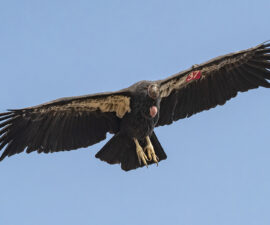
At about one month of age, our California condor chick Cuyamaca (pronounced “Kwee-ah-MACK-ah” and meaning “through the clouds” in Kumeyaay), should weigh around 4.4 pounds (2 kilograms). The parents, Sisquoc and Shatash, may start leaving the chick alone overnight, sleeping near the nest. If the weather is still cool or it’s raining, they may continue to brood overnight until the weather improves. Even though the parents are increasing their time away from the chick, they remain VERY vigilant and protective of their nest and ESPECIALLY their chick. Some field biologists have even seen wild condor parents chasing black bears away from the nest area!

Up until now, the chick has been scooting around the nest on its tarsal joints. We refer to that as a tarsal crawl. It’s not uncommon, at this age, to see the chick standing all the way up on its feet, teetering around the nest, holding its wings out for balance. As its legs get sturdier, the chick may even approach the parent, begging for food. The wing-begging behavior we’ve been seeing will get more pronounced: lots of wing-flapping, head-bobbing, and trying to position itself in front of the parent.

It is possible that the parents, who are offering larger quantities of food per feeding session, might be providing a small amount of fur/hair in the chick’s diet. (Part of the adults’ diet includes mammals, like rats and rabbits.) Condors can digest just about every part of the animals they eat, except for fur. This fur accumulates in the digestive tract and is eventually regurgitated as waste. We refer to this as casting. A condor’s cast is composed of predominantly fur, whereas a cast from an owl has fur and bones; owls can’t digest bones, but condors can. We have seen condor chicks cast hair pellets as young as three weeks of age. When the chick casts, it throws its head forward several times, mouth open, until the pellet is ejected from its mouth. It can look like the chick is in trouble, but it is perfectly normal and good for the chick.

At around 45 days of age, Cuyamaca will get its first health exam. We will obtain a blood sample for the lab to make sure the chick is healthy and send a portion of this sample to a lab in the Genetics Division of the San Diego Zoo Institute for Conservation Research. From this blood sample, the geneticists can determine if Cuyamaca is male or female. Also during the exam, we will weigh Cuyamaca (the chick should weigh between 7.7 and 8.8 pounds or 3.5 and 4 kilograms), and we will inject a transponder chip as a form of identification. It’s the same kind of chip you can get for your dog or cat at the veterinarian. Most importantly, this exam allows us to administer a vaccine for West Nile virus, a disease that originated in Africa and was accidentally introduced to North America by humans. North American animals, including condors, usually don’t have a natural immune response to West Nile virus, so we are trying to give our chicks as much of a head start as we can.

This exam will be the first time that Cuyamaca will see humans, so it will naturally be disturbing for the chick. We try to be as quick as we can (9 to 10 minutes) to minimize the disturbance. Additionally, we will keep Cuyamaca covered with a towel to reduce its exposure to humans and to provide it a bit of security. Sisquoc and Shatash are usually away from the nest when we perform the procedure to keep them as calm as possible, as well. We have to keep in mind that we don’t want Cuyamaca to become accustomed to or feel reassured by our presence; we want it to be a wild condor, uninterested and wary of humans, so that it may someday fly free in California, Arizona, or Mexico.

Cuyamaca will look very large at this age compared to how big it was at hatch, but remember that it is still less than half of its adult weight. There is much more growth and fun to come on Condor Cam!

Ron Webb is a senior keeper at the San Diego Zoo Safari Park. Read his previous post, Condor Chick Watching: Age 3 to 4 Weeks.

3

Condor Chick Watching: Age 3 to 4 Weeks

The chick feels safe in the corner of the nest box on April 16.

The chick feels safe in the corner of the nest box on April 16.

At 3 weeks of age and 42 to 52 ounces (1.2 to 1.5 kilograms), our California condor chick can start to thermoregulate, or control its own body temperature. This is when the parents can start leaving the chick on its own during the day. Depending on the ambient temperature, the chick may be seen shivering or panting in an effort to warm or cool itself. Also, on warm days, the chick may inflate the air sacs in its chin and neck to cool down. Air sac inflation can also occur after a particularly filling meal. Often, Sisquoc or Shatash may spend time in the nest with the chick, but they may not necessarily sit on the chick.

The chick is more mobile, scooting around the nest on its haunches, or tarsal joints. We refer to this as a tarsal crawl. It’s not quite standing up on its feet, but it can move about, following the parents and investigating different parts of the nest. You may see the chick start to gather items (feather, scraps of old food) from around the nest and move them to one corner. The chick likes to sit or sleep on this pile and play with the different items. These feathers and old food scraps are often brought to the nest by the parents. Birds replace their feathers through a process called molting, kind of like when mammals shed their hair/fur. We don’t know if the parents are bringing these items to the nest specifically for the chick or if it’s just happenstance, but the chick loves to investigate and play with them!

As the parents start leaving the chick alone for longer periods of time, it will be easier to watch the chick when it sleeps. Just like all growing youngsters, condor chicks sleep A LOT. With longer legs and gawky bodies, they often sprawl out, wings askew, in odd positions when they sleep. Do not worry! The chick is perfectly fine.

At approximately 1 month of age, the chick weighs around 3.9 pounds (1.8 kilograms). The parents may start leaving the chick alone overnight, sleeping near the nest. If the weather is still cool or it’s raining, the parents may continue to brood overnight until the weather improves. Even though the parents are increasing their time away from the chick, they remain VERY vigilant and protective of their nest and, especially, their chick. I hope you continue to watch the chick grow on Condor Cam!

Ron Webb is a senior keeper at the San Diego Zoo Safari Park. Read his previous post, Condor Chick Watching: Age 2 to 3 Weeks.

2

Condor Chick Watching: Age 2 to 3 Weeks

The chick on April 12

The chick on April 12

At two to three weeks of age, the real fun of condor chick-viewing begins! The chick is getting bigger, weighing between 500 and 1,200 grams (1.1 and 2.6 pounds) and can often be seen poking its head out from under a parent’s wing. The parents might be spending less time sitting on the chick, weather permitting, leaving it unattended for longer periods of time, possibly 30 minutes or so. Never fear! They are nearby, often just out of Condor Cam’s view, 6 to 8 feet (1.8 to 2.4 meters) away.

It is usually easier to observe feeding behavior at this age as well. The parents stand a little to the side of the chick now, so you may catch a glimpse of food being transferred from parent to chick. The chick’s crop (the bulge in the esophagus where food is stored) may be visible when it’s full. It is between the size of a golf ball and a tennis ball and is a bald patch of skin. You will also witness a very common behavior called wing begging: the chick begs for food by flapping one or both of its stubby little wings and bobbing its head excitedly. This behavior can persist until after the chick fledges, or leaves its nest, at four to five months.

The chick hatched wearing a fluffy coat of white down feathers. The main function of down is insulation to keep a bird cool or warm, whatever its body needs. At this stage, the chick’s white down is starting to transition to gray. Sometimes this can make the chick look dirty or scruffy, but it is still as healthy as it ever has been. Both chick and parents frequently groom the feathers to make sure they are working the way they should be. These dark feathers also help the chick blend in with the substrate and the nest cave walls, since the parents are not covering the chick as much as they recently were.

Some viewers have noted that the chick looks like it has scabs on its head/neck or has wounds on its body, matting its down feathers. This is actually regurgitated food stuck to its face or body. Feeding can be quite exciting for the chick, and some food doesn’t always end up in its mouth! The chick obviously can’t take a bath at this age, but the food dries up, gets crusty, and flakes off, a major benefit of having a bald head! If you’ve seen the big condors eat at Condor Ridge at the San Diego Zoo Safari Park or Elephant Odyssey at the San Diego Zoo, you can attest to the condors’ ability to keep clean after a messy meal. Also, the presence of flies in the nest is nothing to worry about. Keep in mind that condors are carnivores, feed their chicks via regurgitation, and nest in cavities (caves, crevices, etc.) that are often sheltered from the wind. All of these components add up to a very comfortable environment for flies as well as condors. Never fear: condors have excellent immune systems and are only mildly annoyed by the flies!

Happy viewing, and thanks so much for your support!

Ron Webb is a senior keeper at the San Diego Zoo. Read his previous post, Condor Chick Watching: Hatch to 1 Week.

21

Meet Ted, Our New Tiger

Ted stands for a treat during his quarantine period.

Ted stands for a treat from Karla during his quarantine period.

The Harter Veterinary Medical Center at the San Diego Zoo Safari Park is also the quarantine site for many animals that come into our collection. We currently have an eight-year-old male Sumatran tiger, affectionately called Teddy, who has been with us for the mandatory 30-day quarantine period. During this period we collect samples, run tests, and do physical exams to ensure the health of incoming animals.

Teddy came to us from the Fort Wayne Children’s Zoological Garden, located in Fort Wayne, Indiana. He weighs about 240 pounds (109 kilograms) and has a striking coat of black stripes on a deep orange background, unique to the tiger. He is a very calm and affectionate animal. The keepers at the Fort Wayne Children’s Zoo have done a wonderful job with Teddy’s training, and he arrived with many learned behaviors that will make our ability to work with him in a new setting much easier.

Some of these behaviors are to sit, lay, roll-over, stand, shift from pen to pen, hold position, and show his right or left paw. The keepers who will be taking care of him in his new home at the Safari Park’s tiger exhibit have been visiting him daily to form the bond and relationship so essential in working with animals of his caliber. He will be joining his new family soon and may be visible on exhibit sometime this month.

Karla Michelson is a senior hospital keeper at the San Diego Zoo Safari Park.

1

Condor Chick Watching: Hatch to 1 Week

Shatash sits tight.

Shatash sits tight.

As many regular Condor Cam viewers witnessed, our California condor chick hatched on March 26, 2013, weighing around 180 grams (6.3 ounces). The hatching process can be grueling, so afterward, the chick usually rests a lot and is brooded (sat on) by the parents. We often call this sitting tight. The parents are providing protection and warmth, especially while the newly hatched chick is drying off.

Being weak and wobbly, the chick often is hard to feed, but that is okay. The chick is getting nutrients from the yolk sac that it absorbed into its belly just before hatching. After about a day, the chick can hold its head steady, and the parents then start providing food. They eat food we offer out in the flight pen, and then bring it to the chick in their crop (a bulge in their esophagus where they can store up to 3 pounds or 1.3 kilograms of food). The food is regurgitated for the chick, providing a warm and nutritious meal. Mmmmmmm!

The diet we provide varies, depending on the day, but it can include rabbits, rats, trout, beef spleen, and ground meat. While the chick is very young, it is often difficult to witness a feeding, since the parents are standing directly above the chick, blocking the camera’s view. If you see a parent slightly bobbing its head while standing over the chick, feeding is occurring. Feeding sessions are fairly short for small chicks, since their crop is only about the size of a lima bean.

Both California condor parents provide care for the chick. This drive is very strong, and it’s not uncommon to see the parents vying for time with the chick, especially immediately after hatching. This happens in the form of leaning into each other, pushing one’s way onto the chick; scooping the chick from one parent to the other; or nipping at neck skin or tugging at feathers to get the other parent to move. Usually, one parent acts more dominantly and controls the interactions a little more than the other parent. This time, mother Shatash took this dominant role, despite her being much smaller than Sisquoc. Other years, we’ve seen Sisquoc take this role. We interpret this periodic shift in dominance, and the other bird’s acceptance of this shift, as a very good trait in a condor pair. As time passes after hatch, they settle into a routine, and the nest exchanges become much calmer.

One viewer concern was the number of times the chick was stepped on by the parents. In many species, ranging from hummingbirds to elephants, babies get slightly squished by a parent. Usually, it’s just a minor misstep, and the baby lets the parent know with a brief vocalization. Condors are no different or no more fragile. They are very hearty little chicks! As young as four days of age, we have seen chicks sifting through the sand in the nest, picking up items on their own. We’ve even seen chicks swallowing small pieces of its eggshell for dietary calcium.

At the end of the condor chick’s first week of life it weighs around 10.5 ounces (300 grams). It is getting much stronger but is not venturing around the nest very much yet. Coordination is improving, and we can witness social interactions with the parents: nibbling, preening, and nuzzling. Every once in a while, you may see the chick quivering, almost like it has the hiccups. It is actually vocalizing. Condors don’t have a true voice box, or syrinx, like other birds, but they can make crude, primitive vocalizations. Adults may grunt, wheeze, or hiss. Chicks can make a high-pitched, scraping squawk, usually when begging or out from under the parents for too long.

The next few weeks of development are very exciting, not just for the condor family, but for any of us watching on the Safari Park’s Condor Cam. Stay tuned!

Ron Webb is a senior keeper at the San Diego Zoo Safari Park. Read his previous post, The Next Chapter in the Adventures of Saticoy.

7

Next Chapter in Adventures of Condor Saticoy

California condor chick, Saticoy, as seen on Condor Cam in April, 2012.

California condor chick, Saticoy, as seen on Condor Cam in April 2012.

Our Condor Cam superstar from last season, Saticoy, is heading out into the wild blue yonder! We have recently received notification from the U.S. Fish & Wildlife Service that Saticoy will be released to the wild in California.

For those that are new to the San Diego Zoo Safari Park’s Condor Cam, Saticoy is one of our California condor chicks who hatched here last season and is the sibling of this year’s Condor Cam chick. He actually hatched live online on the morning of March 10, 2012. Thousands of lucky viewers logged on to experience this one-of-a-kind event.

Here at the Safari Park, we have been video-monitoring our condor nests for over 20 years, but 2012 marked the first time that a condor nest was available for viewing by the public. The parents (father Sisquoc and mother Shatash) did an amazing job of feeding and caring for Saticoy as he hatched and grew under the watchful and admiring eyes of all of his fans. When he hatched, he weighed around 180 grams and had a wingspan of only about 5 inches. Now, at 1 year of age, he weighs 17 pounds (nearly 8 kilograms) and sports a 9 1/2-foot wingspan!

Saticoy and two of our other youngsters, Nechuwa and Sukilamu, had their pre-shipment examinations on April 2. Our veterinarian staff gave them all health exams and took blood samples, making sure that they are free from disease before they are released to the wild condor population. They will be transported on April 11 to the Bitter Creek National Wildlife Refuge in the Los Padres National Forest of southern California. There, they will receive new wing tags, wing transmitters (so the field biologists can track them), and be socialized with another group of condors before they are finally allowed to fly free. The release date has not been set yet. It could be any time from late summer to mid-winter. We’ll try to keep you up to date on release location and date as we get notice.

With any luck, Saticoy will thrive in the wild and use the experience he gained from his parents, Sisquoc and Shatash, and his release mentor and cohort here at the San Diego Zoo Safari Park. As you stay tuned for more in the adventures of Saticoy, enjoy watching his younger sibling grow up on Condor Cam, and remember to vote for a name for this chick by April 15!

Ron Webb is a senior keeper at the San Diego Zoo Safari Park.

11

White Rhino Births: What We Know and Don’t Know

Eight-Day-Old Southern White Rhino Kayode

Kayode, at 8 days old, frolics at the Safari Park.

For the first time in about 12 years, a newborn southern white rhino is running around at the San Diego Zoo Safari Park. His name is Kayode, and he’s a spunky little dude, charging the Cape buffalo with his mother, Kacy, following close behind. He’s a welcome, if not long awaited, addition to the herd. You might be wondering why there aren’t more calves like Kayode cavorting at the Safari Park? Why has more than a decade passed between southern white rhino births?

In zoos around the world this trend appears to be commonplace. Females brought in from the wild to establish zoo-based breeding programs have generally reproduced relatively well compared to females born in captivity. The reason why remains unclear. We suspect that most zoo diets contain plants that produce chemicals called phytoestrogens. During their 16-month gestation, female white rhinos could be exposed to these compounds through Mom’s diet, resulting in permanent fertility issues later in life. In many other species, exposure to phytoestrogens during gestation causes similar reproductive problems.

Notice the words I use here: appears, generally, relatively well, could be. Even coming from a scientist (a notoriously skeptical bunch), these statements do not inspire much confidence. That’s because this breeding problem is particularly complex, and solid data proving that captive-born females have a breeding problem, and that it is caused by diet, is hard to come by. Here are a few questions and answers demonstrating what we know and what we don’t know:

Q: Do captive-born female southern white rhinoceros have trouble reproducing?
A: It looks that way. Depending on the study, estimates of the percentage of captive- born females that have reproduced ranges from 10 percent to about 50 percent. However, a more thorough investigation of individual histories that may preclude reproduction needs to be conducted. In other words, determining if non-reproducers even had access to mates, were housed in properly sized enclosures, or lived in appropriate social groups will give a more accurate indication of the extent of the problem.

Q: Are phytoestrogens a possible cause of this phenomenon?

A: We think so, and we have data to support it! At the molecular level we know southern white rhinos are sensitive to phytoestrogens. We also know that many zoo diets contain phytoestrogens. However, we have not and likely cannot conduct the types of cause- and-effect experiments that could prove it, because that would require having many groups of rhinos eating diets with different levels of phytoestrogens and following reproductive success for multiple generations.

Q: Are there any dietary differences between institutions that have breeding success and those that do not?
A: Anecdotally, yes. At most institutions commercial pellets comprise a large proportion of diets, which we know contain high levels of phytoestrogens. At the four or five institutions that have the greatest captive-born female breeding success, diets appear to consist of mostly grass, and we are investigating to determine this for sure. We have not been able to detect phytoestrogens in grass samples from one of the more successful institutions. Interesting for sure, but not quite a smoking gun.

I hope you can appreciate what we’re up against. As we work toward a solution, we continue to find pieces of information that alone do not meet the burden of proof but together they continue to build a case for phytoestrogens causing reproductive harm in captive-born females. We still have a long way to go, but one day I am certain we will have an answer. In the meantime, come see Kayode and learn for yourself why his name means, “he brings joy.” While you are watching him, consider this additional piece of information that I neglected to mention. Kayode’s mother, Kacy, just so happens to have been born at one of the institutions that feed their rhinos primarily grass. Now THAT’s pretty interesting!

Christopher Tubbs, Ph.D., is a scientist in the Reproductive Physiology Division of the San Diego Zoo Institute for Conservation Research.