Uncategorized

polar cam

40

Polar Bears: Keeping Cool

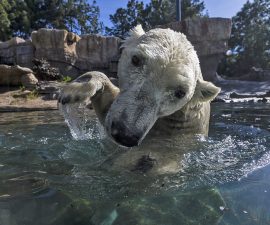
Tatqiq knows how to stay cool!

The summer of 2012 will go down in history as one of the hottest on record. This brings lots of questions as to how polar bears at the San Diego Zoo can live in even the milder heat here. The first answer: our 130,000-gallon (490,000 liters) pool is chilled to under 55 degrees Fahrenheit (12 degrees Celsius). The shallow area allows the bears to lie down and even sleep if they choose. The mid-range allows for great soaking opportunities, and the 12-foot (3.6 meters) deep end allows for complete submersion and swimming. On most summer days, the breeze through the exhibit comes right off of San Diego Bay, so it is a cooling sea breeze. Throughout the exhibit there are numerous shaded areas with various bedding materials for the bears to sleep on. There is also a portable air conditioner we can direct up by the back area where they especially like to sleep. Inside the bedroom area, we also have air conditioning to take the heat out if absolutely necessary.

The real reason we can keep our polar bears comfortable, even on the hottest days, is by limiting the amount of fat they have on their body. For polar bears to survive the cold of the Arctic, they must build up at least 4.5 inches (11 centimeters) of fat over their body. They do this by eating seal blubber. A polar bear’s diet is 90 to 95 percent fat in the wild. They are so specialized for eating fat that they metabolize close to 90 percent of what they eat into body fat.

Here in San Diego, our nutrition staff has developed a diet that is 5- to 10-percent fat, so our polar bears get what they need for good health but not for bulking up for a cold winter. All of our bears would weigh much more than they do now if they had those fat layers. Kalluk, who is now over 1,100 pounds (500 kilograms), would probably be closer to 1,600 pounds (725 kilograms)! When polar bears put fat on, it goes first on their belly to protect their core. Do you know that the body temperature of a polar bear is the same as ours? 98.6 degrees Fahrenheit (37 degrees Celsius)! The fat then layers over their bum and spreads out over their body.

Here’s one way to tell our three apart: When you look at them in profile, Kalluk and Tatqiq have a rounding of their bellies, but from the top of the hip to the tail it’s flat. Since we keep a bit more weight on Chinook (just in case she might be pregnant), her belly is nice and round, and her bum matches! And let’s not forget the CARROTS! Polar bears get little to no nutrition or calorie from vegetation. Our three can eat as much as they like and not put on a pound. Currently, they get 100 pounds (45 kilograms) a day between them that gets chewed, swallowed, slightly steamed in their bellies, and then eliminated. As keepers, we call that job security!

One problem with warm weather we seem to be challenged with this summer is the algae growth. Our water quality team constantly monitors the pool’s water for safety and cleanliness, but algae is airborne until it finds moisture. With the warm temperatures and direct sun, we’re experiencing quite a bloom. We add rock salt to help, but, unfortunately, some of it has imbedded into Tatqiq and Kalluk’s hollow hair shafts. It sneaks in through the small breaks in the shaft formed by grooming. This won’t harm them in any way, but it’s pretty embarrassing to have polar bears with a greenish hue! Our polar bears were once famous for being green when they lived in the smaller grotto exhibit decades ago. Since moving to this exhibit in 1996, we’ve not had any “greening,” until this year. So in the next few days we’ll be hosting “spa days” for a purpose—mineral salt-water soaks for all! Chinook and Tatqiq have always been pros at the soak; Kalluk will be challenging, since he thinks it’s only about dive bombing his sister and then slurping the saltwater off his giant paws. He’s got 13 inches (33 centimeters) on each foot to slurp from!

Summer brings great fun but also great danger with the dry heat. It is sad to hear of fires burning across our nation, so many losing their homes. It’s heartbreaking to lose so much; thank goodness for insurance. In the past few decades, polar bears have lost their ice homes in an area the size of Texas and Alaska combined. We now see forest fires burning in the Canadian tundra, the place with one of the highest densities of polar bear denning, the place where our beloved Chinook was born. What insurance do they have? They have us. We must be the guardians of our planet. We must continue to reduce our greenhouse gas emissions, especially when it seems there is no hope. We still know it can be done. We must be the insurance to protect and insure that our children and grandchildren will still have the opportunity see the magnificent polar bear roaming our planet.

JoAnne Simerson is a senior keeper at the San Diego Zoo. Read her previous post, Polar Bears: Breeding Season.

Watch the polar bears daily on Polar Cam.

40

Science for Kids: Observing

Do you remember watching panda Su Lin when she was born in 2005?

We are coming up on bear pregnancy-watch season at the San Diego Zoo! Both our giant panda Bai Yun and polar bear Chinook have bred this year, and we are anxiously awaiting signs that they are pregnant. Our fingers are crossed, and all the tools we use to monitor their status are just about ready to go. Of course, we are all excited by the prospect of bear cubs in 2012, and I think it’s safe to say that we will all enjoy the opportunity we have to look into the bears’ dens and observe these ursid moms and their cubs.

An important aspect of our conservation research is the study of animal behavior, which tells us much about the biology of the animals we love and provides us with tools to assess how the animals are doing and what a “typical” animal should be doing during important phases of its life. The study of animal behavior can provide tremendous insights into a species’ biology and gives us tools we can use to help conserve them. While the behavioral data we collect fits into a scientifically devised systematic framework, there is much to be gained from simple observation as well.

I have tried to share the joy of observing animals with my kids in hopes that it will also provide a connection with science and what it means to be a scientist. Often, when we are out and about in our neighborhood or at the park near our home, we stop to watch what the various animals we see are doing. It is amazing how exciting and exotic a squirrel can seem if you really stop and take a few minutes to watch the way it interacts with its environment, the way it responds to your presence, and the various ways it vocalizes and flags its tail to send signals to other animals around it. One of our other favorite animal-watching activities is going on a “bug safari,” which simply entails going into our backyard and turning over a rock. This simple excursion provides a window into the fascinating world of potato bugs, ants, and worms. Very cool!

Panda Cam viewers watched Mei Sheng grow to roly-poly cuteness in the birthing den in 2003.

Another readily accessible way for most kids to experience being an animal behaviorist is to watch our own exotic bears through Panda Cam and Polar Cam. While giant panda and polar bear cubs are undeniably cute, they are also fascinating to watch, and the care and patience the mother bear shows while tending to her offspring is fascinating. After each of Bai Yun’s cubs, our scientific and animal care staff watches the activity in the den in great detail and with unflagging fascination. I love that this very same view into the den will be available to anyone who visits our website.

We are all counting the days to the (hoped for) panda and polar bear births. As part of that, we are making sure that all of our camera systems and microphones are ready in the dens so that we can continue our studies of maternal care behavior in bears. This time around, I hope some young scientists out there will study the bears along with us.

Megan Owen is a conservation program manager for the San Diego Zoo Institute for Conservation Research. Read her previous post, Children and Nature.

0

Sugar Bears!

Long ago my dad would take me early in the morning to the donut shop to get the freshest donuts. I remember how beautiful the donuts were when right out of the fryer the baker rolled them in granulated sugar and they just sparkled in the lights of the donut shop! Last Tuesday, May 12, we put over 100 bags of playground sand on the beach for the San Diego Zoo’s polar bears. And by Tuesday afternoon I had three beautiful “sugar donuts” sleeping on exhibit!

The bears were so excited to see and smell the sand. So after quick swims they rolled themselves in the beautiful white crystals. Both Chinook and Tatqiq kept their black noses clean, but our boy Kalluk had a sparkling nose! I think I love these “sugar donuts” even better!

Chinook

Chinook

So many of you have commented on the beautiful white bear you see on the Polar Cam. Are you ready for this? That is our “pigpen” Chinook! She has never looked so beautiful! She has completely finished her molt and seems to be glowing! She was very happy the other day, as well, when the new essential oils from our enrichment wish list came in. Once again she anointed herself with her favorite, “Roman chamomile.” Still no answers on if we’ll see cubs this fall, but we are getting ready. Then den is almost complete and we’re still working out the configuration to hopefully have a den camera that can be shown on the Zoo’s Web site.

Kalluk is definitely out of his breeding daze. I’m sure you’ve seen how much more time he now spends playing and swimming. Tatqiq is ecstatic to have her play buddy back! We are still keeping a variable schedule on all three bears. You may see any combination of one, two, or three out!

I see many of you are asking about what the bears like for beds. On exhibit we have the fresh sand, mulch piles, and burlap coffee bags (which they love). Palm fronds are always a big hit whenever we can get them. In their bedrooms, we can use other items without worrying about clogging up the filtration. The bears do love Bermuda hay, pine needles, mulch, rubber stall mats, and cardboard boxes! All three of them are very good at making their beds using whatever we give them. But Kalluk does seem to take great care in his creations, spending much time moving things around so they are just right. He also uses many of the toys as pillows. It’s pretty funny watching a 1,000-pound boy being so particular about his bed!

In the Arctic, polar bears make beds as well. If the snow is deep enough, they’ll break through the icy crust and dig down to get shelter from the wind. They also dig into kelp beds along the coast. It’s a great soft bed that’s good to eat as well! A few years ago, a big male bear broke into the cardboard bin at the town recycle center in Canada and made himself a bed. He apparently was in there for several days before anyone noticed. Keep recycling. . .it’s good for polar bears in many ways!

JoAnne Simerson is a senior keeper at the San Diego Zoo.

0

Polar Bear Anniversary

Tatqiq and Kalluk, April 5, 2001

Tatqiq (on top of crate) and Kalluk, April 5, 2001

Eight years ago, on March 30, 2001, 22 pounds of polar bear arrived at the San Diego Zoo. The little male was 12 pounds and the little girl was 10. At this size it was difficult to tell them apart, so we shaved a spot on the head of the male. We affectionately called them “Bubba” and “Sissy.” They clung to each other in the strange new world, so we quickly reassured them with warm formula, soft bedding, and a quiet room.

What a cutie!

Tatqiq–What a cutie!

This was my first meeting with our now-famous brother and sister polar bears. Of course we found fitting names for them to replace the cute names they soon grew out of. We knew our boy, although tiny at the time, would grow, so when we found the Inupiaq word for thunder we chose “Kalluk.” And our little girl had the most perfect round, white face, so the Inupiaq word for moon was just right: “Tatqiq.”

What most folks don’t know is that these are actually their middle names! In choosing their names we wanted to do justice to the people that live in their land and also to the geography. Kalluk and Tatqiq were rescued on the pack ice in the southern Beaufort Sea along the north coast of Aalaska. The area was at the mouth of the Piasuk River. So, Kalluk is actually “Beaufort Kalluk,” our sea of thunder, and Tatqiq is actually Piasuk Tatqiq, river moon. We soon found that they were aptly named and Tatqiq had great depth to her name. Not only was she beautiful and peaceful; remember the Credence Clearwater Rival song, Bad Moon Rising? That’s how she quickly became Kalluk’s boss even as he soon grew to double her size. Would you believe he actually gained five pounds in one night?!

Kalluk

Kalluk

Seeing Kalluk with his bald patch on his head now brings back some very fun memories of the two tiny little orphans. Of course, his loss of hair now is due to the “love” bites and wrestlings with Chinook. It will all grow back when his new fur grows in with this year’s molt. Did you know that polar bears molt once every year? The old fur sheds off and is replaced with a brilliant, shiny new coat. We can use this fur loss to confirm maternity dens in the wild. When a female dens up, she will go through her molt. In the summer when the snow melts away, a pile of her fur will confirm where her den had been and where she had given birth to her new, tiny cubs.

I’ll say it for all of us: here’s hoping Kalluk and Chinook will be successful, and we’ll once again all enjoy a new generation of little polar bears!

JoAnne Simerson is a senior keeper at the San Diego Zoo.

0

Polar Bear Breeding Season

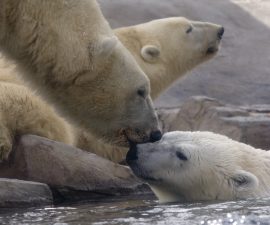
Inquiring minds want to know…yes, we are in polar bear breeding season! And yes, Kalluk and Chinook (pictured) have been, ahem, “amorous.” Phew! Now for some of the details…

We began to see behavior changes in mid-December that indicated Kalluk was having some hormonal fluctuations we attribute to breeding season for males. Chinook followed the beginning of January with her behavioral changes. We know quite little about polar bear breeding and exactly what occurs when, but from past experience it would seem the females fluctuate in their cycles. The fluctuations occur over a one- to two- week period with a 24- to 48-hour period of intensified behavior. The fluctuations show in behavior changes such as sleepy, grouchy, rambunctious, and solicitous! It seems this can last for a few months. Potentially, Kalluk and Chinook could be in this until June!

One of the changes we expected we’d make was to remove Kalluk’s sister, Tatqiq, from the other two. We are happy that everyone is doing really well together and even still playing together on some of the days the hormones don’t seem to be so high!

So at this point we won’t be taking Tatqiq out of the mix except for variability. We are keeping Chinook and Kalluk together 24 hours a day now. We watch them closely for any changes in behavior. At some point, Chinook will decide she is no longer interested in Kalluk’s advances, and then we’ll again make some changes depending on how each bear is behaving.

If this all sounds a bit like a roller coaster, you’re right! Like a rollercoaster we are having steep climbs, fast downhills, curves, slow-paced meandering, and surprises every day. Also, like a roller coaster at the end, we expect to say “wow! What a great ride!” We’ll keep you posted.

JoAnne Simerson is a senior keeper at the San Diego Zoo.

Watch the polar bears daily on Polar Cam!