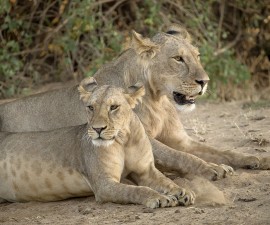
Thanks to our dedicated animal care staff, we have now completed all the initial preference trials (see Big Cat Preferences and Big Cat Preferences, Part 2) with lions, tigers, and cheetahs. Our findings reveal that there are both species and individual differences in enrichment preference, which will help us make educated decisions when providing enrichment for our felids. Ensuring the highest quality of care for every animal in the collection is our top priority, and this is just one project leading toward that goal.
The next phase of this project is being completed by Erin Lane, our Neeper Endowed Fellow, with the assistance of some of our wonderful volunteers. The project includes examining the effects of enrichment (scents and objects) on the 24-hour behavior of lions. We have installed cameras throughout the San Diego Zoo Safari Park’s lion exhibit to observe what the effects of the enrichment are both during the day and at night. This will also provide some insight into the activity budgets of the animals. For example, throughout the day a person might spend about 8 hours sleeping (33%), 1 hour commuting to and from work (4.2%), 9 hours working (37.5%), 2 hours cooking/eating (8.3%), 3 hours watching tv (12.5%), and 1 hour exercising (4.2%). We want to know what percentage of time the lions eat, sleep, rest, socialize, and play. This information will help us make sure that our enrichment program is keeping the animals active and healthy.
We will also be recording different behaviors such as scent marking, sniffing, and clawing to make sure we are providing opportunities for these behaviors, which are part of their natural behavior. Keep in mind that lions in the wild typically sleep between 16 and 20 hours a day (66.6% to 83.3%), and we hope our lions spend their time in a similar fashion. If you have been to the Safari Park’s Lion Camp before, you probably already know that they spend a good portion of their time sleeping just the way a lion should. The question is: how much?
Lance Miller is a scientist for the San Diego Zoo Institute for Conservation Research.
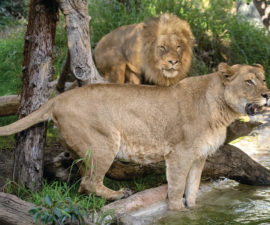
Tango, our Transvaal lion, is 19 years old. Lions live for around 20 years in zoos, which makes Tango an elderly lioness. She and her sister, Mweezi, were born at the San Diego Zoo on August 12, 1992 (see Golden Girls in Their Golden Years). Tango and Mweezi were their own pride for almost 10 years until, sadly, Mweezi passed away in July 2009. As lions live in prides, we needed to give Tango extra care and attention to fill the void left by the loss of her sister.
One instinctual lion characteristic is its roar. Lions use their roar as one form of communication. It identifies individuals, strengthens the pride’s bond, and lets other animals know of the pride’s domain. After Mweezi’s passing, Tango’s roar became a little shorter and a little weaker. We suspected that it may be because her roar was going unanswered. Hali O’Connor is Tango’s favorite keeper; she takes care of her five days a week. Tango and Hali have a very strong bond, so Hali started answering Tango’s call with a roar of her own. Hali and Tango roared together every day, and we started to notice that Tango’s roar was becoming longer and stronger. Soon, Tango’s calls had returned to the roar that she used to communicate with Mweezi. To this day, anytime Tango calls, we answer.
Aside from roaring, Tango loves to vocalize. She grumbles while she chews on her bone, when we talk to her, when she’s showing affection (rubbing her scent glands on the door where we are standing), when she is grooming her rope toy, and when she’s sitting in a fluffy bed. I could go on forever, but we’ll just say she is a very vocal cat! One day Tango and I were talking, and she started falling asleep as she was talking to me. I thought “she’s talking her self to sleep!” Tango is one of the most comical cats I have ever worked with. She is truly one of a kind.
I’ll share more about Tango and her wonderful personality in a future post. There is much to share about this beautiful cat!
Beth McDonald is a senior keeper at the San Diego Zoo. Read her previous post, Langur Name Revealed.
Environmental enrichment is utilized within zoological institutions to ensure animals are physically and psychologically healthy. The goal of an enrichment program is to promote species-typical behavior while allowing some control for animals within their environment. The Behavioral Biology Division of the San Diego Zoo Institute for Conservation Research is currently conducting a research project examining individual and species enrichment preferences for large felids (lions, tigers, and cheetahs) at the San Diego Zoo Safari Park (see post, Big Cat Preferences, Part 2). Based on some preliminary results, we are interested in learning more about different scents (perfumes) that attract the animals and promote the behavior of exploration.
The research project will include examining the behavior of our large felids when presented with a variety of colognes and perfumes. The goal of these scents is to increase our cats’ exploration and activity levels. At the same time, we will send samples of these scents to a chemist to determine their chemical make-up to learn the properties that animals respond to the most. Through this research, we hope to discover the elements of these scents that encourage species-typical behavior so that we can continue to enrich the lives of the animals within our facilities. In addition, information gained from this study can be used to enrich felids at other zoological institutions. With the link between animal welfare and reproductive success, it is important to ensure the highest levels of care for the animals within zoological institutions as many of these species are conservation dependent.
We can’t do this alone. We’re once again calling upon the generosity of our fans and fellow conservationists to help us in this cause by donating old or unused cologne and perfume. If you have colognes and perfumes that you would like to donate to the study, please send them to:
San Diego Zoo Institute for Conservation Research
Attn: Lance Miller
15600 San Pasqual Valley Road
Escondido, California 92027
Thanks so much for your support. Your generosity will improve the lives of our animals and help us work for a better future for the wildlife of our planet!
Lance Miller is a scientist for the San Diego Zoo Institute for Conservation Research.
Update: You may also bring your perfume and cologne donations to the Zoo or the Safari Park! Just take them to our Guest Services window. We are also accepting monetary donations for the study through our Animal Care Wish List.
Update from Lance, January 31, 2011: I would like to say thank you again to everyone in the San Diego region and throughout the United States who has sent in perfumes and colognes. The cats will ultimately benefit from all your kind donations as we continue to learn more about environmental enrichment for these amazing animals.
It’s hard to believe that our little cubs at the Wild Animal Park’s Lion Camp are already one year old. Where did the time go? (see blog, Lion Cubs Grow by the Minute.) It seems like only yesterday we were looking into those soft brown eyes, wondering, “Are you Tamu or Laini?” “Is your left shoulder or left hip to be shaved?” Now I look into those eyes and a whole personality appears.
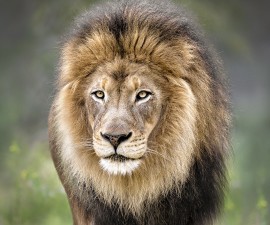
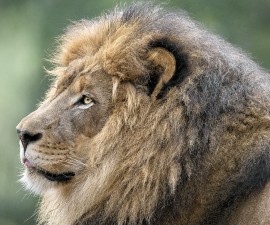
Oshana’s boy Zawadi is the biggest of all the cubs. Weighing in at 198 pounds (90 kilograms), he is quite the presence. He has a laid-back demeanor with the keepers and with the other cubs most of the time, but he can be quite the lion when he wants something. When he sets his sights on a toy or food item, he doesn’t hesitate to muscle his way in; usually with one or two hearty growls he manages to take whatever object he desires. He’s a handsome guy with a blond mane sprouting from his wide head and just the hint of a dark mane on his throat and chest. His eyes are light brown with a gold tint that blends with his golden coat color. He looks so much like his older half brother Kamau, at times. When looking at Zawadi it is almost like looking back in time when Kamau was his age.
Laini and Ingozi inspect a colorfully wrapped treat.
Oshana’s other boy, Ekundu, is the second heaviest of all the cubs at 170 pounds (77 kilograms). Like his brother, he also has a laid-back attitude, but instead of growling like Zawadi to get what he wants, Ekundu just uses his weight and is often seen flopping on top of another cub. Ekundu almost appears polite; when he finishes his meal before the cub next to him, he will walk away. When told by his keepers he is “all done,” he rarely pushes the other cubs away from their food.
My favorite Ekundu story happened a while ago. It was the first time Nyack, our hand-raised cub (see blog, New Cub Joins Lion Camp Pride) was allowed to have a rabbit with all the other cubs. Nyack walked into the large chute area with his rabbit in his mouth. All the other cubs were busy munching their rabbits and Nyack walked by each one cautiously. He came up to his best friend Ingozi; Nyack appeared to be proudly showing him his rabbit. Ingozi snarled and batted the rabbit out of Nyack’s mouth, put his paw over his new acquisition, and growled harshly at Nyack. Nyack seemed confused and frightened; he retreated to the end of the chute, huddled in the corner, and bellowed a low long cry over and over. Ekundu came out from an adjoining room and looked down the chute at Ingozi holding two rabbits and Nyack crying in the corner. Ekundu then strolled over to Ingozi and, quick as can be, snatched a rabbit away from Ingozi, marched it down the chute, dropped it right in front of Nyack, and then turned and walked away. If I hadn’t seen this with my own eyes I don’t think I would have believed it!
Ingozi pounces on a cardboard critter.
Next in Oshana’s litter is her daughter Tamu, the smallest of all the cubs, weighing 151 pounds (69 kilograms). She has a darker, ruddy coat color and an old scar circling her right eye, the remains of some squabble or misstep out on exhibit. She’s a voracious eater and a quick learner. Tamu attaches herself to toys and will hold on with claws, baring her teeth at whoever comes to investigate. She is often the victim of Ekundu’s body flops; he doesn’t seem too intimidated by her possessive snarls, and it often makes him more curious when she is defending some prize.
Oshana’s other daughter, Laini, is one of the biggest females, weighing in at 160 pounds (73 kilograms). She’s smart and very communicative. Laini will greet her keepers with a hearty snarl and hiss, only to offer intense focus when asked to cooperate with learning new behaviors. She’s a quick learner and will watch her trainer intently, waiting for her next cue. Although she is almost 10 pounds heavier than her sister, Tamu, they look so much alike we sometimes have to look them in the face to tell “who is who.” Laini is stubborn when asked to come down off one of the high benches and shift to another room, but cooperates quickly when asked at a training session.
At 168 pounds (77 kilograms), Mina’s daughter Sarabi is the heaviest of all the female cubs. Lighter, almost gray in color, her square jowls and slender muzzle make her look older than her one year. As a young cub she seemed like a “tough girl,” warning off the boys and greeting her keepers with a hiss and a snarl. As she’s gotten older, she doesn’t appear to be quite as brave. When new enrichment is placed in one of the rooms, she seems leery and usually waits for another cub to investigate before she moves in to check it out. Sarabi is more trusting and curious with her keepers and will approach, although cautiously, when a keeper presents an unusual item, usually to assist in training.
Mina’s other daughter Kaya weighs 160 pounds (73 kilograms). She’s light in color like her sister and shares the same medium brown eyes. Kaya seems like she has a busy mind, an independent thinker like her Aunt Oshana, often appearing to be more concerned with what another cub is doing instead of what she is doing. Kaya is bold with new objects and is often one of the first ones to explore new enrichment items. She is playful and will hoard bones, or especially good enrichment items, from the other cubs. When approached by another cub intent on taking a toy or bone away, Kaya can turn into a pure lioness, growling, snarling, and holding on with muscles and claws.
Ingozi is Mina’s only boy, weighing 165 pounds (75 kilograms); he is the second smallest of all the male cubs. He has a sweet, almost comical disposition. Ingozi is shorter in stature and has dark brown, wide-set eyes, giving him a gentle appearance. His right upper lip is often caught on his teeth, allowing the tip of his tongue to stick out between his lips. He is cooperative with his training but quite independent. Ingozi was the first cub introduced to Nyack (our hand-raised cub) and still will call out to him if Nyack is shifted into another room out of Ingozi’s sight. The two cubs often sleep next to each other.
Nyack is 163 pounds (74. kilograms); he is one month younger than the other cubs and yet weighs only 2 pounds (0.91 kilograms) less than his cousin, Ingozi. Nyack is one of the pride of cubs. He is quite independent and fits in well with all the cubs. His mane has been coming in dark and shaggy, yet he still has spots on his legs and his face. His head is long and narrower with almost a “Roman-type” profile. He has become very possessive of his food and will fight anyone who tries to take a taste. Nyack and Ingozi are almost constant companions, with Sarabi often found resting with them. Nyack seems quite taken with her and will walk in front of her, waving his favorite toy (an old phonebook) in an attempt to get her to follow him and play.
These cubs grow and change daily. What a fun experience it has been to observe this process. I can hardly wait to see what happen next!
Amy Whidden Winter is a keeper at the Wild Animal Park.
Moderator’s note: We celebrated the first birthdays of all eight cubs on Tuesday, November 11. There was a frozen cake and other frozen treats for the cubs, as well as cardboard critters for them to play with, made by the Park’s Conservation Corps students. The next “party” for the cubs will be on Sunday, November 16. It is for the Conservation Corps; as they were unable to attend the festivities on Tuesday, we are having them come and place the rest of their enrichment animals on exhibit for the cubs. The keepers are going to add a few bloodsicles, too! It should all be happening around 9:30 a.m.