Uncategorized

langurs

6

Primate Enrichment

A siamang and orangutan inspect a painted gourd that was filled with goodies.

What exactly is enrichment and how is it used in the San Diego Zoo’s overall animal care program? This is a question that is asked more frequently than in the past. The general definition of enrichment is to make fuller, more meaningful, or more rewarding. This has a direct correlation to enhancing the quality of life for the primates in our care. Enrichment at the Zoo is equal in value to the provision of food, water, and shelter. Keepers spend many hours figuring out ways to stimulate the animals in our care, both mentally and physically. One of the biggest challenges is providing the monkey or ape with something that is safe and indestructible!

Orangutans are known for their independent thinking capabilities. If there is a way to dismantle or destroy something, they will find it. But just this process is stimulating! Since orangutans are arboreal, we try to provide items that we can freely hang from the climbing structures inside their habitat, simulating the natural movement of branches. Large plastic disks, balls, and other objects can be stuffed with plant material or novel food items like cereal, sunflower seeds, hot sauce, and spices. These enrichment items are then secured to the climbing structure with hardware and rope. We have to be diligent about making sure the nuts and bolts are very tight, otherwise one of our more mischievous orangutans (I didn’t want to name names, but…Karen) will be dismantling the apparatus within moments!

Hammocks are always a favored piece of furniture for most primates. They use them as storage units, to lounge in, and play on. And, for the industrious species, unravel, unweave, and retie with their own unique knot-tying skills!

The black mangabeys, which can be found in the Zoo’s Lost Forest, are very adept at manipulating puzzle feeders that are provided for them inside their “bedrooms.” Opposable thumbs come in handy when attempting to pull raisins out of tiny holes on a board or moving peanuts through a maze mounted to their enclosure. Hanging mirrors are also a novel way to spy on your neighbors down the hall! I have seen monkeys hold the mirrors (with safety glass) and angle them just right to get a good look at me or one of their conspecifics in the next room!

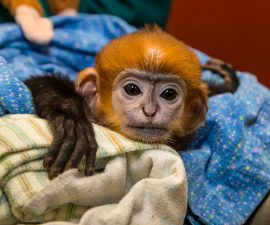
Primates are problem solvers. They use this skill every day in their natural environments as well as in their habitats at the Zoo. With the help of the Zoo’s March Wish List, we can provide opportunities to encourage stimulation for exploration, foraging, problem solving, and the senses. Wish List items include paper streamers for the bonobos, flowering shrubs for our colobus monkeys, and mirrors for Francois’ langurs,

Kim Livingstone is a lead primate keeper at the San Diego Zoo. Read her previous post, Gorilla Born at the San Diego Zoo.

13

Silver-leaf Langurs

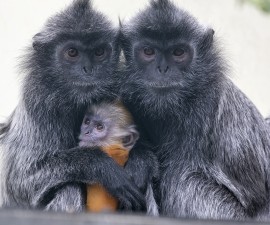
Meet our new silver-leaf langurs! Aden, our resident male, is brave, outgoing, and adventurous. He lives with four females: Tevy, LiLi, Adamena, and Zoe. Tevy and LiLi are mature and attentive to the younger langurs; Adamena learns a lot from Tevy and LiLi; Zoe is our youngest and smallest, timid yet curious.

We are very proud and excited to have these langurs. This group adds increased genetic variability to the North American population. They are from the Singapore Zoo, and their genetic make-up is highly valued. Langurs are very sensitive primates. Found in the rain forest canopy of Southeast Asia, they are difficult to study in the wild, so little is known about their natural behavior. They can be challenging to care for in zoos, and our priority has been to make them feel as comfortable and secure as possible.

The silver-leaf langur troop arrived in the San Diego Zoo’s Sun Bear Forest in August 2008. In an attempt to mimic their natural habitat, we filled their bedroom area with large pieces of ficus browse. This gave them places where they could “hide” while I cleaned their bedroom, keeping my head averted so as not to gaze directly in their eyes and making sure my movements were slow and smooth.

To help them adjust to the exhibit, we connected all of the branches and other perches into winding trails so the langurs would not have to jump. This helped them navigate around their new home comfortably; as they got more familiar with the layout, we gradually removed the connections!

I hoped that by “making friends” with the male, Aden, the rest of the troop would see that it was okay to have me around. Over the first few weeks, I spent time with Aden, talking to him and offering a favorite treat: peanuts! This helped build a bond with him that has spilled over to the rest of the family, and they seem to have adjusted very nicely to life in San Diego.

Be sure to stop by Sun Bear Forest and look for the striking silver monkeys with a long tail and wild Mohawk!

Beth McDonald is a keeper at the San Diego Zoo.

Read Beth’s previous blog, A Gibbon Birthday Party.