Uncategorized

koalas

10

A Koala Kwest, Part 1

One of the many sulfur-crested cockatoos seen in Australia.

Having never been to Australia before, I was thrilled when I was told I was being sent “Down Under” to work with some of our staff and researchers from Queensland University on a wild koala study! Before we even packed, we had a few meetings where I was told over and over, “We are going to a small Island off the coast of Queensland. Be prepared for bug bites, heat, humidity, spiders, and challenging hiking.” I was amazed at people’s reaction when I told them work was sending me to Australia. “Be sure to go to this city… See this… Eat there… Oh, and go to that place with the koalas” were all things I heard. To which I would reply, “No, you don’t understand. This isn’t a vacation, I’ll be working.” And it was work, but also an amazing adventure. But I’ll get to that in a moment.

The single-engine plane is ready to take us to Keswick.

Thankfully, the long trip to Australia was uneventful. (However, I must say it was odd to lose a day on the calendar due to crossing the International Date Line.) Shortly after landing in Brisbane and getting through customs, we took another flight north to the smaller city of Mackay. It was there that I got to experience something I have never experienced before: riding in a single-engine airplane. And the best part was, every seat was a window seat because there were only five seats (including the pilot’s)! The waters off the coast of Queensland were beautiful, and we were even treated to seeing a couple of humpback whales.

We finally arrived on the island of Keswick, about 35 kilometers (21.7 miles) off the coast of Queensland. Keswick is right next to St. Bees Island, separated by about a quarter of a mile or 0.45 km, depending on the tide. And Keswick is where we stayed each night because St. Bees does not have any accommodations for a long stay with overnights. We arrived in the early evening, and as soon as we got off the small aircraft we were loudly greeted by a flock of wild sulfur-crested cockatoos flying to Keswick from St. Bees Island. This was another first for me, seeing so many of these bright, white birds in flight. I immediately looked at my watch to mentally note the time; given birds tend to have habits based on time of day, I wanted to make sure I was in the right place to watch them again tomorrow at this same time.

Suddenly there was the sound of a blast of air off in the waters between the two islands. Sure enough, two humpback whales were slowly making their way down the channel of deep water between the two islands. Everyone—and I mean everyone, even the people that live there—stopped what they were doing and rushed to the shoreline to stand quietly as we watched them slowly pass by.

The infinite stars seen on Keswick.

Like I said, this was an amazing trip. Wild cockatoos and humpback whales all within minutes of arriving, and it didn’t stop there. Once the sun had set, we were treated to a clear sky filled with what looked to be infinite stars and a lot of large flying foxes (fruit bats). For the most part we could only hear the squeaks and chirps of the bats, and every now and then we could see their silhouette against the star-filled night.

And to think… this was just how the day of travel to our koala adventure ended. The actual adventure had yet to even begin!

Rick Schwartz is a keeper and San Diego Zoo Global ambassador. Read his previous post, Clouded Leopards Make TV Debut.

0

Koala Headlines

“Koalas no more in our bush”
“Koala listing another example of government ‘greentape’…”
“Koala listing offers no protection from logging”
“The vulnerable koala: are we in time to save our national icon?”
“Koalas get some protection in parts of Australia”

These are just some of the headlines coming out of Australia these days. And for good reason: Environment Minister Tony Burke announced on April 30 that the federal government decided to list the koala as vulnerable in New South Wales, Queensland, and Australian Capital Territory. However, there are two other states that are part of the koalas’ home range, Victoria and South Australia, where the federal government did not list the koalas as vulnerable, and this is bringing up some debate and discussion.

While is it is great to see the conservation research of Bill Ellis (former San Diego Zoo Institute for Conservation Research postdoctoral fellow and still a research collaborator of mine) being used in the political arena by helping the federal government come up with the vulnerable determination for koalas, there is always more that could be done. The debate and reason for the lack of protection for southern (Victorian) koalas is that there is a common misconception of the robustness of the southern ranging koala population, since there are high numbers in that region.

More than population numbers need to be taken into account when listing an animal. Kellie Leigh, conservation biologist from the Australian Ecosystems Foundation (and a collaborator with me on koala scent studies), says many of the large koala populations in Victoria have been bred from a small number of individuals that were reintroduced from the French and Phillip islands. “There is evidence that these populations suffer from inbreeding depression, including things like testicular abnormalities,” Dr. Leigh says. “This lack of genetic fitness also means that the populations are much more susceptible to pressures like disease.”

The idea that the Victorian koalas are “eating themselves out of house and home” perpetuates the idea that this population of koalas does not need protection like their northern counterparts. “Looking at numbers alone is just not meaningful in conservation terms. While the listing is welcome and a step in the right direction, we need to conserve the koala right across the species range if we want to hang on to this iconic animal,” says Dr. Leigh. Even with scientific input on the declining numbers of koalas in the northern states, the koala was not listed to the highest level: endangered.

It is wonderful that the San Diego Zoo has a robust colony of Queensland koalas for all Zoo visitors to see. And we will soon have a new home for them, opening in Spring 2013. But in my 10 years of koala research, I didn’t think that there might be a time when I might not see a koala in the wild. As a guest at one of my first talks at the Zoo asked, “Why are you studying koalas if they are not endangered?” My response was that their foothold in Australia could change at any time and could cross that threshold. Unfortunately, I am sorry to say that this is where we are heading. However, all is not lost, and the crusade for preserving the koala in Australia is strong. Although this listing does not cover all the koala populations, it is one more step in the right direction. So the next time you stop in and see our koalas, remember their wild counterparts and that there is reason for hope!

Jennifer Tobey is a research coordinator at the San Diego Zoo Institute for Conservation Research. Read her previous post, Victorians: The Other Koalas.

4

Snugglepot and Cuddlepie: Koala Headliners of Roaring 20s

Our first koalas arrived in San Diego in 1925. Photo credit: San Diego History Center

I’ve had an absolute blast researching the saga of Snugglepot and Cuddlepie, the San Diego Zoo’s first-ever koalas who arrived from Australia in 1925. Snugglepot and Cuddlepie also have the distinction of being the first koalas to live in a zoo outside Australia, which was big news back in the 1920s. I was thrilled to discover that our Zoo library has newspaper clippings dating back to 1916 when the Zoo was founded, and they contain a wealth of stories about the expedition that brought these precious marsupial superstars to San Diego. The Zoo has started construction of a new forest home and care center for our koalas to be called Australian Outback, and I thought I’d share a few historical tidbits for koala fans.

Tom Faulconer admires one of the koalas he escorted to San Diego.

The adventure itself was filled with drama and intrigue. I can only imagine what it must have been like for San Diego Zoo Director Tom Faulconer to travel across the Pacific Ocean by steamship in December 1924 with 200 North and Central American animals onboard. He was the sole Zoo employee on the trip, responsible for everything from travel logistics to feeding the animals and cleaning their crates! In January 1925, he returned to San Diego with 200 unusual Aussie critters in tow. All aspects of the tale mesmerized me: major storms, seasick animals, an alligator escapee on deck with the passengers, a king cobra in Faulconer’s stateroom, the koalas nearly missing the ship to the U.S., and many more escapades.

I was also fascinated by the writing style featured in the old newspaper clippings. The choice of words and phrases enchanted and sometimes amused me. By today’s standards, some words have taken on different meanings, others might be considered old-fashioned, and a few would be deemed inappropriate. Below are some of my favorite headlines and passages, which include the original grammar and punctuation. Enjoy your journey back in time!

A KOALA IS…
Dec. 21, 1924 (The San Diego Union)
“A droll little fellow, abnormal in many ways, he is the original Teddy Bear. His little, podgy, tailless body, short thickset head and round, tufted ears lead some countenance perhaps to the ursine analogy, but there the likeness ends. When irritated or disturbed they utter a cry described as a hoarse groan. Young Koalas make delightful household pets. They are naturally docile and quickly become attached to their owners, following them about the premises.”

Sept. 29, 1925 (The San Diego Union)
“He can climb anything, and when attacked, if unable to save himself by climbing he will lie on his back and swing his mean claws. But the koala is very affectionate and is fond of petting parties, never offering to attack a human being.”

KOALAS IN THE NEWS
Dec. 21, 1924 (The San Diego Union)
Zoo To Have Koala Bears: Interesting Description of These Little Known Animals
“Since the word got around the Director Tom Faulconer of the zoo had gone to Australia to bring back Koala bears among other specimens, and that the zoo was going to undertake the propagation of them, the telephone at the Zoological garden office has been ringing constantly. A surprisingly large number of people are interested in various ways regarding the proposed undertaking, and the situation has at times taken a humorous turn. This was especially true when a prudish little old soul, fearful of the savagery of the beast, insisted that the zoo abandon the idea before lives were lost.”

Jan. 27, 1925 (San Diego Sun)
Weird Animals Due for San Diego Zoo: Tom Faulconer Returns From Australia With Queer Collection of Birds and Animals
With enough kangaroos to hold “kangaroo court” every day in the month and enough weird birds and snakes to furnish scenery for a Dantesque picture of Delirium Tremens, Tom Faulconer, director of San Diego’s famous zoo, is on his way from San Francisco to make the Balboa park institution rank second among the zoological gardens in the United States.

On his arrival in Australia, he made the old stories of horse traders pale into insignificance. Swapping a rattlesnake for a wombat, a wildcat for an egg-laying echidna, and so on down the line, would unfold a tale of barter that might have been entitled ‘What Made the Wildcat Wild.’

As a result, the San Diego zoo will be enriched by some 28 kangaroos, to say nothing of an assortment of bandicoots, dingoes, phalangers, wallabies and whatnot. What may all these things be? Search us!”

Jan. 28 1925 (San Diego Sun)

Weird Guests of Local Zoo Arrive Today
If you heard loud, weird noises emanating from the foot of Broadway about 1 o’clock today, don’t be alarmed. It was neither some new murder being perpetrated, nor was it a band of Cocopah Indians on the war path—it was merely 100 birds, together with a miscellaneous assortment of animals and reptiles completing their long journey from Australia.”

By the way, if you would like to know more about the Australian Outback, please click here for details as well as to find out what you can do to help our koalas receive their new home!

Georgeanne Irvine is associate director of communications/development for San Diego Zoo Global.

4

Koalas and People

Can you imagine finding Sarge in YOUR backyard?!

It seems like only yesterday I was in San Diego catching up with all the people at the the San Diego Zoo and the San Diego Zoo Institute for Conservation Research, but today I am in a very different and unique environment: North Stradbroke Island. I have written before about our work on this amazing island near Brisbane in Australia, but the most recent trip was a real eye-opener. Most of my work is centered on the remote island of St. Bees, where we don’t see any other people, and the koalas go about their business almost as if we don’t exist. On North Stradbroke Island, it seems that the locals—both koala and human—have worked out how to share their environment, at least in the small township of Amity Point.

Earlier this year we fitted four koalas at Amity Point with radio and GPS collars so we could track them and record their positions throughout the nights. Now we are recovering the collars and plotting the data, revealing a very interesting story. Far from only using the patches of trees that remain around and within the township, the koalas at Amity seem to make themselves right at home even within people’s backyards. I have included a photo of Sarge, one of the males we had collared. We found him sitting in the front yard of a house in Amity, apparently not disturbed by the occasional passing tourist. You can see the fence in the background, which leads to our next koala.

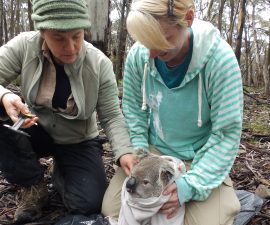
Library (so named because we first caught her in front of the local library grounds) was living right on the seaside, in the backyard of some locals who had made her transport easier by building bridges over the fences between their properties. By leaning old tree trunks up against the fences, they had created a passage for koalas to travel along, safely negotiating the urban landscape. When we caught her, we not only had several generations of residents watching us—we also found her to have a joey in her pouch.

Despite the houses, occasional shops, and frequent tourists, the koalas in Amity seem to highlight how people and koalas can share the environment. The locals are very interested in what any researchers are up to (and want to make sure we have a good reason to be catching the koalas!) and are keen to do what they can to encourage koalas to move safely through their properties. Sometimes this can be quite exciting, as one resident told us of an occasion when a koala landed on her roof, only to climb back into the tree (probably embarrassed for being clumsy), but in general the humans and koalas are co-existing in harmony.

We recovered a lot of detailed data recording where each of our koalas went, and it is clear that the residents’ yards and street trees are very important to these animals and that people who make sure the koalas can move through their properties are doing a great job in securing the future of this population. All the koalas were healthy, and each female had a joey in her pouch, which is a welcome change from some other locations in Southeast Queensland.

We will be continuing our work on North Stradbroke Island for several years to come; I am hoping we have found another haven, like St. Bees Island, where their future is a little brighter than many other places.

Bill Ellis is a Clark Endowed Postdoctoral Research Fellow for the San Diego Zoo Institute for Conservation Research. Read his previous post, Urban Koalas.


1

Urban Koalas

I have spent the last month or so in western Queensland and in the Northern Territory, so it is nice to be back in southeast Queensland working with the urban koalas again. With my colleagues from The University of Queensland, we have extended our project that began on St. Bees Island and are using the same tracking techniques down among the urban sprawl of Brisbane. It is a very different style of work here; we have electricity and motor vehicles and assistance is never far away, but there is another interesting and unusual thing about working here—the locals. Not the local koalas, the local people.

Everywhere we go we invariably meet someone who has knowledge of the local koalas. Some people have seen their suburbs change from semi-rural landscapes to high-density dwellings, and often these folks recall the days when koalas roamed freely across their lawns and climbed their trees. Too often, the tales are sad ones of the lack of recent sightings, and generally people are happy to see that we are taking an interest and doing our research.

In Redlands, south of Brisbane, the local council is supporting our radio tracking project through which we hope to determine the extent of use of backyard trees and street trees by koalas, as well as finding out what attributes of local parks and bush patches are most attractive to koalas. The council hopes to be able to protect the best patches and augment the lesser-used ones, while protecting linkages and stopping the loss of any trees koalas use.

Of course, when we are catching koalas in the urban areas, the interested local folks are not far away and often come and inquire as to what we are doing with “their” koalas. Far from being a distraction, this is a wonderful vote of support for what we are doing, and it’s a pleasure to tell them that we, too, value “their” koalas and are helping protect their habitat. As you can see in the photo, we quite often draw a bit of a crowd, so the pressure is on to make sure we handle the koalas very carefully and explain what we are doing as we go along.

The photo shows Sean up the tree as we catch a koala we called “George” – because that is what the local people told us his name was! We also caught a female – Mary (also named by the locals in honor of the street she is most often found along) in the tree next to her and both of these koalas were fitted with GPS collars similar to those we use at St. Bees Island. If you look closely, you can also see the small tree guards around the newly planted koala food trees in the ground at this site. All over Brisbane tree planting projects are under way to redress the loss of koala trees, even along local streets like this one.

The people who live with koalas are an interesting bunch: they talk with great enthusiasm about the noise during the breeding season (from the koalas bellowing – something I am also interested in) and about which koalas they have recently seen. Recent studies suggest that koalas in the southeast are in grave danger, but with these people on their side and with the data we are producing in the hands of the council, I hope the koalas are here for generations to come.

Bill Ellis is a Clark Endowed Postdoctoral Research Fellow with the San Diego Zoo Institute for Conservation Research.

0

Western Koala Experience

koala_bill_rollieKoalas are widespread across Queensland, Australia, so my travels can take me far and wide researching this unique animal. On the way to St. Bees Island in August, I traveled west to Clermont, in central Queensland, to help a research team from the University of Queensland investigating how koalas use the drier parts of their range. Clermont is about 250 miles due west of St. Bees Island (my study site, see post Island Koalas: A New Season). It is a mining and rural area, with many large cattle and cropping properties spread out across the plains. Koalas in that area use a variety of trees, from the tea trees (Melaleuca) and brigalow (Acacia) that they rest in during the day, to the large coolabahs, poplar box, and blue gums (Eucalyptus) that they eat, mostly at night.

The research at Clermont is focused around what the koalas are doing in the post-mining landscapes, and I was helping Dr. Sean FitzGibbon track, catch, and collar koalas that use the rehabilitated areas of one of the coal mines in the district. Sean has been using the same technology that we use at St. Bees Island (GPS collars) to follow his koalas, and he has found some very interesting information. Recently he has discovered that koalas from nearby areas have made short trips into the revegetation on his study site. The koalas come from the adjacent bush land, spend several days in the new areas of forest (with trees less than 30 feet tall) and then go back to the native bush. After a period, they repeat this, so Sean is trying to find out if the koalas are just investigating the new bush, if they are eating the trees there, or if they are looking for mates in these patches.

This is very exciting news for koala researchers, because no one knows how old forests have to be before koalas will start to use them, or whether old mine sites could really be suitable for koalas in the long term. The areas that Sean has found koalas using were planted with Eucalyptus trees about 13 years ago.

I got to meet several of Sean’s koalas on this trip, and although I am attached to my study animals at St. Bees Island, I certainly do have respect for the koalas of the west. These animals survive through very harsh, hot, and dry summers, traveling long distances (up to half a mile each night), and have to survive among the farms and mines of central Queensland. I’m pictured above releasing Rollie, a large male we found on what we think was his first trip into the rehabilitation at Clermont. He was a very big male who was quite happy to get back up his tree after Sean removed his collar to collect the data.

It was really interesting to visit koalas that live such a different life to the coastal and island koalas I am more used to these days. They are so spread out among the woodlands and along the creek-lines that it seems like you will never find them. But there they are, quietly going about their business. I certainly hope that the people out west plant more trees for them in the future.

Bill Ellis is a Clark Endowed Postdoctoral Research Fellow for the San Diego Zoo’s Institute for Conservation Research.

0

Island Koalas: Eating Habits

Blue gum (eucalyptus) leaf under microscope

Blue gum (eucalyptus) leaf under microscope

Whether it is in the koala barn at the San Diego Zoo or in the field in Australia, the fine details of the lives of koalas provide a steady stream of questions for keepers and researchers alike.

I have just returned from Brampton Island, which is a small island near our main research site, St. Bees Island (see post, Koalas: Floating Research Station). Both islands lie several miles off the coast of Queensland, and both are home to healthy populations of koalas. However, that’s where the similarities seem to end.

Brampton Island has a diverse array of vegetation, from native pine stands through ironbark forests to wetter rain forests. By comparison, we are used to tracking koalas across the open blue gum woodlands on St. Bees Island, with occasional forays into rain forest gullies or across acacia and grass patches. It has become clear to us that the koalas living on Brampton Island encounter a more varied habitat than do the koalas that live on St. Bees.

At the San Diego Zoo, the dietary preferences of koalas have been studied so that the koalas can be fed with the species they prefer. To do this, research coordinator Jen Tobey and the keepers spent many hours offering the koalas a variety of leaves and analyzing the responses. In the wild, working out what koalas eat is a little harder, because they feed mostly at night, and then during the following day they don’t always sit in the trees where they ate. Fortunately we are able to tell what koalas have been eating by examining koala poop. The small particles of leaf left behind in their droppings present unique signatures of each species eaten, so, with a little help from some stain and a microscope, we can see what they’ve been eating.

Since the tree species are quite different between St. Bees Island and Brampton Island, we figured that their diet might be different as well. So we collected lots of leaves on Brampton (we already had a lot from St. Bees), took them back to the laboratory, and are comparing them using a microscope to the leaf fragments found in the koala poop. Now it’s just a question of time and a lot of slides, and we will know just how different the eating habits are of koalas on the two islands, as well as among koalas living on the same island.

Bill Ellis is the Clark Endowed Postdoctoral Research Fellow at the San Diego Zoo’s Institute for Conservation Research. Read his previous blog, Koala Conference Washed Out.

0

What Is an Elephant Odyssey Ambassador?

Good question, and pretty easy for me to answer because that’s me, Rick Schwartz! I have been a keeper at the San Diego Zoo for over eight years, working with a wide variety of animals and people. Recently I was given the opportunity to shift my focus from keeper work to ambassador work for the Zoo. As Elephant Odyssey’s ambassador, I get to travel around San Diego and the country as a representative of the Zoo. My job is to share with everyone anything and everything that is Elephant Odyssey.

That said, I need to tell you that this year the San Diego Zoo is going to open the largest exhibit area in its history: Elephant Odyssey. No pun intended, but this area is huge, and the animal care sections are going to be like nothing else out there! Of course, the Zoo is known for the exceptional care it provides to all of its animals, and Elephant Odyssey will set the bar even higher. As for guests visiting Elephant Odyssey, you will be immersed in a bioclimatic zone that will bring you into the environment AND take you back in time, too. Okay, okay, maybe I’m getting ahead of myself here. It’s all so exciting and there’s so much to share, I just can’t wait to tell everyone!

You’re probably thinking, “Do we need an ambassador? Everyone already knows about the San Diego Zoo.” As true as that may be, there are a lot of interesting facts that people may not know. For instance, did you know that elephants under our care range in age from 1 to 54 years old? Our youngest African elephant at the Wild Animal Park, Kamile, is a vibrant 1 year old and our oldest Asian elephant, Cookie, is a mature 54 years old. Did you know that the Zoo’s conservation efforts span the globe? We are conducting habitat studies in Africa, releasing California condors to the wild in North America, studying koalas in Australia, and so much more! Check out our Web’s new conservation section.

There is so much information to share with everyone about the Zoo, Wild Animal Park, and San Diego Zoo Conservation Research! Honestly, my enthusiasm for getting out there and talking to people tends to get the better of me.

Let’s face it: I’ve got a big job to do, one of elephantine proportions! The Zoo has a lot going on all the time, and this year will be more eventful than ever. Between the opening of Elephant Odyssey and the many conservation projects we’ll be highlighting, I am going to be a very busy ambassador, working hard to get the word out to everyone.

For now, as I trade out my zookeeper tools for a laptop computer, I ask that you keep checking our Web site. You’ll find new blogs popping up here and there and new videos coming online; a whole page dedicated to Elephant Odyssey should be debuting this spring.

Rick Schwartz is Elephant Odyssey ambassador for the San Diego Zoo.

11

Koalapalooza: A Joey Is Named

After months of anticipation and careful planning, San Diego Zoo Discovery Days: Koalapalooza finally arrived: These four exciting days were filled with news interviews and keeper talks featuring not only koalas but our other special marsupials as well, including tree kangaroos, wallabies, and the closest relative to the koala, the wombats. We were so excited to have a long weekend dedicated to our favorite animal, the koala, but I must admit we were a little nervous!

The guest turnout was amazing and topped expectations. Other departments crucial to our koala program had booths set up. One booth featured our conservation researchers, who shared the important work they are doing to help us learn more about koalas and aid in conservation efforts in Australia; kids could even learn how to radio track and locate stuffed koalas around the Zoo, just like we would when looking for wild ones in Australia. Another booth highlighted our extremely important browse department, which grows all the eucalyptus, the only food a koala will eat. This is not an easy job, because our koalas eat a lot of eucalyptus! Guests could also speak to our veterinary staff about koalas; these are very specialized animals are different from other mammals when it comes to veterinary care, but our staff is excellent!

Our educators and animal trainers brought out more animals, and keepers in other areas of the Zoo gave special talks. There were different opportunities to donate to koala conservation, including an online auction, fun activities for kids, as well an Aussie barbeque meal and music. I even got a koala painted on my face!

One of the highlights of the event was our Name the Joey contest. Our almost 10-month-old joey needed a name! We thought it was definitely time to stop calling her our own personal nicknames (like Sweetheart and Cutie pie) and give her a permanent identity. It was tough decision making, but we narrowed down the long list of great submissions from Zoo guests and supporters to five beautiful choices. “Sooky”, meaning “soft” or “tame,” won by a fairly large margin. Thank you all so much for submitting names and voting at Koalapalooza. Now our precocious little girl has a name!

Kuna and Amy

Kuna and Amy

My absolute favorite part of the event was taking a koala to the Zoo’s front plaza where guests could see him up close. It is so extraordinary for me to be able to share with people what I have learned from the koalas I have worked with for about seven years now. As Kuna did what he does best (munch away on leaves and look totally adorable), I got to share all kinds of koala facts and answer questions. I also shared little personality traits and amusing attributes that make us laugh, sometimes cry, and grasp the individuality and specialness that each koala possesses. Kuna helped, too. As most koalas are too shy and reserved to be comfortable in a crowd, Kuna showed his individuality and kind spirit with a relaxed and curious personality, which I’m sure made most guests develop a soft spot for koalas (if they didn’t have one already). It’s these qualities that ultimately give us the never-ending passion we have for our job as well as our dedication to doing everything we can to help this irreplaceable species in the wild.

In the end, Koalapalooza was a huge success! Not only did we raise $5,200 for conservation, we were able to interact with Zoo guests directly. The koala keepers would like to thank every guest who attended Koalapalooza or participated in the online voting. On a personal level, your involvement means so incredibly much to us! We know that these are trying times for many people, and I really want to let participants know how much we appreciate any and all of your support. We couldn’t do it without you! I sincerely hope everyone had a wonderful time at Koalapalooza. We would love to see you again at our next Discovery Days event, Bear Bonanza, in March!

Amy Alfrey is a senior keeper at the San Diego Zoo.

Read a blog and watch an interview with Amy

Read the latest blog from a koala researcher