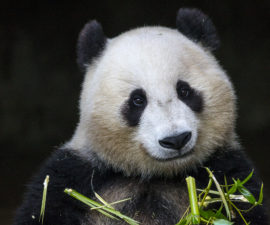
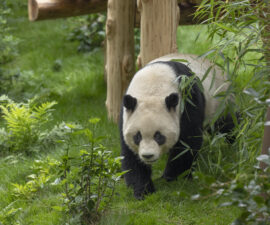
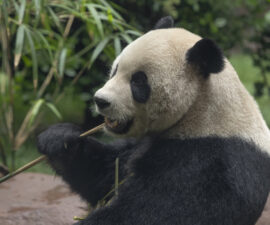
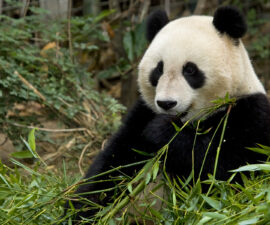
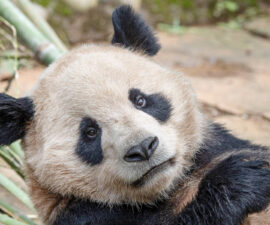
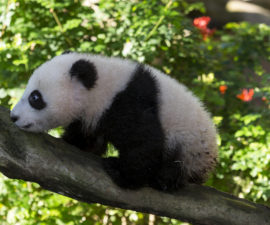
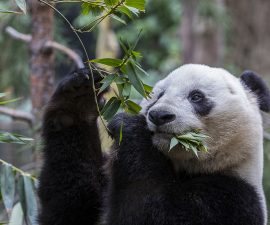
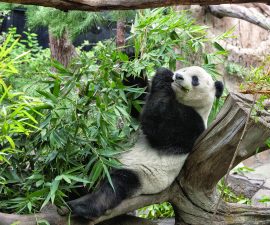
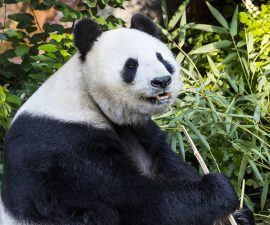
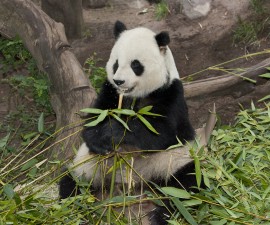
Bai Yun gets some rest with her cub secure in her arms.
Zookeepers are always “on call.” If we leave town, we let our supervisors know when we’ll be back, just in case they need us for anything. If an animal is sick, we work overtime. If there’s late-night construction, we’re at the Zoo at all hours making sure our animals are safe and secure. This is also true if one of our animals is expected to give birth or if she has a newborn.
Right now, the San Diego Zoo’s Panda Team has a schedule to insure that Bai Yun and her newest cub are observed 24 hours a day, 7 days a week. We began this schedule about a week before her cub was born and will continue to observe her 24 hours a day until the cub is at least 2 weeks old. Everybody involved with pandas takes turns rotating through the shifts. As I write this, it’s my turn to do the overnight shift.
So, here I sit, 11 p.m., in the video room of the Giant panda Research Station, watching Bai Yun and trying not to fall asleep. I have to say that I can’t complain much. It’s amazing to watch Bai Yun demonstrate her natural maternal instincts. Right now, the cub weighs only about 4 ounces (113 grams), so it’s my job to make sure that Bai Yun doesn’t sit, roll, or step on her itty-bitty cub. Bai Yun currently weighs around 220 pounds (100 kilograms) and has never accidentally rolled onto a cub. She’s very gentle with each of her movements and is constantly aware of where the cub is.
Of course, the cub is very noisy at this stage of its life and tells Bai Yun exactly where it is. If the cub wasn’t noisy, it would be easy for Bai to lose track of it. While on cub watch, it’s also my job to keep track of the cub’s vocalizations. I have to make sure that the cub makes some noise at least once every two hours. Believe me, that cub does a great job of keeping both me and Bai Yun awake all night!
The San Diego Zoo takes a hands-off approach when it comes to panda cubs; unless the cub or Bai Yun is in some distress, we do not interfere with her rearing of the cub. Bai Yun will barely leave the den for the first few weeks of the cub’s life. She keeps the cub cradled in the crook of her arm (much like humans cradle a baby in their arm) while she’s lying down or sitting up. If she does leave the den, the cub will not accompany her until it is able to follow her on its own. So far, Bai has left the den only twice (for 30 seconds to 1 minute each time) to get a drink of water. During these very brief moments, we have been able to see the cub!
It may surprise you to hear that these are the only glimpses of the cub that we’ve had. If you’ve been keeping a constant eye on Panda Cam, you’ve seen the cub the same amount of time as we have. We’ve been able to isolate these brief time periods on our fancy new DVR and have been able to get a concrete idea of how the cub is doing. It has a beautifully chubby belly, is very mobile, and definitely has a good set of lungs. That cub squawks the entire time Bai Yun is out of the den, letting her know that it is not happy to be left alone. Of course, in response to its vocalizations, Bai Yun immediately returns to keep the cub warm and safe.
During the next couple of weeks, we’ll see the cub begin to look like a giant panda. Its coloring will begin to come in first, before the cub even opens its eyes. After its skin pigmentation develops, that fuzzy, adorable cub fur will appear. Then the cub will begin to open its eyes. This will all develop in the next two to three weeks. During that time, Bai Yun’s trips out of the den will become more frequent and will be a bit longer. When Bai is comfortable leaving the den for roughly 10 minutes or so at a time, the Panda Team will begin talking about examining the cub. Until then, we’ll continue to watch the monitors and wait, just like you…except, I hope, you’re getting some sleep in the middle of the night!
Juli Thatcher is a senior keeper at the San Diego Zoo. Read her previous post, Gao Gao Getting Big Big.