Uncategorized

Gao Gao

16

Hello, Handsome Yun Zi!

Welcome back to the spotlight, Yun Zi!

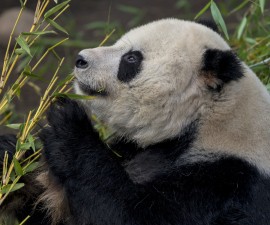
It has been a couple of months, but I’m happy to report that giant panda Yun Zi is now on exhibit for guests to view. Sunday, May 13, was his first day back, and he was putting on quite a show for our lucky guests in the morning. A perfect Mother’s Day treat for our visiting mothers!

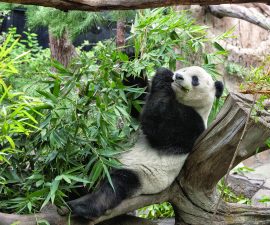
Since father Gao Gao was in that exhibit previously, Yun Zi spent the morning scent marking the entire exhibit. He also was running around and rolling around to show off and have fun. When the front viewing area was redone a couple of years ago, our keepers tried to keep panda youngsters in mind when they requested more climbing structures. Yun Zi is the perfect example of why that is so important for a young, growing panda. He was climbing, scent marking the tree and going all the way to the top to smell the air. It was really an amazing morning for our youngster!

Those who had not seen him in a while were shocked at how big Mr. Yun Zi has gotten. Currently, his weight is about 180 pounds, and he is looking like he is going to be rather tall as well. Since he is 2½ years old, he could potentially continue growing for a couple more years. But just like his parents, his weight can fluctuate with weather changes and different life changes (hormones). Many of our guests told me about being at the San Diego Zoo two years ago and seeing a little baby; they wondered what had happened to him. Just about all of them were astounded when I’d point to Yun Zi and say, “Here he is!”

If you get the chance, please come and visit him, and take a peak on the Panda Cam. As for mother Bai Yun, she has been moved into the north exhibit, which is currently closed to our guests, so that when we begin doing our thermal imaging on a regular basis she is easily accessible. Our first thermal imaging procedure has already taken place; Bai Yun cooperated beautifully, and we have nothing to report. Please remember that it can take a while for our researchers and vet staff to see anything that would indicate a pregnancy. Paws crossed!

Anastasia Horning is a panda narrator at the San Diego Zoo. Read her previous post, Panda Narrator at Safari Park.

21

Dependable Pandas

Open the door, please!

Neither snow, nor rain, nor gloom of night…

We’ve had some wild weather here in Southern California for the past few days. Saturday night, a blustery storm passed through. Blowing winds, downpours of rain, some hail, and snow in the mountain areas left everything sopping wet and cold. But Bai Yun woke up Sunday morning ready to breed. And as always, our trusty male Gao Gao was up to the job.

The exhibits were slick with mud and water, and Bai Yun seemed a little less cooperative than usual. Gao Gao had to convince her to drop her shoulders to the ground to allow him to get the best positioning. Bai Yun weighs 231 pounds (105 kilograms), and Gao Gao is a mere 163 pounds (74 kilos) by comparison, so “convincing” involved a lot of nibbling on her shoulders and pulling at her midsection to get her just right.

Fortunately, he succeeded in his endeavors, and at 8:04 Sunday morning, we had our first copulation of 2012. It’s possible that more of these will follow. Ideally, we would like to get one or two more breedings out of this pair today to make this season a success. Even if the weather remains a challenge, Gao Gao has proven that stormy conditions will not stay him from the swift completion of his appointed duties.

Suzanne Hall is a senior research technician for the San Diego Zoo Institute for Conservation Research. Read her previous post, Getting to Know You, Again.

82

Getting to Know You, Again

Bai Yun's not interested in food these days!

Giant panda Bai Yun continues to march through estrus. Her rate of scent marking has increased from its baseline of roughly .08 bouts per hour to a whopping 43 bouts per hour this morning. She is walking through water quite a bit, a behavior that likely aids in scent dispersal, as her drippy fur leaves a trail of wet odor while she motors about. She continues to ignore her bamboo and even spit yams back at the keepers during a hearing study trial today. She’s fussy, and squirmy, and acting totally normal for a female in estrus.

On the physiological front, she has also given signs of her status. Her genitalia have enlarged in size and changed color. Swabs of her reproductive tract indicate that its composition of cells is changing in a manner consistent with an approaching breeding window. We are running hormone samples when we can get them, but so far today Bai Yun hasn’t given us enough urine to submit something to our lab.

We were thinking we might need to open the howdy gate between our adults in a few days, in anticipation of a breeding window. However, this morning Bai Yun could hear Gao Gao bleating on the other side of the wall between them. She was very attentive to his calls, and she even bleated back several times. It’s unusual for her to be bleating already, her “advertising stage,” remember? She should be silently marking. But no, she was clearly telling us this morning that she was ready to get reacquainted with her mate.

In response, this afternoon we opened the howdy gate for visual access. Gao Gao, as anticipated, was happy to check out the view, and several times he quietly approached while Bai Yun was nearby. For her part, our matriarch sat in close proximity to the gate for the better part of half an hour. She sent him mixed signals: a chirp (which says “come hither”) followed by a bark (which means “stay away”). Sometimes she sat still looking at him; sometimes, she charged the gate. Back and forth she went between the vocalizations. When she chirped, Gao Gao would stay close, sniffing at her and the gate. When she barked, he would leave, but only for a little while. He knows not to be gone too long.

In the coming days, Bai Yun’s barks and ambivalence will give way to more solicitous behavior. Gao Gao will help us keep track of her change of status with his behavior. Follow along on the Panda Cam, and see if you can see that change yourself. We’re looking for rear-present, tail-up behavior on her part. With him, we are looking for a consistent presence at the gate, even pulling at the gate when she is near. When she starts backing into that gate with her tail raised, you’ll know it’s time.

Suzanne Hall is a senior research technician for the San Diego Zoo Institute for Conservation Research. Read her previous post, Who You Calling Old?

35

Pandas: Shaved Bellies

Bai Yun enjoys a meal during snow day in December.

If you’ve been to the San Diego Zoo’s Panda Trek recently, you may have noticed our giant pandas sporting a new look. Our female, Bai Yun, and our male, Gao Gao, have shaved bellies, and their arms have shaved patches of fur. Don’t be alarmed! There is nothing wrong with them.

Recently, both of our adult pandas went to the San Diego Zoo’s Jennings Center for Zoological Medicine for pre-breeding and general physical exams. With breeding season right around the corner, we want to make sure that Bai Yun is healthy and ready for what the future will bring. During breeding season, Gao Gao will smell Bai Yun in heat and become much more active. He also will get excited and begin to scent mark in a handstand position. Bai Yun, in the meantime, will begin scent marking her exhibit with great enthusiasm to promote the message that her hormones are beginning to shift and that breeding season is here.

When (and if!) we put the adults together, it is a carefully orchestrated process. As in the past, we would let them have access to a mutual fence so they can check each other out. If Bai Yun is ready, and Gao Gao is at the fence, the gate dividing them would be opened by the Panda Team. Breeding may span two or more days, but the actual time that they are together is much less than that. Gao Gao is typically the one who lets us know that he is finished with breeding season by not soliciting attention from our female and not showing interest in breeding again.

As many of you know, Bai Yun is 21 years old, which is older for a female in breeding years. Bai Yun is not technically in estrus yet, and she is still being observed closely. The Panda Team will start collecting urine samples so that our reproductive physiologist will be able to monitor her hormone levels. The oldest female that we know of who gave birth in a managed-care facility was 21 years old. There is a very good chance that Bai Yun may not breed or get pregnant this year. We will do our best to keep our guests and fans updated, but we want everyone to keep that information in mind.

Anastasia Horning is a panda narrator at the San Diego Zoo. Read her previous post, Our Growing Takin Herd.

62

Musical Chairs, I Mean Bears!

Yun Zi enjoys a holiday "tree" during snow days last month.

If you come to the San Diego Zoo’s Panda Trek right now you may see a familiar face on exhibit. It’s Yun Zi! Currently we have the two boys out for public viewing as we continue construction projects in Panda Canyon, so we have shifted Bai Yun into our indoor area where she has access to her bedroom, sun room, and garden room. Our keepers say that she is loving life, enjoying the quiet time to herself, and eating quite a bit.

Outside, however, Yun Zi is making his presence known. One his first day back in the main viewing area he was re-scenting the enclosure that Gao Gao is usually in. He had a busy day performing handstands on the walls, trees, and, of course, his water dish. He was exhibiting some great behaviors, covering up another male’s scent!

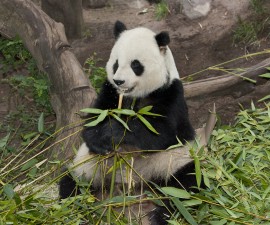
Yun Zi now weighs 158 pounds (72 kilograms) and is filling out nicely. He is eating very well and I think he looks very impressive. Yun Zi is doing training with his keeper as often as possible so that as he gets bigger and older we can perform some of the same husbandry activities as we do for his parents, such as blood draws and ultrasounds.

Gao Gao is also doing very well. He has moved into Bai Yun’s normal enclosure (the left-side exhibit), and the first day he was also re-scenting the walls. As Bai Yun doesn’t do handstands like males do, most of Gao’s time was spent marking the ground and the top of the cave where she likes to sleep. Gao Gao is currently at 165 pounds (75 kilograms) and has been enjoying his panda bread. As some of you know, he has had a few dental issues, something older pandas often experience, but is doing well. The bread is offered to increase the amount of fiber in his diet by incorporating bamboo in a softer form. He currently gets very thin bamboo, and his panda bread is being mixed with some of those yummy leaf eater biscuits to add taste and, of course, nutrition.

The boys have not been too curious about the bear next door, although I have seen each put his head back, smelling the air. Of course, there could be a number of things to smell, but having another male that close should let us see some interesting behavior in the future. As Gao Gao is not much of a climber, it will most likely be Yun Zi who will be looking over the wall. Yun Zi is a very good climber, and when Bai Yun was next door, he would often climb up the tree and smell the air. Bai Yun has never really exhibited any interest in her son next door. I know for some that may seem cold, but these animals are naturally solitary and really do prefer to be by themselves. Watching them on a daily basis, I can honestly say that they thrive in their natural state.

Come see Yun Zi soon, and please don’t mind the construction going on right now!

Anastasia Horning is a panda narrator at the San Diego Zoo. Read her previous post, Construction in Panda Trek.

40

Not-So-Cold Winter for Pandas

Yun Zi enjoyed snow day last month.

Many of our San Diego Zoo visitors have been surprised at how active our pandas have been. It doesn’t really get that cold here in San Diego; therefore, our bears don’t experience the winter season like cold-weather bears. Giant pandas do not hibernate in the wild, and here at the Zoo we don’t see that behavior, either. Typically, if the weather does get cold, we notice an increase in the pandas’ intake of bamboo, and we see their weight increase by up to 15 pounds (6.8 kilograms). This year, we are seeing a fairly slow increase of weight in Yun Zi, and our adults are staying relatively stable, weight-wise.

As for our pandas’ activity levels, everyone is a little different. Bai Yun has been taking this time away from cubs to sleep and relax, and it’s funny how many moms that come to the Zoo can entirely relate to her! She has been eating quite a bit, but then again she always did. This is the first winter that she has not had a cub with her since the winter of 2002. I know so many of you are wondering if we are going to breed Gao Gao and Bai Yun again, and we cannot answer that at this time.

Gao Gao has been up to his normal antics, eating whenever he gets the chance and taking a nice nap in the hay or shavings that our keepers have provided. He is eating his bamboo plus his regular extras: apples, carrots, yams, and leaf eater biscuits. He is also eating panda bread, which is made of ground-up bamboo, and our keepers sometimes put the leaf eater biscuits in the bread as well. Overall, Gao Gao is doing well.

Yun Zi has been on a roller coaster of active levels and naps. Since he is still young, and still growing, we will continue to see his activity levels fluctuate until he is full grown. This past Tuesday, he moved to the front viewing area and Gao Gao was moved into the back, and we had quite a bit of scent marking and interest in what and who was in there before. On Wednesday, Gao Gao went back into the main viewing exhibit, and he also went through the motions of re-scenting his territory.

Anastasia Horning is a panda narrator at the San Diego Zoo. Read her previous post, Talkin’ Takins.

36

Yun Zi: Burst of Energy

Remember when trees had nothing to fear from Yun Zi?

Through the years that I’ve narrated at the San Diego Zoo’s Giant Panda Research Station, I have had the pleasure of watching three panda cubs grow from birth to their departure to China. I’ve seen their personalities come out and have watched them bloom into sub-adulthood. There are the early months where mobility is limited and dependent on Mom, and there are the times when learning to walk and climb can become overwhelming for a cub. Some of my favorite moments with the youngsters have been between the ages of 2 and 3 years. The cubs will often have days where they become extremely energetic and behave in dramatically different ways than what our Zoo guests are accustomed to. Yun Zi has hit this stage, and I have to say it’s a blast to watch him!

The last couple of weeks have proven to be very interesting. Yun Zi has been running around the exhibit several times, dashing up and down the climbing structures several times, and running through his pool, making his exhibit a nice slip n’ slide for our poor keepers. Having done keeper work with our Panda Team for a few years now, I can honestly say that muddy, wet bamboo can be very difficult to clean up! There was one morning when a keeper and I went into Yun Zi’s exhibit to clean and just stood there for a second to take everything in. He had thrown bamboo all over the enclosure and defecated in spots that can be difficult to clean. Yun Zi had even decided to break several of the branches off of a new tree that had just been planted. What usually is a 30-minute cleaning job maximum with two keepers turned into a good hour.

Needless to say, we do our best to provide enrichment for our animals to keep them busy, but at this particular age it is very common to see the kids turn into decorators and change their exhibit around in some way. As Gao Gao and Bai Yun are in the main viewing enclosures, Yun Zi is occupying our north exhibit for the time being (usually open to guests from 9 a.m. to 2:30 p.m.).

Hope everyone has happy holidays!

Anastasia Horning is a panda narrator at the San Diego Zoo. Read her previous post, Hello, Gao Gao.

Note: Our December Animal Care Wish List is now posted and includes an opportunity to donate toward a sturdy, panda-proof tree at $10 increments. Every little bit helps! Thank you.


69

Changes for Gao Gao

It has been awhile since Gao Gao’s surgical procedure, and he has had a good recovery from it. The surgical scar on his belly healed up nicely, and he has returned to being a mobile, active bear. Thankfully, the results of the procedure allowed us to rule out many significant issues that might have been causing his intermittent gastrointestinal (GI) issues, so we can rest a little easier knowing our bear is not suffering from a serious medical condition.

We are, however, working to determine the ultimate source of those GI issues. From time to time, Gao Gao gets a little sluggish and skips a meal or two. After a day or so like this, he rebounds and returns to his normal self. We aren’t quite sure why. It doesn’t appear to be related to the production of mucous stools, something common to pandas living in a zoological setting. Nonetheless, while we are working to get to the bottom of his health issues, the keepers are providing him with extra-attentive care.

We are looking at a multitude of potential contributors to his condition, including dietary influences and the wear pattern on his teeth. Unfortunately, our old boy has a number of dental issues, and we are suspicious that some of the wear and tear in his mouth may be the cumulative result of a life of bamboo consumption. Though we provide him with excellent dental care, bamboo is a pretty tough, fibrous plant to process, and years of stripping and chewing the culm has left Gao Gao’s teeth pitted and worn down.  We saw a similar pattern with our old male, Shi Shi, whose teeth were also worn down in his later years. It’s possible this amount of wear is now making it harder for Gao Gao to properly process his bamboo, leading to his GI issues. As a result, our veterinary and nutritional staff have prescribed various treatments to improve his bamboo-feeding experience: limiting the size of culm strips he gets and feeding bamboo shoots and bamboo bread, for starters.

Though our boy is fully recovered from his procedure, work to help Gao Gao get his system back on track continues. However, you can come wish him well throughout the process, as he returned to the main viewing exhibit over the weekend.

Suzanne Hall is a senior research technician for the San Diego Zoo Institute for Conservation Research. Read her previous post, Gao Gao: Road to Recovery.

77

Su Lin: Back to Bi Feng Xia

Su Lin at 16 weeks old at the San Diego Zoo. What a cutie!

For some critically endangered species, reintroduction is the ultimate goal of captive-breeding programs. While some species have greatly benefited from reintroduction programs, there are inherent challenges associated with developing a protocol that has a good chance of success. As we all know, the giant panda is critically endangered, and our Chinese colleagues are developing a reintroduction program for the species. Months ago, Su Lin was identified as a potential participant in this program. While not slated to be reintroduced to the wild, Su Lin was chosen to live in a large, naturalistic enclosure with the hope that she would give birth, raise her cub to about 18 months of age with minimal human intervention, and then her cub might have eventually been released. For all of us who’ve followed the panda conservation program over the years, this was a great honor and reflected our pride in Bai Yun and Gao Gao’s San Diego Zoo-born offspring.

We have worked closely with our colleagues in Wolong for over 15 years. In that time we have learned so much, and our collaborative, science-based conservation program has become a model for other species. I think I speak for everyone on the Panda Team when I say that we have tremendous respect for our colleagues in Wolong and tremendous confidence in the care and effort they have put into this amazing program.

Recently we learned that Su Lin would be heading back to the breeding base at Bi Feng Xia with her cub. While we were disappointed that this cub, Bai Yun and Gao Gao’s descendent, would not be a candidate for reintroduction, we were confident that the right decision was made. While Su Lin’s new status as a mother made her a good candidate for this program, her inexperience was evident, and the staff at Wolong decided that it was best for both Mom and cub to be returned to Bi Feng Xia base.

Ultimately, we know that the goal that we all share is that of giant panda conservation. And luckily, for those of us who feel a connection to the individual pandas that we’ve gotten to know, this lofty goal includes taking the best care possible of each and every panda in our collective care.

Megan Owen is a conservation program specialist with the San Diego Zoo Institute for Conservation Research. Read her previous post, Polar Bears: Getting Ready.

Update: October 31, 2011. The co-head of our giant panda conservation program, Ron Swaisgood, is currently in China and saw Su Lin and her cub. He reports that Su Lin and baby are healthy and doing well and that her move seems to be for logistics. She may return to the release pen for her next cub.

36

Bai Yun Returns

Here comes that gorgeous panda, Bai Yun!

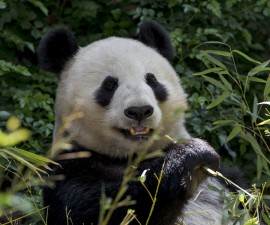
If you have visited the San Diego Zoo’s Panda Trek lately, you’ve noticed that we have shifted our pandas around. Gao Gao is now behind the scenes enjoying the sweet taste of his bamboo bread during his recovery from his medical procedure, and Bai Yun is back in the main exhibit. I am really happy to be watching Bai Yun again. She is so majestic looking, and guests say that she is one of our most photogenic pandas because you can usually see the whites of her eyes against her black eye spots.

The beautiful Bai Yun has not taken much notice of Yun Zi, her two-year-old son who is in the adjacent exhibit, since she moved back to the main exhibit. Bai Yun goes about her day searching for treats hidden around her exhibit, eating her bamboo, and resting her head on her favorite rock “pillow.” Giant panda females only raise their young until they are about 18 months old, and then the cub gains independence. In the wild, if the cub tries to stay with the mother bear too long, he might get chased away. Since Bai Yun would not have the option of chasing her cub away at the Zoo, the juvenile panda goes through a more gradual weaning process. The mother bear and youngster spend less and less time with each other until they gain full independence from one another.

Yun Zi has been an independent young panda so far and spends his days playing, turning somersaults, eating his bamboo, and napping after a meal, just like his mom. After the initial weaning, it was important that the pandas didn’t see or smell one another for quite some time, but currently they don’t seem to be taking notice of each other. I would have to say that Yun Zi took more notice of the takins moving near the pandas than of his mom.

Michelle Penick is a panda narrator at the San Diego Zoo. Read her previous post, Pandas and Trees.