Uncategorized

california condor

2

Condor Chick: First Health Exam

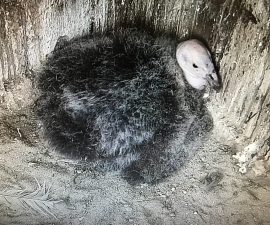
Saticoy at 45 days old

On April 23, California condor chick Saticoy received its first health exam. We normally conduct this exam at around 45 days of age. The goal was to obtain a blood sample for our labs, administer a vaccine for West Nile virus, inject a microchip for identification, and weigh Saticoy.

The first step in this process is to separate the parents from the chick. Of course, the parents (father Sisquoc and mother Shatash) don’t want any invaders in the nest and do their best to defend the chick and keep it safe, as all good parents do. Adjacent to the flight pen, we have a shift pen, used to safely and calmly move large or dangerous animals from one area to another. We offer all of the condors’ diet in the shift pen, so Sisquoc and Shatash are very comfortable entering it for every meal. We shifted Sisquoc into the pen and kept him there until after the exam. From his shift pen, he cannot see the nest area, so he was unaware that we were even in his nest, thus keeping him very calm. He ate and waited patiently until he had access back into his flight pen.

Shatash was not shifted but instead was able to see us go into her nest. We posted one keeper in the nest entryway to keep Shatash out while another keeper entered the nest and covered little Saticoy with a towel. This is the first time that Saticoy had ever seen a person and was understandably nervous and defensive, hissing and lunging at the intruder. Once under the cover of the towel, Saticoy calmed down. The chick was then brought into the adjoining vestibule where our veterinarian staff was waiting.

First, the veterinarian obtained a blood sample from Saticoy’s leg. This sample was sent to the lab to make sure the chick is healthy. Also, our geneticists can determine if Saticoy is male or female from this sample. Next, a vaccine for West Nile virus was administered. This disease originated in Africa and was accidently introduced to North America by humans. North American animals, including condors, usually don’t have a natural immune response to the virus, so we are trying to give all chicks a head start. A microchip was injected under Saticoy’s skin. This chip is a form of identification. It’s the same kind of chip you can get for your dog or cat at the veterinarian. The veterinarian then gave a quick health assessment, checking Saticoy’s eyes, nares (nostrils), beak, feet, legs, wings, and abdomen. Lastly, we weighed Saticoy to make sure the chick was growing on schedule.

While the exam took place, a third keeper was able to enter the nest to clean the camera domes and make sure there were no hazards in the nest cavity. The whole exam, from capture to release, took only seven minutes!

Once the exam was over, Saticoy was returned to the nest, and Shatash was allowed to approach and check on her chick. As previously mentioned, Saticoy was rightfully disturbed by this process, despite our best intentions to minimize stress. Although we feel bad that Saticoy was so nervous, it is actually good for the chick that it was not comfortable in our presence. We have to keep in mind that we don’t want Saticoy to become accustomed to or feel reassured by humans; we want the chick to be a wild condor, uninterested and wary of humans, so that it may someday fly free in California, Arizona, or Mexico. Condors that show an affinity for humans seldom survive in the wild. For several minutes, Saticoy showed defensive posture, hissing at everything, even Mother.

Shatash slowly approached her chick and nervously preened it, eventually soothing it. That is the reason we shifted only one parent; we wanted the other parent present to calm the chick after the exam. About 10 minutes later, Saticoy was showing proper begging behavior, resulting in a feeding session from Shatash. With everyone appearing calmer, Sisquoc was let out of his shift pen. Approximately 20 minutes after that, he also went in to feed Saticoy. If he was alerted to our presence and was upset, he would have immediately entered the nest to check on his chick.

So far, the health exam looks to have been extremely successful. The blood work showed that Saticoy is healthy, and the veterinarian’s initial inspection looked great. The chick’s eyes and nares were clear, the feet, legs, and wings were solid, and vitality was strong. Saticoy weighed 7.7 pounds (3.55 kilograms) and was approximately the size of a bowling ball. Lastly, today we received the sex results from the Genetics Lab: Saticoy is a boy!

Ron Webb is a senior keeper at the San Diego Zoo Safari Park. Read Ron’s previous post, Condor Chick: 30 to 45 Days. Watch the chick daily on Condor Cam!

5

Condor Chick: 30 to 45 Days

Flashback: This chick, similar in age to Saticoy, was hand-raised in 2001. It was the 100th chick to hatch at the San Diego Zoo Safari Park.

See Ron’s previous post, Condor Chick: 1 to 3 Weeks.

At approximately 1 month of age, California condor chick Saticoy should weigh around 4.4 pounds (2 kilograms). The parents, Sisquoc and Shatash, may start leaving the chick alone overnight while they sleep near the nest. If the weather is still cool or it’s raining, the parents may continue to brood overnight until the weather improves. Even though the parents are increasing their time away from the chick (and hence, Condor Cam), they remain VERY vigilant and protective of their nest and, especially, their chick. Some field biologists have even seen wild condor parents chasing black bears away from the nest area!

Up until now, the chick has been scooting around the nest on its tarsal joints. We refer to that as a “tarsal crawl.” It’s not uncommon, at this age, to see the chick standing all the way up on its feet, teetering around the nest, holding its wings out for balance. As its legs get sturdier, the chick may even approach the parent, begging for food. The “wing-begging” behavior we’ve been seeing will get more pronounced: lots of wing-flapping and head-bobbing as it tries to position itself in front of the parent.

It is possible that the parents, who are offering larger quantities of food per feeding session, might be providing a small amount of fur/hair in the chick’s diet; part of the adults’ diet includes rats and rabbits. Condors can digest just about every part of the animal they eat, except for fur. This fur accumulates in the digestive tract and is eventually regurgitated as waste. We refer to this as casting. A condor’s cast is composed of predominantly fur, whereas a cast from an owl has fur and bones; owls can’t digest bones, but condors can. We have seen condor chicks as young as three weeks cast hair pellets. When the chick casts, it throws its head forward several times, mouth open, until the pellet is ejected from its mouth. It can look like the chick is in trouble, but it is perfectly normal and good for the chick.

At 44 days of age (April 23), Saticoy will get his/her first health exam at the San Diego Zoo Safari Park. We will obtain a blood sample to make sure the chick is healthy and send a portion of this sample to our Genetics Division, who can determine if Saticoy is male or female. Also, during the exam we will weigh Saticoy and inject a transponder chip as a form of identification. It’s the same kind of chip you can get for your dog or cat at the veterinarian. Most importantly, this exam allows us to administer a vaccine for West Nile virus, a disease that originated in Africa and was accidently introduced to North America by humans. North American animals, including condors, usually don’t have a natural immune response to West Nile virus, so we try to give the chicks as much of a head start as we can.

This exam will be the first time that Saticoy will see humans, so it will naturally be disturbing for the chick. We try to be quick (9 to 10 minutes) to minimize the disturbance. Additionally, we will keep Saticoy covered with a towel to reduce exposure to humans and to provide a bit of security. Sisquoc and Shatash are usually away from the nest when we perform the procedure in order to keep them as calm as possible. We don’t want Saticoy to become accustomed to or feel reassured by our presence; we want this chick to be a wild condor, uninterested and wary of humans, so that it may someday fly free in California, Arizona, or Mexico.

Saticoy will look very large at this age compared to how big the chick was at hatch, but remember that this little one is still less than half of her/his adult weight. There is much more growth and fun to come!

Ron Webb is a senior keeper at the San Diego Zoo Safari Park.

1

Condor Chick Named!

Six-year-old condor lover Hend with her condor plush, Sophie

We were blown away by the amount of thoughtful name submissions we got on Facebook and Twitter for the California condor chick growing before our eyes on Condor Cam. We were also surprised by the outpouring of support we got for our conservation efforts. Some participants even shared touching stories about condors and why it’s so important to save them from extinction. One such story was from the person who suggested the winning name, Emma Apple.

When Emma posted her name suggestion, Saticoy, she mentioned that her six-year-old daughter, Hend, is a huge condor lover. “She teaches everyone she meets about their plight,” Emma wrote, “She wants to be a ‘Condor Rescuer’ when she grows up.”

It’s not every day that we hear of a six-year-old with such an infatuation for an animal that isn’t typically thought of as cute and cuddly, so we had to know more. “People are always surprised at this little girl’s passion for these (oft perceived as) ugly [birds],” Emma wrote. “Ever since learning of their plight in a documentary about the Grand Canyon a couple of years ago, she’s just been completely enamored by them. I think she’s the coolest. How many pink-loving, 6-year-old condor fanatics are there?”

We agree. Hend is the coolest. When asked why she thinks it’s important to save animals from extinction, Hend replied “Because there would be no more and it was too late for dinosaurs and my brother loves dinosaurs. If there was an important species that’s endangered and they were extinct, we wouldn’t get the things that they give us.” Well said.When Emma told Hend that her name suggestion was the winner, Hend apparently shouted “This is one more step to being a Condor Rescuer!” and continued to release her plush condor named Sophie (after Sophie Osborn, who wrote a book about condors) “back into the wild” all evening. We were told that her condor plush has died of lead poisoning, been nursed back to health and been released back into the wild many times, so the one that comes as a prize will be in good hands.

Hend’s love for saving these beautiful birds gives us hope for the future. If every kid her age shared just a fraction of her passion, we would be in good hands. Thanks to everyone for posting name suggestions and voting for our condor chick’s name. We’re lucky to have such engaged supporters. Stay tuned to Condor Cam to watch little Saticoy grow up!

Matt Steele is the social media planner for San Diego Zoo Global. Read his previous post, Rhino Poaching Increases at Alarming Rate in 2011.

2

Chick Watching: Hatch to 1 Week

This California condor chick is being fed by a hand puppet. The chick you see on Condor Cam is fed by its parents.

Condor Cam at the San Diego Zoo Safari Park provides an opportunity to watch the inner workings of a condor nest, an experience usually limited to keepers and field biologists. We hope you are enjoying it as much as we are! Many viewers have expressed some concerns while watching the little California condor chick hatch and grow. Thank you so much for caring! The chick’s development and health are progressing perfectly. Parents Sisquoc and Shatash are doing an excellent job! Being able to determine if all is well in a nest can often be difficult, especially if you don’t have anything to which you can compare. I’d like to provide some developmental and behavioral guidelines that we consider to be normal for a healthy condor family.

The chick hatched on March 10, 2012, weighing around 190 grams (6.7 ounces). The hatching process can be grueling, so afterward the chick usually rests a lot and is brooded, or sat on, by the parents. We often call this “sitting tight,” as the parents are providing protection and warmth, especially while the newly hatched chick is drying off. With the chick being weak and wobbly, it often is hard to feed, but that is okay. The chick is getting nutrients from the yolk sac that it absorbed into its belly just before hatching. After about a day, the chick can hold its head steady, and the parents start providing food. They eat food that we offer out in the flight pen and then bring it to the chick in their crop (a bulge in their esophagus where they can store up to 3 pounds or 1.3 kilograms of food). The food is regurgitated for the chick, providing a warm and nutritious meal. Mmm! The diet we provide varies, depending on the day, but it can include rabbits, rats, trout, beef spleen, and ground meat. While the chick is very young, it is often difficult to witness a feeding, since the parent is standing directly above the chick, blocking the camera’s view. If you see a parent slightly bobbing its head while standing over the chick, feeding is occurring. Feeding sessions are fairly short for small chicks, since their crops are only about the size of a lima bean.

Both California condor parents provide care for the chick. This drive is very strong, and it’s not uncommon to see the parents vying for time with the chick, especially immediately after hatching. This happens in the form of leaning into each other, pushing one’s way onto the chick, scooping the chick from one parent to the other, or nipping at neck skin or tugging at feathers to get the other parent to move. Usually, one parent acts more dominantly and controls the interactions a little more than the other parent. This time, mother Shatash took this dominant role, despite her being much smaller than Sisquoc. Other years, we’ve seen Sisquoc take this role. We interpret this periodic shift in dominance, and the other bird’s acceptance of this shift, as a very good trait in a condor pair. As time passes after hatch, they settle into a routine, and the nest exchanges become much calmer.

One viewer concern was the number of times that the chick was stepped on by the parents. In many species, ranging from hummingbirds to elephants, babies get slightly squished by the parents. Usually, it’s just a minor misstep, and the baby lets the parent know with a brief vocalization. Condors are no different or no more fragile. They are very hearty little chicks! As young as four days of age, we have seen chicks sifting through the sand in the nest, picking up items on their own. We’ve even seen chicks swallowing small pieces of their eggshell for dietary calcium.

At the end of the condor chick’s first week of life it weighs around 300 grams (10.5 ounces). It is getting much stronger but is not venturing around the nest very much yet. Coordination is improving, and we can witness social interactions with the parents: nibbling, preening, and nuzzling. Every once in a while, you may see the chick quivering, almost like it has the hiccups. It is actually vocalizing. Condors don’t have a true voice box, or “syrinx,” like other birds, but they can make crude, primitive vocalizations. Adults may grunt, wheeze, or hiss. Chicks can make a high-pitched, scraping squawk, usually when begging or out from under the parents for too long.

The next few weeks of development are very exciting, not just for the condor family, but for any of us watching on the Condor Cam. Stay tuned!

Ron Webb is a senior keeper at the San Diego Zoo Safari Park. Read his previous post, Condors: Big Day Approaching.

6

Vote on Name for Condor Chick

Condor Keeper Ron Webb checks on the little chick via Condor Cam.

Our California condor chick at the San Diego Zoo Safari Park is doing great! It always amazes us to see just how quickly these chicks grow up. The time has come to give Sisquoc and Shatash’s chick an official name. We received so many amazing name suggestions, that we had a hard time paring the list down to three. Many of the 93 names we received were so great that they had already been used on condors before! After eliminating those, we spent a long time researching the remaining suggestions so that we could learn the Chumash definitions behind the names. Once we had our list narrowed down to the eligible choices, it was time for us to pick our favorites. After a lot of discussion, we decided on these three choices:

Maxa’lam – “To hold a festival, to throw a party.”As the person who suggested this name said, “Condors are a reason to celebrate!” (Submitted by Jen M. “@folkeye” via Twitter)

Saticoy – “It is sheltered from the wind.”
Our friend who suggested this name wrote, “It is a protected baby, sheltered from the dangers to its species by the captive breeding program. It also goes well with the parents’ names.” (Submitted by Emma Apple via Facebook)

Moyomin – “To be mischievous.”
Those of us who work with this endangered species know condors can be playful, and that’s what makes this bird a treat to work with! (Submitted by Zoelle Egner “@zoelle” via Twitter)

Congratulations to our three winners! Now the choice is yours. From today through the end of the day on Monday, April 2, you have a chance to vote on what our little condor will be named. Wish we could tell you if the chick is male or female, but we won’t know for some time, so pick the name you like best based on the meaning of the name. We think any one of these will be perfect for this chick. Vote here!

Thank you for your suggestions and for your continued support!

The Condor Team

6

Condor Cam: The Proud Parents

Sisquoc is an experienced father.

We’re excited to offer a unique view into a California condor’s nest via our new Condor Cam. I’d like to share a bit of information to help you enjoy what you’re seeing and how to tell “who’s who” on the Cam. If you have any questions about what you’re seeing, feel free to ask them in the “Comments” section at the end of this post, and we’ll do our best to provide answers.

The male condor in this pair is named Sisquoc (pronounced “SISS-kwawk”), and he is wearing yellow wing tags (#28). The female is called Shatash (pronounced “shah-TAHSH”); she is not wearing any wing tags. Sisquoc is the largest California condor at the San Diego Zoo Safari Park, weighing in at 25 pounds (11 kilograms). He is visibly larger than Shatash.

At 2 weeks old, Sisquoc was fed by a keeper wearing a condor puppet.

Sisquoc was the first California condor ever hatched in a zoo (his egg was laid in the wild and brought to the San Diego Zoo for incubation). He emerged from his shell on March 30, 1983, and news of his hatching triggered an outpouring of mail from all over the world. Congratulatory letters were sent by conservationists, zoos, governments, school classrooms, and many individuals, all wanting to help with the condor project. And look at him now—time flies, doesn’t it?

Shatash hatched at the Los Angeles Zoo, one of our partners in the condor recovery program. Her father was the first condor to hatch at the San Diego Zoo Safari Park (again, from a wild-laid egg), back in 1985.
Sisquoc and Shatash have been paired together since 1993. This is their 21st egg. Fifteen chicks have hatched, and Sisquoc and Shatash have raised six of them themselves. The other chicks were raised by keepers who used a condor puppet so the chicks wouldn’t imprint on their human caretakers. Sisquoc and Shatash have proven to be great and reliable parents.

California condors tend to be monogamous and share ALL nest duties: incubating the egg, brooding the chick, feeding the chick, and defending the nest. Throughout incubation you will see Sisquoc and Shatash take turns sitting on the egg to keep it warm. You may see them roll or turn the egg periodically. This gentle egg movement is crucial for the development of the growing embryo.

Incubation bouts can be very short: just a few minutes or birds can sit for two or three days, so don’t be alarmed! Sometimes the parents will sit together in the nest. Condor eggs incubate at about 98 degrees Fahrenheit (36 degrees Celsius). Their egg was laid January 12, 2012, and we are expecting it to “pip,” or start hatching, after 55 days of incubation, around March 7, 2012. We can’t wait!

Ron Webb is a senior condor keeper at the San Diego Zoo Safari Park.

1

“Carrion” Research to the Next Level

James holds a California condor egg produced in the wild.

I have been on the trail of the California condor for some years now. And what a trail it is, from shimmering cactus-studded deserts baking under the relentless hammer of the Mexican sun to the desolate jagged beauty of the Sierra Mountains to the ancient alpine forests of northern Baja California, Mexico, crystallized beneath a silencing white shroud of fog and snow. These are the worlds that this mighty vulture surveys from on high with its enormous black wings, extraordinary eyesight, and an inquisitive and engaging intelligence.

As remarkable and inspiring as the condor and its wild domain are, so too are the heroic efforts of San Diego Zoo Global and its many dedicated partners that have struggled for decades to haul this unique species back from the abyss of extinction. And from a population of just 22 birds at their lowest ebb in the 1980s, this year we have reached a landmark 400 wild and captive condors.

I joined the San Diego Zoo Institute for Conservation Research to provide vital information on the social behaviors, movement patterns, and habitat requirements of the condors that we are reintroducing to their former range in Baja California. Collecting data on free-ranging condors is notoriously difficult. Fortunately, I am equipped with the latest cutting-edge technologies that have opened an unprecedented window onto condor behaviors within their natural environment.

A GPS device attached to the condor's wing provides researchers with valuable information about the bird's flight patterns.

Miniature GPS devices attached to the bird’s wings continuously acquire and transmit data on their flight patterns. An array of weather stations positioned throughout the condor’s range provides detailed information on the meteorological conditions that influence their movement. Analysis of satellite imagery and digital topographic models of the condor’s environment enables me to construct a detailed picture of their habitat use and requirements.

Remote video cameras installed at condor feeding stations allow me to observe and analyze their social interactions without having to wait in the field or disturb the birds with my presence. The science of ecology is being driven by these examples of technological advances, and San Diego Zoo Global prides itself on being a leader in the application of state-of-the-art techniques for conservation research.

My studies have confirmed that condors range hundreds of miles in a single day while exploring and searching for food carcasses and that these flights are typically conducted by subadults before they settle into core home ranges. Condors are able to fly for long periods without expending much energy by harnessing the strong thermal winds generated by mountains and ridgelines to soar with the efficiency of an albatross. Condors also possess a remarkable spatial memory map, returning from long-distance flights directly back to their communal roosts.

There is still hope for this magnificent bird.

I have found myself amazed by condor curiosity and playfulness, as well as the complexity of their tight-knit society. Birds that do not develop appropriate social behaviors at an early age do not successfully integrate into condor society, and such ostracism results in their early demise from predation or starvation. By characterizing the dynamics of condor “pecking orders,” I have determined which attributes confer high or low dominance status. I have learned that each bird has a personality, and condors act much like human teenagers and politicians—continuously jostling and squabbling for rank, resources, and respect.

Some have argued that disproportionate levels of resources are directed toward condor recovery. Indeed, after a field season of freezing temperatures, putrid carcasses, and obstreperous equipment, I have on occasion questioned my own involvement. However, when you stand on a mountaintop or a canyon and this magnificent buzzard with its 9-foot wingspan suddenly swoops over you and completely owns the sky, all sense of doubt immediately evaporates and is replaced with awe, admiration, and hope—hope for the survival of the species and hope that future generations will also have the opportunity to experience condors in the wild. In an age of extinction and loss, the condor is a vital link to our increasingly diminished ecological heritage, an iconic expression of evolution’s genius, and a much-needed example of a conservation success story.

James Sheppard is an ecologist at the San Diego Zoo Institute for Conservation Research. Read his previous post, Wild Condor Chick Gets Own TV Show.

View our own California condors on our new Condor Cam!

1

Wild Condor Chick Gets Own TV Show

A California condor watches over his chick in the family's cave in Baja California, Mexico.

Recently, conservation scientists and managers from San Diego Zoo Global’s California Condor Recovery Team successfully installed an autonomous video camera system inside the cliff-face nest site of our new wild-hatched condor chick in Baja California, Mexico—for the very first time! This high-tech field video system consists of a tiny, low-light, weatherproof camera that sends images via cable to a separate recording box equipped with a memory card. The batteries powering the unit are constantly recharged by a portable solar panel, so once the unit is set up, it can record video footage for weeks at a time. We acquired the video recording unit through a generous grant provided by Judy Wheatley, a member of the Zoo’s board of trustees.

Okay, great, so you have a neat video camera – but how do you install one in a condor nest high up in the mountains? With a lot of sweat, grunt-work, and no fear of heights!

I acquired and set up the unit and transported it to the condor nest site with the assistance of program manager Mike Wallace and Mexican field staff Juan Vargas and Mohamed Saad. To minimize disturbance to the condor family, the camera installation trip coincided with the condor chick’s scheduled health exam and vaccination, so also present were the highly experienced and capable vets Jeff Zuba and Fernando Sanchez.

Early on a very hot Baja summer’s day, our team set off to inspect the chick and install the video camera. With pounds of scientific and veterinary equipment strapped to our backs, as well as climbing rope and gear and plenty of water, we slowly and carefully wended our way down a steep, cactus-covered scree slope toward the nest. The chick’s parents had chosen their real estate well, and it took us many hours of hard slog just to get to the top of the cliff where the nest was located. The chick has a spectacular view that looks out across a mountainous vista covering remote valleys and ranches all the way to the Pacific Ocean.

At the staging site, we set up our equipment in preparation for the descent into the nest and the health inspection. While the chick was being examined and vaccinated, Juan rappelled with the camera down into the nest and bolted it into the roof of the cave. The resulting panoramic view of the nest now enables us to monitor the chick’s development as well as the behaviors of its parents. In this short video clip, you can see the chick’s proud dad (condor #269) in the foreground. The chick then pops up behind him and flaps its short, stubby, developing wings. The video is in black and white because the camera is specialized for extremely low-light conditions, such as those experienced inside a cave.

The condor program has its fingers crossed that this chick will successfully fledge and make its first flight out of the nest in the coming months to join our wild condor population. This is just one example of how modern technology and scientific research is improving the San Diego Zoo’s ability to effectively manage and expand the reintroduced condor population in Mexico.

James Sheppard is an ecologist at the San Diego Zoo Institute for Conservation Research. Read his previous post, Measuring Wind beneath Condor Wings.

0

10 Reasons for Hope

The International Union for Conservation of Nature (IUCN) estimates that the current extinction rate for species on our planet is more than 1,000 times the rate it would be naturally, thanks to human factors. Climate change is implicated in reductions to water availability in ecosystems and ice in the Arctic. These days you only have to turn on the television to have a front row seat for the environmental disaster unfolding in the Gulf of Mexico. Everywhere you look, the news about the state of nature seems gloomy.

Working to make positive change in protecting rare species and their habitats is not an easy task. It takes the efforts of trained experts, working collaboratively, often on limited funds and against a ticking clock, to ensure the survival of a portion of our planet’s biodiversity. It requires the support of people and governments who believe in the value of such work. And it relies on the fundamental belief that such actions can make a difference. In short: it takes hope.

On May 21, Endangered Species Day, the San Diego Zoo’s Institute for Conservation Research will celebrate by launching its new initiative, “10 Reasons for Hope.” This effort draws attention to some of the successes we have had as a means by which to inspire us all to continue to fight the good fight. Our reasons for hope highlight projects making a difference in both wild and captive management of species at risk.

Several projects have contributed to increasing wild population numbers via reintroductions or translocations. The Institute has long been involved with the efforts to turn around the decline in California condor numbers; we have seen the wild population increase from 22 to 180 birds in recent years. In Hawaii, more than 200 puaiohi have been released into native forests. Close to home in Southern California, the numbers of endangered kangaroo rats have increased through translocations into good habitat. Without the work of our staff and partners, and the support of governments and communities, these species would have continued on their trajectory toward extinction. Now, we have witnessed the reversal of those trends.

There have also been significant achievements in managing captive populations. We have developed a screening lab for the chytrid fungus, which has devastated wild populations of amphibians the world over. By testing samples in captive populations, we can ensure their survival, and wild populations can be supplemented with animals from breeding programs. We helped launch Genome 10k, an effort to sequence the genomes of vertebrate species that will allow for better treatment of zoonotic diseases in both wild and captive animals. And the number of giant pandas in zoos and breeding centers worldwide should reach 300 this summer, ensuring a self-sustaining captive population.

Here’s something we can all be a part of: connecting our children to nature. There is an international movement to get kids out of the house and onto the trails, beaches, and parks in their area. Fostering this connection will ensure a future generation of environmental stewards, people who care enough to support conservation objectives. We can all participate by introducing our children, or other young relatives or friends, to the wilds in your own backyard.

The news of the world can be depressing, and the constant barrage of pleas for assistance or action on behalf of the world’s declining species and habitats can feel overwhelming. But take heart. In some places, and in big and small ways, efforts are making a difference. Our reasons for hope offer clear examples of how the battle can be won and how it is being won in many different ways. We invite you to allow a little hope to seep into the gloom and doom by visiting the 10 Reasons for Hope page. The future of biodiversity on the planet depends upon those who allow that spirit to guide them to action on behalf of us all.

Suzanne Hall is a senior research technician for the San Diego Zoo’s Institute for Conservation Research.

0

Putting the “Odyssey” in Elephant Odyssey

Columbian mammoth

Columbian mammoth

Imagine walking through Southern California 12,000 years ago. Believe it or not, the surrounding plants and landscape wouldn’t be much different than the natural surroundings you see today. However, the diversity of animals would rival that of modern-day African savannas. It might be difficult to visualize a family of Columbian mammoths traversing across the local terrain or a teratorn (relative of the modern-day condor) gliding along the air currents of the foothills with its 12-foot wingspan.

Giant ground sloth

Giant ground sloth

Elephant Odyssey is named so because it will literally be an odyssey through time as you enjoy the bioclimatic zone of Southern California, 12,000 year ago. During the Pleistocene epoch, North America was alive with a vast wealth of animals that is unmatched on this continent today. Herbivores like the large-headed llama, dwarf pronghorn, ground sloth, and Columbian mammoth, once roamed with many other grazers and browsers of the time. Saber-toothed cats and American lions were both carnivores that dominated their territories as they raised their young and hunted their prey. Daggett’s eagles and Merriam’s teratorns were giant birds that soared, scavenged, and hunted throughout the area.

Elephant Odyssey brings you back to this time of mammoths by exploring what has been discovered through fossil finds across Southern California. You will first experience an active mock tar pit and fossil dig that will be staffed with interpretive volunteers. This will bring forward the concept of what once lived here and will also establish their extinction and what may have happened to these animals.

As you move from the fossils toward the animals of today, you will get to come into contact with life-size replicas of some of the species that lived during the Pleistocene. Life-size statues of a mammoth family, a ground sloth, and many more will be situated to allow your natural line of sight to pick up the living counterpart in the distance, visually bridging time.

Merriam's teratorn

Merriam's teratorn

Wandering through Elephant Odyssey, you will experience today’s living counterparts with the animals of 12,000 years ago. The diversity of species will span the globe and also bring to the forefront what is happening to these animals in their current environments. Some may be in danger of going the way of their Pleistocene ancestors while others might have stable populations at this time. Still others, like the California condor, may even have been on the brink of extinction recently but are making a comeback.

Of course, there are other elements and aspects to Elephant Odyssey, but hopefully this will give you an idea of what to expect as we start our odyssey on May 23.

Rick Schwartz is the San Diego Zoo’s Elephant Odyssey Ambassador.

Read Rick’s previous blog, Elephant Odyssey Opens In Two Months.