Uncategorized

African elephants

257

You May Call Her Qinisa

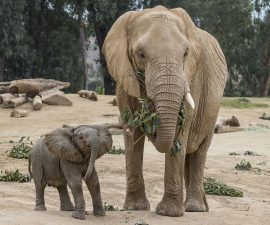
Little elephant Qinisa is one cute girl!

You can stop calling her baby girl or not! But if you want to call the Safari Park’s female African elephant calf, who was born on August 28, with her official name, here it is: Qinisa, a Siswati word that means to act with energy, act determinedly, fulfill one’s word, or speak the truth. The name is pronounced (!) EEN-EE-seh (! is a tongue pop instead of a q sound).

Her name is very fitting, as Qinisa has been determined (successfully, I might add!) to develop fastest of the 12 calves born to the herd of African elephants at the Safari Park. At only one-week-old she was sucking water into her trunk and using it to pick up objects like sticks. I watched Qinisa do that today, and she sure seemed like a pro! This dexterity has not been seen at such a young age, according to Curtis Lehman, San Diego Zoo Safari Park animal care manager. This skill had been documented after a couple of weeks of age among the other calves.

She has mastered her nursing technique!

Qinisa seems to be spending the least amount of time nursing compared to the others, but she obviously seems to be getting more than enough milk from her mother, Swazi! Curtis thinks she may have also mastered how to nurse quickly, since she is averaging a weight gain of 1 kilogram (2.2 pounds) per day. The calf has gained 40 pounds (18 kilograms) in her first 21 days of life. She’s growing much too quickly for my personal taste, but just right for normal calf development.

The Elephant Team is still documenting Qinisa’s developments. They were out today with clipboard in hand taking notes every time she nursed. Beside her quick learning curve, they also observe how other elephants interact with her. The other elephants interact with Qinisa whenever Swazi allows it. Big brother Mac is playing nice; then again, he’d better, or Mom would have a word or two with him. Apparently, the adult females only interact occasionally, since they know to keep their distance from a protective Swazi, the herd’s matriarch.

But our two young female baby-sitters, 6-year-old Khosi and 5-year-old Kami, seem to have the most access to the calf and continue to compete for baby-sitting rights. Kami and Emanti get to hang out with the trio of Swazi, Mac, and Qinisa overnight, so Kami has the upper hand to get more baby-sitting time. Kami was never far away from Qinisa while I watched this morning. She was so gentle with the calf, I couldn’t help but smile. Swazi seems to now be taking advantage of the two baby-sitters and wanders away from Qinisa when she naps, but not for long. If Qinisa wakes, Swazi comes back quickly.

Yadira Galindo is a senior public relations representative for San Diego Zoo Global.

240

Elephant Moves

Elephants Connie (in front) and Shaba at their new home at the San Diego Zoo.

Many people have been asking why we conducted such a large-scale, multi-zoo, multi-elephant transfer. It is an appropriate question. This operation has been in planning for several years. It begins with the original rescue of the elephant herd from a scheduled cull in Swaziland back in 2003. Our plan was to prevent the elephants from being killed, to protect the land and help other species by removing the elephants, and to improve the reproductive potential of African elephants in North American zoos. We succeeded in all three.

When the African elephant breeding program at the San Diego Zoo Safari Park started becoming successful, we began to consider how to best manage a growing population. We wanted to maintain female calves with their mothers for life and male calves until adolescence; this is natural in the wild, but not the norm in zoo populations. Typically in the wild, if a herd becomes too numerous it will split down matrilineal lines, and new bulls will sire future offspring. To do the same, we needed to identify a zoo that could be the recipient of roughly half of our herd’s females, their offspring, and the most appropriate bull. This facility needed to have a state-of-the-art facility, well-trained staff, appropriate climate, management program that mirrored the one our elephants were already used to, and be relatively close to San Diego. The Reid Park Zoo in Tucson, Arizona, worked very hard over several years to meet those criteria.

We chose to send to Reid Park a breeding group of elephants to their brand-new elephant facility and receive from them their two elephants, Connie and Shaba, into our Elephant Odyssey facility at the San Diego Zoo, where we specialize in caring for older elephants.
The selection of the best animals to send to the Reid Park Zoo was very difficult, and not just because of the close relationship we have developed with all of them. The decision had to balance various factors: who created the best social group in Tucson and in San Diego, what demographic and genetic factors were most important, and who are the best trained elephants in the herd. In the end, the decision was made to send Mabu, Lungile, Litsemba and her two calves, five-year-old Impunga and one-year-old Tsandzikle (Sundzu). This move was made in the best interest of the individual elephants and for the species as a whole.

Now that the transfer is complete, we hope that more African elephant calves will be born at both facilities combined than would have been born at just the San Diego Zoo Safari Park if the move hadn’t occurred. All of this effort is, of course, simply to ensure the survival of this amazing species.

Jeff Andrews is an associate curator of mammals for San Diego Zoo Global. Read his previous post, How Far Do Elephants Walk in One Day?

124

Loss to Elephant Family

Umoya with her son, Emanti, last year.

Today the San Diego Zoo Safari Park and its African elephant herd are mourning the death of the spirited Umoya. As the mother of two calves, Phakamile and Emanti, she will be missed not only by these two but by the entire herd and the keepers who have worked so closely with her since she arrived at the Park in 2003.

Moya, as we called her, was 21 years old. She was born in Kruger National Park and was one of the original seven African elephants rescued from Swaziland from being culled because of an elephant overpopulation. She could often be seen walking backward in the exhibit, making her quick to identify among the females. Moya enjoyed training sessions with the keepers and was a very quick learner. Most importantly, she was a good mother.

Phakamile, or Kami for short, was born in 2007. Moya immediately cared for her first calf, keeping her close and making sure she grew healthy and strong. In 2010, Moya gave birth to Emanti, a male who is now 18 months old and just at the weaning stage. He will surely miss the caring reach of his mother’s trunk and her protective instincts, but he will have his big sister by his side. Kami has always been a good sister and even a good cousin, reaching out to all the younger calves.

Because the elephants live a natural herd structure, we believe their social interactions will keep Emanti and Kami safe and cared for. Their “aunties”—the other adult females—have always been known to care for each other’s calves, even encircling the calves when they think there is a problem. Some calves have even been seen nursing from their lactating aunts. Emanti should no longer need his mother’s milk. He has been eating solids for quite some time, and if this morning was any indication, he should progress well among the social unit that is the Park’s African elephant herd.

As they do in the wild, the herd was offered an opportunity to mourn Moya. The elephants came to see Moya after she died—some touched her with their trunks and others simply stood by her. By her side were Kami and Emanti, but once the others began to walk away, the two youngsters followed their aunts to an adjoining yard.

Animal care staff discovered Umoya lying down with injuries when they arrived at the Safari Park early Thursday morning. The injuries indicated there might have been an aggressive interaction with another elephant. We thank you in advance for all your well wishes and know that you, too, will feel this loss.

Yadira Galindo is a senior public relations specialist for San Diego Zoo Global. Read her previous post, Valentine’s Day, Mammoth Style.

96

Elephant Birth Watch

Ingadze, shown here as a baby, will be a big brother soon!

African elephant Umngani is pregnant with her third calf, making her the San Diego Zoo Safari Park’s first soon-to-be three-time mom. We’re expecting a September baby, but her due date could be as late as October 8. Based on the results of her progesterone assays, we’ll probably start our volunteer night watches sometime next week.

We currently have 17 African elephants, and this will be the 11th calf from this herd (9 out of 10 births currently surviving). We have been bringing Umngani’s daughter Khosi, who turned 5 on September 11, and son Ingadze, who is 2½ years old, into the upper and lower holding yards every evening in preparation for the upcoming birth.

Curtis Lehman is an animal care manager at the San Diego Zoo Safari Park. Read his previous post, Our Newest Park Elephant.


17

Elephants: Calf of Umoya

Umoya and her son

As many of you know, there were some difficult circumstances following the birth of Umoya’s calf on May 12 of this year (see post, A May Elephant Baby) at the San Diego Zoo’s Wild Animal Park, so it’s been a big relief to their adoring and caring public, their keepers, and our veterinary staff that things have worked out so well for the both of them.

The little guy currently weighs 290 pounds (132 kilograms) as of July 4. He’s figured out some of the social hierarchy within the herd, namely “watch your step” around Swazi. He’s learning to play with half brothers Ingadze, Lutsandvo, and Swazi’s calf, born in April (see Newest Elephant Calf).

Nap time!

Umoya’s son is very easy to entertain if you have a hose in your hand. Big sister Kami shares the babysitting duties with Mom, but for the most part he stays pretty close to Umoya. Because of this, whenever Umoya ventures into the big pool, junior follows right behind her without any hesitation. If the water level is such that he can remain standing, he’s usually right underneath her, dipping his mouth into the pool for a drink or three (he likes to drink). If the pool level is higher, he’ll actually swim around her. If his head goes under, he’s already figured out the trunk-periscope thing, which is just hilarious to observe. He really loves the water, more than any of the other calves have at this age.

If you get the chance to come to the Wild Animal Park, make sure you visit the Elephant Viewing Patio for the 11 a.m. Elephant Rush and also later in the afternoon, when the elephants are more likely to be swimming in the pool. You might be lucky and get to observe a “Baby Pool Party” from a great vantage point. And if Umoya decides it’s time to cool off, you’re sure to see little munchkin #3 sliding in right behind her!

Curtis Lehman is an animal care supervisor at the San Diego Zoo’s Wild Animal Park.

20

Wild Elephant Kachikau

Kachikau and her calf

Kachikau was a large female elephant, approximately 30 years of age, and the matriarch of her family herd of 8. Her nature seemed to be one of a calm, reserved matriarch. Not once had we witnessed her show any signs of aggression or distress. She kept her calf close to her side and was an attentive mother, much to the pleasure of the young one, who seemed shy among the larger elephants.

Kachikau, second from left, strolls with her herd.

On September 25, 2008, during the harsh dry season, Kachikau was fitted with a satellite collar. In her herd were two young calves, the first one aged about two years and the other only a few months old. The youngest looked extremely thin, and at the time our vet thought that she would not survive the remainder of the season. However, six months later, when the herd was spotted in Botswana along the Chobe River, we were relieved to learn that not only did the young calf survive, but that she belonged to Kachikau.

Kachikau, second from right, and her calf in April 2010.

During the two years we followed Kachikau’s movements, she covered a 6,755-square-kilometer (2,608 square miles) area. The majority of her time was spent within the protection of the Chobe National Park, staying close to the river in the dry season but periodically crossing to feed on the grasses that occur on the floodplains. During the rains she roamed further, venturing into the forest reserves. The herd preferred the western side of the Park, which has the least amount of tourism traffic. However, when we observed her from our research vehicle, her family did not seem disturbed by our presence, sometimes walking within a few meters of us.

Occasionally, the herd would return to the forested area close to where we originally collared her. We believe these sporadic jaunts north were induced by the herd’s familiarity of the area and their desire for particular food sources. It was on one of these excursions that Kachikau was tragically killed.

The last time we saw Kachikau alive, she and her young calf looked healthy among several other elephant herds, forming a congregation of elephants nearly 300 strong. Only one week later, after tracking her in Chobe National Park, she crossed the river once again. We were surprised this time, only because the river was in full flood. Kachikau’s 2-year-old calf would have had to cross a 2-kilometer (1.2 miles) stretch of water with the support of the herd. Continuing on her track, Kachikau did not sway from a course that we had not observed before. To us, she had just returned to an area familiar to the herd. After 2 days, 17 kilometers (10.5 miles) from the river’s edge, Kachikau’s collar sent a GPS point from the same position. Upon discovering this, we immediately jumped in our vehicle and set out to learn why she was not moving. We were hoping that somehow the collar may have fallen off. We plotted a course on our GPS to ensure we could drive the vehicle in as close as possible to the data point. Within a few kilometers of the point, we decided there was too much surface water and had to hike the rest of the way in. Positioning ourselves to use the tracking antennae and placing the headset on, we looked up to see vultures fly from the ground into the sky. Our hearts sank, as we knew the inevitable: Kachikau was dead.

We examined the situation and all evidence as best we could. Her tusks were intact, so we believe it was not a poaching incident. We found no evidence of her herd or her young calf. We talked to the farmers that were closest to the location, and they reported that they were not having problems with elephants crop raiding, despite us noting they had no means of deterrence around their crops to stop any animals from doing so. There were no signs that Kachikau may have had any natural physical complications, either. Our initial assessment is that Kachikau had likely been shot when she crossed the river.

Unfortunately, this is not a rare occurrence. Villagers, farmers, and fisherman regularly shoot at elephants to either scare or intentionally harm them, in hopes to prevent elephants from entering fields, villages, or damaging property, such as fishing nets laid out across the river. The elephants are not necessarily actually doing the offense, but it is one method that people use to avoid potential conflict.

Kachikau’s death is tragic and sadly unnecessary. The issues surrounding the incident are extremely complex, but they threaten African elephants throughout the continent. We are currently working to address these concerns. Elephants Without Borders, with support from the San Diego Zoo, has started an ambitious new program to try to avoid these retaliatory killings and reduce human-elephant conflict. Our Elephant Conservation and Community Outreach Farming Project, the first project of its kind in southern Africa, ultimately aims at achieving a level of coexistence between elephants and people.

To support our elephant conservation work in Africa and learn more, visit the San Diego Zoo Global Wildlife Conservancy.

Kelly Landen is the director/program manager for Elephants Without Borders.

43

Welcome, Elephant Msholo!

Msholo reaches for some tasty leaves!

Msholo reaches for some tasty leaves!

On October 3, 2009, Msholo, an African elephant from the Lowry Park Zoo in Tampa, Florida, arrived to join the current herd at the San Diego Zoo’s Wild Animal Park. Msholo is one of the 11 elephants rescued from a scheduled cull in Africa’s Swaziland in 2003. He came from the Hlane Game Reserve in Swaziland; other elephants from that same reserve now living here at the Wild Animal Park are Swazi, Umoya, and Umngani.

We are working on plans to combine the elephant yards at the Park. However, the reaction will probably be like what happened when he was released from quarantine: we were all excited, but most of the elephants didn’t seem to care! The one exception was Mabhu, our African bull elephant.

Msholo has room service in his new bedroom at the Wild Animal Park!

Erin with Msholo in his new bedroom at the Wild Animal Park.

Msholo was aptly named, as his name translates into “appears from nowhere.” One of the first things we noticed was how quickly and silently he moved. Msholo has been fearless from the start. He quickly learned to shift from stall to stall and was even weighed a few hours after arrival. His transition was smooth, as his keeper, Tina, accompanied him from the Lowry Park Zoo. Tina remained with us for a few days to help acclimate Msholo to his new surroundings. After Tina left, our work with Msholo began.

Here at the Wild Animal Park, we train our elephants to place their trunk on our palm when asked. We can garner a lot of information from physical contact with the elephant’s trunk to help evaluate the training session and the animal’s comfort level. If the trunk is tense, it may mean the animal is nervous or perhaps getting frustrated. If the trunk is relaxed, the animal seems to be relaxed as well. This was very important to train initially, because in order to remove Msholo from quarantine, we needed to make sure he did not have tuberculosis. This is determined by doing what we call a “trunk wash.” Saline solution is squirted into the elephant’s trunk, the trunk is raised and then lowered, the saline pours back into a receptacle, and the sample is sent to a lab for analysis. This test is done three days in a row. We successfully trained Msholo for his trunk wash in less than three weeks, and on December 22, he was released from quarantine.

Msholo is a lot of fun to work with. He is eager to learn and is progressing very quickly. He is very agile and extremely adept at gathering his own browse. Once he had cleared the branches easily within reach, he then developed a new technique for gathering more browse: he would climb the wall and stretch his trunk as far as it would stretch and blow on the leaves, causing them to sway. He would then quickly grab the branches as they swung back down (see top image). He’s so smart!

Over the past few months, it has been really great to see how our relationship has grown and changed with Msholo. He has always been eager for attention and sessions, but was not as keen about being touched. Now his eyes get more relaxed, and he brings his head lower and tilts in for a few scratches. He also is learning to trust us more and more. The Tembo Stadium show arena is a great place for training sessions; however, Msholo doesn’t seem to care for it. Yet he chooses to stay with us and work through his discomfort rather than leave us to go eat his hay and other goodies out in his yard.

Msholo is a very sweet bull; it is easy to see why Tina and the other keepers at Lowry Park Zoo were so attached to him. If you haven’t had a chance to see the new bull, he is in the old Asian elephant yard (the former residents of that yard now live at the San Diego Zoo’s Elephant Odyssey). Hopefully, the yards will be connected soon, and in the future we can have some of Msholo’s babies running around, too!

Erin Ivory is a senior keeper at the San Diego Zoo’s Wild Animal Park.

Watch the Park’s elephants daily on Elephant Cam.
Read a previous post about the Park’s herd, Elephant Calf Talks the Talk.

NEW: Video of elephant calf born Feburary 14, 2010!

135

Elephant Calf Learns the Ropes

Umngani leads Ingadzi, Kami, and Khosi.

Umngani leads Ingadze, Kami, and Khosi.

If you haven’t made it up to the Wild Animal Park to see our new baby elephant, you’d better hurry: he is growing up fast! (See post, Baby Elephant.) At only 3 months of age, Ingadze is almost 400 pounds (180 kilograms) and is quickly learning the tricks to being an African elephant.

Just this past week he learned how to swim in the big pool. Using his trunk as a snorkel, he followed mom Umngani out into the deep end, doggy paddling the whole way with big sister Khosi and half sister Kami there to help. When they are in the shallow end, all the elephant youngsters like to dog pile onto one another; Khosi and Kami, always with a watchful eye, make sure the boys Impunga and Musi don’t play too rough.

Khosi and Ingadzi stay close to Umngani.

Khosi and Ingadze with Umngani.

Each day Ingadze grows more curious about his home. He is constantly picking up sticks and even tries to pick up rocks that are too heavy for him. He seems to enjoy water and learned how to drink with his trunk at a young age. Ingadze has many older siblings to look up to and learn from, but his two favorite pals are big sisters Khosi and Kami. Kami often leads Ingadze away from the adults, as if playing mom to him.

Ingadze, Kami, and Khosi follow Umngani.

Ingadze, Kami, and Khosi follow Umngani.

Ingadze is full of personality and spunk and seems to seek out playtime with the keepers. Being weighed every day to monitor his growth gives us extra time to spend with him, and he seems to enjoy the attention. Positive interactions now lay the groundwork for future training sessions he will receive once old enough to eat solid foods more regularly.

So make sure to come visit Ingadze and his growing family at the Wild Animal Park. Don’t forget your cameras!!!

Laurie Amador and Mindy Albright are keepers at the Wild Animal Park.

Watch the Wild Animal Park’s elephants daily on Elephant Cam.

0

Botswana: Making a Difference

One of the elephants we tracked.

This is one of the elephants we saw in Chobe National Park.

Rick is sharing his adventures in Africa with staff from our conservation partner, Elephants Without Borders. Read his previous post, Botswana: Chobe River.

May 9, 2009 (Saturday)

Yesterday, Friday, we did our last bit of filming and said our goodbyes to Chobe National Park. After we got the shots we needed, Shea Johnson, the San Diego Zoo’s videographer, and I had a great time just watching several herds of elephants come down to the river from the surrounding area. I’d have to say one of my favorite things to watch was the littlest babies rolling and playing in the mud. It was also very interesting to watch the mothers, aunts, and older siblings stand protectively around and over the youngsters while they played.

On our last visit to the national park we also got to see a couple of jackals, a small herd of giraffes, four or five warthogs ,and countless impala. As the sun set on another beautiful day, we headed back to the lodge. It was a very good way to say good-bye to such an amazing part of the world.

Today, Saturday, was spent wrapping up our last-minute work and packing for our long trip back. We are scheduled to sit in on a talk Dr. Mike Chase is giving about Elephants Without Borders (EWB) this evening. Needless to say, I am looking forward to that, especially after seeing certain elements of his work first hand.

We have had a very productive trip and thanks to Dr. Chase and Kelly Landen, we were able to get a lot of things done in a little amount of time. Tomorrow we fly from Kasane to Gaborone and we’ll spend the night there. The following morning we will take the first flight out to Johannesburg and then connect to our long flight back to the States.

Shea gets video footage of me talking about Africa.

Shea gets video footage of me talking about Africa.

If there is any one thing that I have taken away from this trip, and if there is any one thing I wish to share with you, it is this: one person can make a huge difference. The proof is in the Zoo’s conservation partner, Elephants Without Borders. Dr. Michael Chase had a dream and a passion to do something for the majestic elephants of Africa. His dream and passion is shared by Kelly, and now the two of them are making a difference, a huge difference. I strongly suggest you learn more about their work, and the work of people like them, that are out there doing something about conservation.

With that, I have to say goodbye to Botswana, or maybe just a “see you later.” What a wonderful country.

To support our elephant conservation work in Africa and learn more, visit the San Diego Zoo Global Wildlife Conservancy.

Rick Schwartz is the San Diego Zoo’s Elephant Odyssey Ambassador

0

Botswana: Still Tracking Elephants

The collared female and her herd

The radio-collared female and her herd

Rick is currently in Africa to see elephants. Read his previous blog, Botswana: Tracking Elephants.

May 5, 2009 (Tuesday afternoon)

After lunch, we headed back the way we came, checking a side trail off of the firebreak trail for elephants, but still no luck and no sign of the elephants we were looking for. We turned back toward the river, some 60 miles (100 kilometers) away and decided we would meet up with the river at the point where the Chobe National Park starts and then drive in to the park from there.

Once we got closer to the river, but still outside of the national park, we came across small villages. These were mostly a couple of shacks and paddocks for goats and cattle. We did cross paths with two men walking back to their village and had a chance to talk to them. Initially, Dr. Mike Chase of Elephants Without Borders (EWB) talked to them in Setswana (sounds like: Set-z-wana), the native language spoken in Botswana. They then started to speak in English, which allowed the rest of us to understand the conversation (though I must admit I love the sound of Setswana and the cadence of the speech patterns).

Mike asked about their cows and goats. He asked if they had seen or heard any lions and if they were afraid that they might be in the area. The two men seemed to feel the lions do not come near their village. And they said, with no reserve, that they shoot lions that get too close. With that in mind, I suppose the lions have learned to stay away, plus food looks to be abundant there in the neighboring national park, at least right now. Then Mike asked about elephants: had they seen any or had they heard any in the last few days? They said that since the rains, there have been no elephants, but before the rains elephants did come through here on the way to the river. We thanked them for their time and for allowing us to take their photos.

We continued north through a small town (I believe it was either Mabele or Muchenje). It was right on the river, and we could see obvious signs that elephants had been through the area. From there we headed east and drove a bit to get to the gate that takes us back in the Chobe National Park again.

The radio-collared female (right) with her calf and a herd-mate

The radio-collared female (right) with her calf and a herd-mate

Driving through the park along the dirt trails, I could tell that Mike and Kelly Landen (also with EWB) were disappointed that we never came across the collared elephants. Though Kelly was still trying to locate a signal from the top of the truck, it seemed the two of them were a bit deflated. Then, as we were about an hour away from camp, we saw more elephants at the base of a monstrous baobab tree. As we approached I am not sure who pointed it out with excitement first, Mike or Kelly: the matriarch of the herd was indeed one of the collared elephants we were looking for! We soon discovered that the reason the radio signal was never picked up as we approached was because the collar’s frequency was off by a bit.

We were able to line ourselves up so as they traveled they walked right past us. This allowed Mike to observe the herd and Kelly to photograph the herd for documentation. We were also fortunate enough to get a very good look at the newest baby, which looks to have been born in late December. Once the herd moved on, we did dung sample collecting. This is all sent to a lab to analyze hormones, DNA, stress markers, and, of course, to find out what they have been eating. Kelly explained to us that the goal is to collect samples from the collared elephants and the herd throughout the year to see how things change or stay the same.

After all was said and done, the whole mood of the group changed. We did it! We found one of the collared animals, and we saw that she was well, as was her herd and her new baby. Samples were collected and all of it was documented by Shea Johnson, our Zoo videographer! We celebrated by finding a good spot further down the river to watch an amazing sunset after an amazing day.

To support our elephant conservation work in Africa and learn more, visit the San Diego Zoo Global Wildlife Conservancy.

Rick Schwartz is the San Diego Zoo’s Elephant Odyssey Ambassador.