Uncategorized

Search Results for ‘Xiao Liwu ’

223

Why all the Panda-monium?

Zoo InternQuest is a seven-week career exploration program for San Diego County high school juniors and seniors. Students have the unique opportunity to meet professionals working for the San Diego Zoo, Safari Park, and Institute for Conservation Research, learn about their jobs and then blog about their experience online. Follow their adventures here on the Zoo’s website!

cameron_W3_picOn Thursday, I went to the Zoo not only with the InternQuest program, but also with my biology class. The field trip was specifically to visit the Zoo’s collection of insects, but we were eventually given a worksheet and allowed to drift about sightseeing. My group and I tried to visit the newest panda baby, Xiao Liwu, but were thwarted by time constraints and the dozens of panda fans waiting in Panda Canyon.

While we didn’t get to see the purportedly adorable Mr. Wu, we certainly had a front-row view of the “panda-monium” that has helped bring the species back from extinction. People of all ages and backgrounds were eager for a peek at the famous black-and-white bear. On their way out, many of them stopped in the shop to purchase a plush panda toy, a T-shirt, or any of the dozens of other panda-themed items. My friend bought a panda-patterned lanyard, and we didn’t even see the baby! We were surrounded by evidence that the conservation efforts focusing on giant pandas are going strong but, as Senior Research Technician Ms. Suzanne Hall told my fellow interns and I later that day, it wasn’t always this way.

Fifteen to twenty years ago, the habitat fragmentation of the giant panda was such that the species was right on the precipice of extinction. Humans struggled to help the species. In the past, every time a pair of twins was born in captivity, one of them would die because the demands of caring for two cubs was just too much for the mother panda. “When I started working with pandas back in 1998,” Ms. Hall said, “we didn’t even know what we should do to change what we were already doing….” Obviously, things have changed. The public can now bask in the presence of the San Diego Zoo’s sixth panda cub. But what, exactly, was it that changed? How did we go from the aforementioned precipice of extinction to crowds of panda fans coming to pay homage to the Zoo’s “little gift,” Xiao Liwu?

While pandas have always held mystery and magic for some, it seems to have started when China had the foresight to send its furry ambassadors around the world to different zoos. I am of the opinion that when the most innovative minds around the world can collaborate and share research and ideas, almost anything is possible. For example, in the event of the birth of twins, a mother panda will only care for one baby. Slowly, humans have learned to be excellent pseudo-mothers to the unlucky twin. Now, an incredible 95% of these twins survive. A sustainable captive population has been achieved, zoos around the world have had successful panda births, and scientists in China are working on reintroduction of individuals back into the wild.

Speaking of successful panda births, “even after six cubs, it’s still amazing,” Ms. Hall says of watching panda births at the Zoo. The first panda born at the Zoo, Hua Mei, was also the first to survive to adulthood in the United States. She has since gone on to have nine cubs of her own, including three sets of twins! Ms. Hall keenly remembers Hua Mei’s birth. “The mood here was euphoric. Everybody was so excited to be a part of that process.”

And this, the euphoria and excitement, is the driving factor behind “panda-monium”; it’s just so amazing to be a part of the process of saving such an awesome animal! People can really connect with pandas. Again, in the words of the eloquent Ms. Hall: “You conserve what you love, and you love what you know.” If you don’t know about a species, if you never have the opportunity to form a connection with an animal, why would you care if they were to go extinct? People know about pandas thanks to outreach efforts from organizations like the Zoo, and they care. This gives me hope for the future.

So, do you care about pandas? All species, pandas included, need not only your heart but your dollar behind them. If you really care about these fantastic animals, start asking questions! Ask the manufacturer if that nice bamboo shelving comes from sustainably harvested sources. Ask your favorite food brands if the palm oil in them is produced without the destruction of habitat. Ask about everything, and use your questions and your money to support a future where your children and grandchildren and great grandchildren get to wait in line to visit these creatures, too. Not only will they thank you for it, but the children and grandchildren and great grandchildren of Xiao Liwu will thank you, too!

Cameron, Conservation Team
Week Three, Winter Session 2013

0

Collaboration as Conservation

Zoo InternQuest is a seven-week career exploration program for San Diego County high school juniors and seniors. Students have the unique opportunity to meet professionals working for the San Diego Zoo, Safari Park, and Institute for Conservation Research, learn about their jobs and then blog about their experience online. Follow their adventures here on the Zoo’s website!

Cameron_RealWorld_W2What do a fertility clinic, a veterinary hospital, and a Burmese python hunt in Florida all have in common? Believe it or not, the answer is sperm! On our most recent InternQuest adventure, my fellow students and I visited the Reproductive Physiology Lab at the San Diego Zoo Institute for Conservation Research (ICR) to learn about all of the science it takes to make those cuddly little zoo babies.

As it turns out, the complexities of the world of reproduction go way beyond the standard facts of life, especially when endangered species are involved. Say you work at the San Diego Zoo, and you’re trying to breed a pair of animals. Sometimes, the animals in question just won’t cooperate. When you’re trying to save a species that has had its numbers drastically reduced and finding other individuals for your breeding program simply isn’t possible, you have to work with what you’ve got. But if “what you’ve got” is a pair of very uninterested pandas, you can’t just wait around and hope for a cub.

Fortunately, the scientists before you (including those at the ICR) have created fantastic processes dealing with things like sperm collection and artificial insemination. But before we can get to the fancy stuff, we have to start out with a basic understanding of the sperm that we’re going to be dealing with. How can we freeze it for storage without killing it? How can we tell if we have killed it by accident? How long does it last when frozen? The questions are virtually endless but there is only so much panda sperm in the world for you to perfect your techniques with. Also, nonprofits have limited budget. The solution to these problems brings me back to the unlikely combination of institutions that this blog post began with: the fertility clinic, the vet hospital, and the python hunt.

Incidentally, the sperm of the everyday house cat is very similar to the sperm of the more exotic felines, and the sperm of dogs is not only similar to that of other dog-like creatures (such as wolves and foxes), but also to bears. This is awesome for scientists like Dr. Barbara Durrant, Nicole Ravida, and Carly Young. These three women all work in the Reproductive Physiology Lab that we visited. Dr. Durrant is the Director of the Reproductive Physiology Division, while Ms. Ravida and Ms. Young are Senior Research Technicians. They have formed partnerships with many diverse organizations to collect resources used in their research. If your pet has been spayed or neutered in San Diego, there’s a chance that their removed ovaries or testes may have gone to the Zoo. They collect such organs that would otherwise be discarded from animal shelters, vet clinics, and feral cat centers and use these samples to help endangered species. Recently, they’ve even been able to start studying snake reproduction from organs collected from the Florida pythons. The government of Florida instigated a hunt of this invasive species in January of 2013, and the Reproductive Physiology scientists were allowed to take samples from the gathered pythons. They also get tools and other resources from human fertility clinics.

I was really surprised to hear that the ICR collaborates with other organizations in this manner, but it makes more sense when you think of the researchers and their conservation mission as a start-up company. They’re learning how to create a better product by tinkering with things that other “companies” cast off or have worked with in the past. Organizations dedicated to helping animals, however, are less inclined to be competitive with each other than those in the corporate world, and more inclined to help each other reach similar end goals. In a world where everyone’s bottom line is a better future for animals, innovative partnerships like these can thrive.

As my fellow interns and I discovered, many other innovative techniques in the lab have been developed specifically for studying sperm. Ms. Young showed me how scientists use a counter and a grid pattern, along with a five-point scale, to assess the motility (meaning the movement and speed) of thawed sperm. There’s a type of dye called eosin/nigrosin stain that, when combined with semen and examined under a microscope, will color dead sperm pink but leave live sperm their typical whitish color. There’s even a method of speeding up sperm motility by adding caffeine to semen! The scientists in the Reproductive Physiology Division are definitely putting their acquired resources to good use, and the San Diego Zoo has had lots of little chicks, cubs, and pups to show for it.

Next time I visit Xiao Liwu, the Zoo’s newest panda cub, I’m definitely going to have a different perspective. So much research goes into such a little ball of black and white fluff! And while all of this is amazing, a part of me wishes that all this wasn’t so critical. Don’t get me wrong, science is fun! But how did we get to this point? It’s fantastic that such partnerships exist, that such cutting-edge science is being used to save species. But maybe, if we as a people had stepped in earlier to curb things like habitat destruction, species like the panda wouldn’t be at the point where only the most advanced science can save them. Looking into the future, it’s just not possible to do breeding programs in zoos for all the species that are close to extinction. This means that if we really want to protect them in the long term, we need to do more for protecting their wild habitat in conjunction with the cutting-edge research in field like Reproductive Physiology.

Deforestation in particular devastates species and destroys entire ecosystems, but we all have our own small power as consumers to make a change. If you ever happen to be looking at bamboo floors, for example, ask a bit about their source’s sustainability. While scientists will do what they can (and then some), it’s also up to the rest of us to make our own partnerships within the business community, and support those who go out of their way to protect our planet and the other creatures that live here. I think that if we can come together with the python hunters, the reproductive physiologists, and the bamboo flooring installers, serious and meaningful change can happen for our planet.

Cameron, Real World Team
Week Two, Winter Session 2013

78

Adoption Package for Panda Fans

The 2013 T-shirt for Panda-Monium

The 2013 T-shirt for Panda-Monium

Hi, Panda Fans!

For those who cannot attend Panda-Monium 2013 (see post, Panda-Monium, we’ve put together a way for you to feel a part of it and support the San Diego Zoo and our wonderful giant panda family at the same time. The fabulous San Diego Zoo Adoption Team has come up with another panda adoption package just for Panda-Monium 2013! For those of you who are new, the Adoption Team has been creating a special adoption package just for us for a couple of years now. The adoption is, of course, symbolic.

The special packages includes an animal fact sheet on giant pandas, panda photo, and a one-of-a-kind Panda-Monium 2013 personalized adoption certificate you can print. The photo you will receive in the download is our adorable cub, Xiao Liwu! The adoption package is just $35. All the monies collected go directly toward enrichment items for the animals at the San Diego Zoo.

This is the link to the special Panda-Monium 2013 Adoption package. The San Diego Zoo staff and animals really appreciate our support!!

The Panda-Monium 2013 Event Coordinators

UPDATE: Please know that Panda-Monium 2013 is sold out, and there are no more T-shirts available for the event. However, the San Diego Zoo is now taking reservations for our annual Black & White Overnight, which features our famous panda family! Adults-only night (for ages 21 and older) is Saturday, August 3; Family nights are offered Saturday, August 17 and August 24. More info here…

196

Big Guy on the Block

Gao Gao is fueling up for breeding season. Little does he know....

Gao Gao is fueling up for breeding season. Little does he know….

As some San Diego Zoo guests are finding out, Gao Gao is the only panda out for viewing in the main exhibit currently (Bai Yun and her cub, Xiao Liwu continue to charm guests in the north exhibit until noon each day). As construction workers continue building Yun Zi’s artificial tree (which looks great so far!), Gao Gao has been entertaining us with his usual eating and sleeping, and a little extra movement right now.

Many of you know that Bai Yun would typically begin showing some hormonal behaviors as early as March for breeding season, and Gao Gao is letting us know that he is ready. He is currently eating more and gaining weight to show off to that gorgeous female he sees once a year. Of course he will not be breeding this year as Bai Yun is with a cub and not cycling. So the big question everyone’s been asking lately is, “What will Gao Gao do?” This year Gao Gao will just have to cope, and soon he’ll realize that he doesn’t smell a female in estrus.

As for next year’s breeding opportunities, we can’t say. To the best of our knowledge there hasn’t been a female panda to give birth over the age of 21, and Bai Yun will be 22 this coming September. We have observed an older male, Shi Shi, but watching a female for her entire breeding life has taught us so much about what is normal for Bai Yun. She is, after all, a big part of Gao Gao’s success as a breeding male—she is responsive and an amazing mother to her offspring.

Come see us soon, but do not be upset if you see Yun Zi off exhibit as his tree is being constructed!

Anastasia Horning is a panda narrator at the San Diego Zoo. Read her previous post, Pandas: The Big Boys.

83

Pandas: Yun Zi and Family

Yun Zi's done a lot of growing since he's 3rd birthday.

Yun Zi’s done a lot of growing since his 3rd birthday.

Panda Yun Zi, now 3 1/2, has been off exhibit while his new artificial tree is created. Keepers report that he is enjoying his time off exhibit with all the extra attention he gets from them! As you may know, Yun Zi has access to an enclosure that is next to the north exhibit where his younger brother, Xiao Liwu, and mother are during the day. This has provided great fun for Yun Zi!

In this off-exhibit enclosure, Yun Zi can scamper up a climbing structure high enough to peek into the north exhibit to see his mother and brother. And, he can peek at them and sniff them through the doors that connect the two exhibits. This is very exciting for Yun Zi but is not appreciated by his mother! While he is up high or at the door, Yun Zi calls to his family members with soft, friendly bleats. These are answered with barks and chomps from Bai Yun, basically telling him to back off. After all, Bai Yun’s priority is to protect her newest cub from any intruder, even if that intruder is her older son. Yun Zi takes these reproaches in stride–no harm done!

Many of you have been wondering about snow day(s). We are hoping to have the first snow day sometime next month, on a day that has not yet been finalized. When we have a firm date, we will post it on the Panda Cam page. More good news: thanks to generous donors, enough money has been raised to provide Xiao Liwu with an additional snow day on his birthday!

Debbie Andreen is an editor and blog moderator for San Diego Zoo Global.

615

A Tree for Panda Yun Zi

Just wait until Yun Zi sees his newest gift from panda fans!

Just wait until Yun Zi sees his newest gift from panda fans!

It’s official! We are going to start building Yun Zi’s artificial tree very soon! We have talked to our wonderful contractors and have decided on its design and placement. It is going to look like a large bonsai tree and will be around 15 feet (4.5 meters) tall. We are very excited and thankful for the donations from all the panda fans that went into this! Our Horticulture Team added a new Chinese elm tree in Yun Zi’s exhibit as well on Thursday, February 14.

We will be taking down Yun Zi’s current climbing structure to make room for the 6-foot (1.8 meter) base of the artificial tree. The tree will take approximately four weeks to build on site (yes, it will be built in the exhibit!) as long as weather conditions are ideal (no rain). As a keeper, I really enjoy exhibit renovations, and to help design something like this tree is amazing. I am really excited to see how all the pandas will enjoy it and use it (as you know, we sometimes rotate the pandas into different exhibit areas).

There is a lot of preparation that is being done to Yun Zi’s exhibit currently, so please be patient with us and understand that he will have to be off exhibit during this entire process. Gao Gao will remain on exhibit as long as he seems comfortable during the building phase of the tree (Gao Gao’s exhibit is right next to Yun Zi’s). Yun Zi will be in the indoor bedrooms close to his keepers, and during the day he will have access to the outdoor habitat next to Bai Yun and Xiao Liwu’s north exhibit. When you are visiting Mom and cub, look up in the trees and you might see Yun Zi!

Jennifer Becerra is a senior panda keeper at the San Diego Zoo. Read her previous post, Panda Cub: The Den.

227

Panda Cub: Growing and Climbing

Cub blah blah

Xiao Liwu practices his climbing skills.

Over the last few weeks, we have watched Xiao Liwu as he acclimates to having people in his environment and handles being on exhibit for longer periods of time. So far he is doing extremely well: sleeps most of the morning, wakes Mom up, and begins to play. As he grows, he has become more sure of himself and has gotten more daring as he plays with his mom, Bai Yun. Each panda cub born here has been different in his or her personality and growth patterns, and it has been an amazing experience watching so many cubs grow up here at the San Diego Zoo.

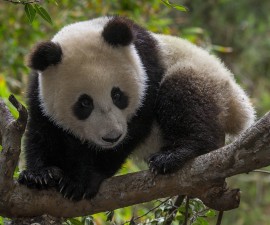
As Xiao Liwu grows and becomes more confident, one thing we are going to see is much more climbing. Right now there are tree guards on the tree in the north exhibit so that keepers can keep and eye on the baby and get him inside in the afternoon. Once the cub is able to move to the main exhibit, he will have access to the outdoor area all day and access to the nice, big tree. Cubs have to begin climbing at a young age as a defense mechanism, since their mothers go off to eat for several hours of the day. Being up that high makes it less likely that another bear or leopard can reach the cub.

Another behavior that will be fun to watch is the playtime between mom and cub. Through Bai Yun’s actions, Xiao Liwu learns to defend himself. As the baby gets bigger, these actions will change accordingly.

Xiao Liwu’s exhibit is open from 9 a.m. to noon every day for right now, and we will keep you posted on when this may be extended and when the cub may move to the main enclosure. Hope to see you soon at pandas!

Anastasia Horning is a panda narrator at the San Diego Zoo. Read her previous post, Panda Cub: First Days on View.

SNOW DAY UPDATE: Thanks to our generous Wish List supporters, we raised enough funds to have one snow day for little Xiao Liwu and his family. But we’d like to have another snow play date! Each $10 donation will go toward a second snow day for our “Little Gift” as we hope to raise more funds to have a second snow day in the summer for his first birthday! See our Wish List for details.

200

Panda Cub: Answers

Can he get any cuter?

Can he get any cuter?

During my visit with the Panda Team after Xiao Liwu’s exam (see post Panda Exam: Behind the Scenes), I had a chance to ask some of the questions panda fans sent in and have compiled the answers here. The best news? Xiao Liwu is doing great! He measured 34.6 inches (88 centimeters) from nose to tail, and his tail is 3.5 inches (9 centimeters) long. His size compares to that of sister Su Lin at this age. His claws became hard after just a few weeks and are now quite sharp! There may be another exam or two, depending upon Xiao Liwu’s willingness to participate. So far, he has been the most cooperative of the cubs, which is why we’ve been able to do so many exams with him. Once the exams stop, he probably won’t have one again until he is moved to another facility or is old enough to breed; any required exams will be done under anesthesia. Yun Zi hasn’t had an exam since his cub days.

And what about Bai Yun? She is the picture of health as well! Her appetite is in full bloom, as it usually is this time of year. She is not exhibiting any symptoms associated with arthritis or any other condition one might associate with an older bear. Keepers were surprised to learn that some panda fans consider her to be “cranky” with the cub, as they see her as a content mother bear.

For those who have a thing for paws, here's a close-up view of Xiao Liwus' hind foot.

For those who have a thing for paws, here’s a close-up view of Xiao Liwus’ hind foot.

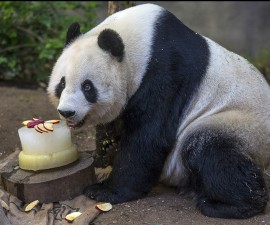
Xiao Liwu’s continued weight gain indicates that he is getting enough milk from his mother. Although our keepers don’t witness nursing bouts, it is obvious the cub is well fed. He is weighed twice a week, and the Panda Team keeps an eye on his growth curve. The cub is eating apples when he can get them; he has to be fast, as Bai Yun likes apples, too! He also has been nibbling on the hard leaf eater biscuits, and keepers are considering soaking them a bit to make them easier for the cub to chew. In China, young bamboo shoots arrive in the springtime, just when young cubs are ready to start sampling it. Pretty neat, eh?

Now, about those falls. The substrate in both the exhibit and the garden room is comprised of lomax, rather than dirt. Lomax is much softer than dirt, so when cubbie falls, and he will, it’s not on concrete or hard-packed dirt. When he falls, he may land on his feet, his side, or his cute little bottom, but panda cubs are born stuntmen: they know how to fall and roll to prevent injury. None of our cubs, including Mr. Wu, has EVER cried out after a fall. NEVER. If he were to cry, it would sound like a loud chirp. A fun story: there was a bird in the area that made a sound similar to a cub’s distress chirp. Every time the bird made this sound, Bai Yun would rush to Xiao Liwu, who was usually sleeping in the moat, to make sure he was okay. Bai’s ears are always on the alert, perked up for any indication that her cub may need help.

I'm diligently jotting down Mr. Wu's measurements for nutritionist Jennifer Parsons. The green door leads to the cub's bedroom; the fenced door opens into the garden room.

I diligently noted Mr. Wu’s measurements for nutritionist Jennifer Parsons. The green door leads to the cub’s bedroom; the door to the left opens into the garden room.

Keepers describe Bai Yun’s parenting style with Xiao Liwu as “more relaxed” and say she was much rougher with Yun Zi than they have seen with Xiao Liwu. If he needs her for help getting out of a tight situation or to nurse, the cub gives a soft cry. She has not yet dunked him in the pond, which has a few inches of water in it. When he is older, he may see Yun Zi or Gao Gao when passing through the tunnel system that connects the various exhibit and bedroom spaces, but he will most likely not be given access to look at them through the howdy gate, as males are not tolerant of each other.

When Xiao Liwu and Bai Yun go off exhibit for the day, they spend their time in the garden room, sun room, and bedroom areas, and usually sleep on the platform in the garden room. Although some fans have asked if an infrared light can be set up for nighttime viewing, we think that for now we’ll give our mother and son some privacy. Maybe for the next cub….

And how does our newest cub compare to his siblings? Keepers say Xiao Liwu is unique in that he is so comfortable in his surroundings and handles new situations very well. He is a tolerant, confident, and independent young rascal who really seems to enjoy the company of his keepers. He is curious and playful and has already started target training (touching his nose to a target for a reward) much earlier than his brothers and sisters. This is probably due to his love of apples and ear scritches from his keepers, which are used as the rewards! During my time with the Panda Team, I could tell that he is well loved and well cared for, by both his mother and his keepers. What more could a little guy ask for?

Debbie Andreen is a blog moderator and associate editor for San Diego Zoo Global.

316

Panda Exam: Behind the Scenes

Diagnosis: Acute Cuteness!

Diagnosis: Acute Cuteness!

I was privileged to attend panda cub Xiao Liwu’s exam Wednesday morning, January 30, my first ever, and I’m sure I will always remember my close encounter with Bai Yun’s Little Gift. I’d love to share this experience with all of you!

The exam was scheduled to begin at 8:30 a.m. I arrived early (naturally!) and greeted our photographer, Ken, videographer, Maria, and members of the Panda Team. A large piece of thin carpet had been laid down in the keeper work area where the panda cub exams are held, and a Kong toy, small plastic ball, leafy bamboo, a small log, and an apple slice were all in place, just as I’ve seen in the exam videos. I looked directly into the eyes of Matt Kinney, the attending veterinarian, and asked him to please make sure the six-month-old cub was fine after the many falls and tumbles he has taken. Panda fans want to know! See video below to  hear Matt’s findings.

At this time, Bai Yun was already out in the north exhibit, eating her bamboo breakfast, but the cub had been held back in the off-exhibit bedroom area for the exam. At 8:30, panda keeper Beth opened the door to the bedroom, scooped up the cutie, and placed him on the scale in the bedroom to get his weight. She called out his weight: 19.4 pounds (8.8 kilograms), and then carried him into the exam room. I gasped in delight when I saw him in her arms: Xiao Liwu in the flesh/fur/cuteness! My very first thought was how roly-poly he looked. My eyes got wet, but I tried to remain calm.

Our nutritionist, Jennifer, had been delayed, but Dr. Matt got right to work with the physical exam, as the team didn’t know how long Mr. Wu would be cooperative. The cub’s eyes, mouth, heart, body condition, and more were all checked, but I found myself watching (envying!) keeper Beth scratch and scritch the active cub to keep him in one place and keep those curious claws and teeth away from our doctor. Xiao Liwu seemed to love every minute of attention! He enjoyed the apple and grabbed onto the ball, but ignored that bamboo stuff and log. Yet the cub was silent throughout—didn’t make one peep the entire time!

I asked Ken to take some photos of Xiao Liwu’s paws, as so many fans have wondered if those paws are webbed like father Gao Gao’s. I wanted proof that they are not! Ken obliged, and I saw just a barely visible patch of gray fur on each hind leg. I tried to look for his black tail tip, but the cub kept his tail curled up. I was amazed at how close Ken and Maria were able to get with their cameras without bothering the special boy one bit!

And then, Jennifer arrived and handed me a clipboard: I was to jot down the measurements she took! That’s right: I would be doing something useful! I got to get down at cub level next to (not on) the carpet so I could hear Jennifer call out the different numbers (13 different measurements in all!). By then, Xiao Liwu was eager to explore more of the carpet. He came right over to me and TOUCHED THE CLIPBOARD WITH HIS NOSE! Now, I have a confession. Many of you were hoping I would have the chance to touch the cub and whisper sweet nothings in his ear, and I certainly could have at this point, but I did not. Why? It was such an honor to be there, to be this close, and I wanted to respect him as he was. It’s hard to explain! He was so near that I could SEE what he would feel like: a very coarse-haired chubby panda cub. It doesn’t get much better than that. Just the fact that he came over to me (and my clipboard) was all I needed to feel fulfilled (why are my eyes getting wet as I write this?). I hope you all understand.

Xiao Liwu was so unfazed by the whole exam thing, but we’ve promised guests that our little panda star can be seen on exhibit daily at 9 a.m. With a sigh, I watched as he willingly followed Beth back into the bedroom. From there, he continued ambling through the tunnel system and right on out to the exhibit, where I could see Bai Yun STILL munching on her bamboo but facing that door, as if watching for her cub’s arrival. I hear he feel asleep soon after!

I stayed behind to ask the Panda Team some of the many questions panda fans sent in, and I will share the answers in a future post. Right now, I’m still on a panda cub high!

Debbie Andreen is an editor and blog moderator for San Diego Zoo Global. Read her previous post, Panda Cub: Last Exam?

Click to enlarge chart

Click to enlarge chart

151

Panda Cub: Adventurer

Let's play some more!

Ready to play some more, son?

Xiao Liwu was very active today, January 29, in Panda Trek’s north exhibit. At first he was on top of his tree stump, sleeping away in the hay as cozy as can be. He slept for at least an hour and a half. The six-month-old finally woke up and began his adventure of climbing on tree limbs and exploring in the exhibit. He tried chewing on some bamboo leaves, just as mama Bai Yun does. I always notice he tries to copy Mom as much as he can. Wu then was interested in the plants, biting at the little branches and leaves. He’s very interested in the world around him. I always notice he will try biting on different leaves and branches.

Then he wanted to play with Bai Yun, which our guests love to see! They were wrestling and playing in the bin full of hay. He practices his bear skills while playing, just like humans learn while they play! One of my favorite moments of the morning was when he would run after Bai Yun and try to bite her on her bottom. He just makes me laugh!

Sometimes he can be so stubborn with his one-track mind, but it always makes for good stories and a great experience for our guests. As the morning came to an end, Xiao Liwu enjoyed playing in the bushes exploring the flowers and leaves. This “little gift” is quite a little adventurer!

Alyssa Medeiros is a panda narrator at the San Diego Zoo. Read her previous post, Panda Cub: Little Gift.