Uncategorized

About Author: Russ Van Horn

Posts by Russ Van Horn

4

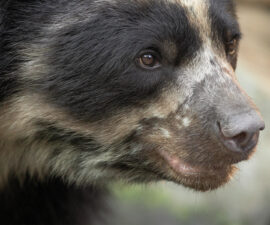
Andean Bears: A Surprising Discovery

A member of our collaborative field team watches a cliff for bear activity.

This summer my colleague Megan Owen and I were fortunate enough to have an intern working with us. Michael Forney was the John E. and Dorothy D. Helm Summer Fellow, working in our Applied Animal Ecology Division (see Summer Intern Enjoys Opportunities). He extracted behavioral data from videos of wild Andean, or spectacled, bears, living in the tropical dry forest of northwest Peru, where we work with the Spectacled Bear Conservation Society. Some of the videos were collected opportunistically by the field team, when they unexpectedly encountered a bear, and other videos were collected on a more systematic basis. There are more videos yet to review, but the preliminary results are pretty interesting.

These were the first behavioral data ever collected on wild Andean bears, and they delivered some surprises. For example, for most of the year the bears appear to lose weight, suggesting that there’s not enough food available. However, during the period of time when sapote fruit is available, the bears feed primarily on those fruits and appear to gain weight. We’d already seen this pattern, from different sources of data; however, Michael’s results suggest that dry forest Andean bears do not respond behaviorally to a feast and famine cycle like Northern Hemisphere bears would.

Sapote fruit: Does it dictate bear activity?

You may already know that American black bears and brown bears really focus on foraging during the period before they hibernate. Generally, these black and brown bears are driven to fatten up before the months when they won’t eat, so they spend as much time eating as possible. If Andean bears in the dry forest, which don’t hibernate but which do spend months with little food, behaved like these other bears, then you’d expect the bears in the videos to spend most of their time eating sapote fruit during the relatively brief period when it was available. However, Michael’s data show that adult females, with or without cubs, spend relatively little time eating, even when there appears to be a surplus of sapote fruit.

Why don’t these females spend more time feeding? We’ve generated a few hypotheses to address this question, but confirming this phenomenon and testing these hypotheses will require more data from more videos.

This is not just an abstract academic question, without relevance for the conservation of these bears. If weight gain among female Andean bears in the dry forest is constrained by sapote fruit availability, then perhaps an increase in the number of sapote trees would improve the body condition of the bears. However, if weight gain among these females is constrained by something else in addition to food availability, as might be suggested by Michael’s data, then increasing the number of sapote trees would not improve the bears’ body condition. Michael’s work reminds us that we have a lot to learn about Andean bears to further their conservation.

Unfortunately, we’ll have to pursue this question without Michael’s help, as he’s finished his internship with us and has gone south to put his talents to work in Ecuador. Thanks, Michael, and good luck!

Russ Van Horn is a scientist in the Applied Animal Ecology Division of the San Diego Zoo Institute for Conservation Research. Read his previous post, Peru: Conservation Science at Local Level.

1

Peru: Conservation Science at Local Level

The SBC field team Isaí Sanchez, Javier Vallejo, and José Vallejo) practices the collection of behavioral observations on domestic sheep.

“Se ha producido el error ‘2176’ en tiempo de ejucución; el valor para esta propiedad es demasiado largo.”
Okay, that’s not good. Let’s try it again. Go ahead and click on the “save” icon.
“No se ha encontrado la ruto de acceso.”
Well, that’s just great.
Isn’t it about time for a coffee break?

In other words, we had some unexpected troubleshooting to do. The plan was that I would work with the team from the Spectacled Bear Conservation – Peru (SBC) and a Peruvian university student (Álvaro Garcia) to create a database for the management and analysis of the photos from the camera traps in the dry forest. The programming to create databases like this was written by Mathias Tobler, a large-mammal ecologist now with the San Diego Zoo Institute for Conservation Research. I’d successfully tested this programming, called Camera Base, with photos from camera traps in southern Peru. Unfortunately, we couldn’t get it to work right with the dry forest photos. Eventually, Mathias was able to help me identify the problems, which is a big relief since the database will make it much easier and faster to conduct analyses on the data from the camera trap photos.

One of the goals of the Andean (spectacled) bear program, and much of the work of the Institute for Conservation Research, is to train people from wherever we work to conduct conservation science. So, I’m excited that more Peruvians are now getting involved in the program and learning new techniques. The SBC field team members also continue to expand and hone their skill set. For example, we’ve developed protocols by which they’ll be able to collect data by observing the behavior of wild Andean bears in the dry forest. These methods are derived from standard practices in the fields of behavioral ecology, and they’ve been used to study the behavior of captive bears of several species, including those at the San Diego Zoo.

However, the practice of behavioral ecology is not common in Peru, so we’re breaking new ground, and it’s a challenge for me to convey to the field team the underlying concepts and technical issues involved in collecting behavioral data. So, to ensure we’ve got it right, we practice our technique. Sometimes this appears a bit strange to the neighbors. How do you explain to the guy next door why four people are intently watching his flock of sheep, not saying a word, and making notes on clipboards every minute? Ah, this is conservation science!

Russ Van Horn is a scientist in the Applied Animal Ecology Division of the San Diego Zoo Institute for Conservation Research. Read his previous post, Dry Forest Rain.

1

Biodiversity at Cocha Cashu

Early morning on the lake at the Cocha Cashu Biological Field Station

As someone interested in nature, and as a scientist with San Diego Zoo Global, over the years I’ve been fortunate enough to see four of the world’s eight bear species in the wild. Often these sightings occurred in circumstances that left my heart pounding with wonder, although I admit that once or twice I’d have preferred to know beforehand that all would end well. How many bear species can you list, without referring to a reference? Similarly, how many primate species can you list? They may be big charismatic mammals, but both bears and primates are a tiny fraction of the biodiversity in our world. On a recent trip to the Cocha Cashu Biological Station in southeast Perú, I gained a much better appreciation for the biodiversity of the lowland Amazonian rainforest. You’ve probably heard that tropical rainforests have incredibly biodiversity, but it’s one thing to ‘know’ in your head that the rainforest features amazing biodiversity, and it’s something else to ‘know’ it from experience.

A white-fronted capuchin monkey at the Cocha Cashu Biological Station

Jessica Groendijk, education and outreach coordinator for the Cocha Cashu Biological Station, has written about how she and I began a morning at the field station. We saw giant river otters in the wild! Thus began a truly memorable day in the field. After returning to camp, I quizzed Jessica over breakfast on her interpretation of the otters’ behavior, and various aspects of their ecology. Patiently she explained what was known and not known about giant river otter behavior, ecology, and conservation. She politely refrained from reminding me that most of this information was included in the book on giant river otters she co-authored with her husband. I did read the book, honest! It’s just that I read it a few years ago, and I hadn’t yet had my first cup of coffee…

After fueling up, we grabbed our gear and left camp with Cesar Flores, director of the Cocha Cashu Biological Station, and Luis Ramirez and Samantha Young, both of San Diego Zoo Global’s Conservation Education division, to become more familiar with the habitat and animals surrounding the field station. I’ve spent much more time in the cloud forest, and the tropical dry forest, than in the lowland Amazon rainforest, so the Amazon is like a different world to me. In my humble opinion, it is truly wonderful, in the full sense of that word.

The forest canopy at Cocha Cashu Biological Station

By the end of this day at Cocha Cashu, Jessica and I had not only seen giant river otters (!) and numerous bird species, we’d also seen seven species of wild primates: white-fronted capuchin monkeys, brown capuchin monkeys, spider monkeys, common squirrel monkeys, red howler monkeys, saddleback tamarins, and emperor tamarins. My heart got a decent workout.

Cocha Cashu has long been known as a great place to conduct biological field research, to better understand how things work in the lowland Amazon rainforest. After seeing the improvements Cesar and his staff have made since I last visited the station, and talking to these folks about their vision and goals, I’m hopeful that Cocha Cashu will continue to be a source of knowledge, and that this knowledge will help guide efforts to conserve the lowland rainforest and its diverse components.

Thanks again, Jessica, for allowing me to share a wonderful morning on the lake at Cocha Cashu, and thanks to Cesar and all the other people in Perú and in the US who made our visit, and our involvement at Cocha Cashu, a possibility.

Russ Van Horn is a scientist in the Applied Animal Ecology Division of the San Diego Zoo Institute for Conservation Research. Read his previous post, Are Wild Areas a Luxury?

1

Are Wild Areas a Luxury?

A critically endangered white-winged guan in Peru's northwest

There was some disturbing news from northwest Peru, near where we’ve been working in the dry forest on Andean (spectacled) bear conservation research in collaboration with the Spectacled Bear Conservation Society: some local hunters had poached white-winged guans within a private, protected area. The white-winged guan, a bird somewhat similar to a wild turkey, was thought to be extinct until rediscovered by scientists in 1977. Efforts to breed it in captivity and reintroduce it to the wild have been ongoing for the last few decades, but although the population has increased, it is thought there are less than 300 adult white-winged guans in the wild. The species is listed as critically endangered by the International Union for Conservation of Nature (IUCN), the world’s largest global environmental network.

It would be easy to simply condemn poaching of white-winged guans as a shortsighted, illegal act, but this wouldn’t address the question of why the guans were hunted. One of the long-standing threats to guans has been hunting, and now poaching, for their meat. Like turkeys in North America, guans are large birds that taste good to humans. I wonder, then, whether the guans were killed for food. If so, this should lead us to consider a contributing factor in poaching: poverty and the lack of options that go along with it.

A camera-trap photo shows several white-lipped pecarries in the humid transitional forest of Cusco, Peru.

Every year there are many instances around the world (including North America) of wildlife poaching for trophies, for the commercial trade in their body parts, and for the commercial trade in wildlife as bushmeat. But there are also many instances of poaching for consumption by local residents living next to protected areas. This type of poaching illustrates the need to engage local residents in conservation actions and the need to work toward the sustainable development of local economies. If local people are struggling to make ends meet, and they don’t see benefits from conservation, don’t you think they might consider it a luxury to set aside wild areas and wild animals for conservation?

A camera trap photo shows a collared peccary in the humid transitional forest of Cusco.

I’m not sure, but I suspect that past over-hunting of peccaries in the dry forest might explain why they’re rarely detected by our camera traps. Two species of peccaries, the white-lipped peccary and the collared peccary, have been frequently photographed by camera traps in humid forests of Cusco at the same elevation as the dry forest of Lambayeque, but it’s rare for camera traps in the dry forest to take photos of peccaries. Perhaps the dry forest is not good habitat for peccaries, but given that collared peccaries range across a wide variety of habitats, including other dry forests, I wonder whether their scarcity at our study site reflects past predation by hungry humans.

It’s nothing new to say that most conservation challenges arise from human actions, but it seems clear that we can’t address those conservation challenges without also considering the challenges facing the humans who live where we work. I don’t know much about how to manage the human component of conservation, so I’m glad that Samantha Young (see post Scientific Concepts for Non-scientists) and the rest of our Conservation Education Division are starting to work with us in the dry forest. We can use all the expert assistance we can get!

Russ Van Horn is a scientist in the Applied Animal Ecology Division of the San Diego Zoo Institute for Conservation Research. Read his previous post, The Bear Necessities.

0

The Bear Necessities in Peru

An Andean bear leaves a paw print in the mud.

My native landscape is either flat, low, and soggy, or flat, low, and frozen, depending on the season. (I prefer it frozen.) I’ve wandered a long way from the northern temperate forests and wetlands of my childhood and the mesas and canyons of San Diego, but if I’m going to conduct conservation research on the Andean bear, Peru is a good place to go. In addition to being a diverse country in terms of culture, topography, and climate, Peru is also home to an incredible biodiversity of plants and animals, many of which are found nowhere else in the world. If conservationists are not successful in their efforts, much of this diversity may soon be found nowhere at all.

An Andean bear and her cub in Peru's dry forest.

I first visited Peru in 2007, investigating field sites and collaborators to start a program that would improve our knowledge of Andean bear biology in support of conservation and support institutions and people already working there. Since then, I have worked with collaborators primarily at two sites: in cloud forests in southeast Peru and in dry forests in northwest Peru. These forests are dramatically different from each other, but both are home to the Andean bear.

Andean bears are considered vulnerable to extinction, primarily due to habitat loss and fragmentation, and, in places, due to poaching. But we know very little about these animals. Two reasons for our ignorance is that this bear avoids humans when it can, and its cloud forest home creates several challenges to researchers. The topography is rugged, with limited visibility from countless trees, shrubs, and really big ferns. And apparently the bears don’t want to be research subjects. In the past, many Andean bear investigators had to rely on indirect evidence of bear presence, such as feces, remains of their last meal, and footprints. Over the past few years, camera traps have become a valuable tool for the study of Andean bears and other inhabitants of the cloud forest, yet some of our key sources of information are still bear feces, food, and feet.

A pasallo tree shows the results of an encounter with an Andean bear.

Since 2010, I have been working in a habitat that offers more opportunities to gather information on Andean bears: the dry tropical forest. This rare habitat is being lost at a fast rate, and some of the key plants of the dry forest are at risk of extinction. Incredibly, because the dry forest is so open, we can often actually see wild Andean bears going about the business of being wild Andean bears, which allows us to collect behavioral data we could never collect in the cloud forest. To our great surprise, it appears that just a few food sources are important for dry forest bears. The fruits of the sapote tree are large, so it is not too surprising that the bears depend on them. However, the pasallo tree, which is hard wood and without obvious nutritional benefit, attracts the bears during some months of the year, and they expend a lot of energy turning these trees into toothpicks. The more I learn about Andean bears, the more I realize what I don’t know.

I have been reminded of a few things while working on the Andean bear program. Promise no more than you can deliver and deliver on what you promise. Know and admit the limits to your knowledge and your abilities. Treat people with respect. Never mistake education for intelligence or wisdom. And, just like in the old cowboy movies, always shake out your boots before you put them on the morning. It really is better to be safe than sorry.

Russ Van Horn is a scientist in the Applied Animal Ecology Division of the San Diego Zoo Institute for Conservation Research. Read his previous post, Missing Camera: The Work of a Bear?

1

Missing Camera: The Work of a Bear?

The view from the forest near where a camera trap vanished.

At the end of the calendar year, many people think about how to manage their finances to avoid a big tax bill. Well, the Andean bear program just paid a necessary cost to operate a network of camera traps in the cloud forest. I think of it as a tax to Mother Nature, or as she might be thought of in the Peruvian Andes, Pachamama.

In spite of hours of searching effort, it appears that the cloud forest has swallowed a camera trap, perhaps with a little help from an Andean bear. When we set cameras in locations we believe to have a high risk of theft or vandalism, we lock the cameras to the trees. However, this camera was in a remote spot and so was not locked down. The cord used to tie the missing camera to the tree was found snapped and lying on the ground, and there were scratches on the tree, but the camera was gone.

The only route for humans into and out of this site is along our transect of camera traps, and the other cameras did not detect any humans in the area. These facts suggest that the camera was removed from the tree by a wild animal; although some animals sniff the cameras, bears are the only animal we’ve ever detected moving a camera around on a tree. So, my best hypothesis is that a bear pulled the camera down from the tree and either knocked it down the densely vegetated slope or carried it away.

Over 18 months ago, we lost a camera to natural causes at another site when a landslide tore down the hillside and blasted a path through the forest that was about 65 feet (20 meters) wide and almost 1,000 feet (300 meters) long. Unfortunately, the landslide also blasted away the tree to which a camera was tied.

If we’d been able to find either of these missing camera traps, I bet we’d have recovered some interesting photos! As it is, I guess one camera per year is the tax we’re paying Pachamama to work in the cloud forest.

Russ Van Horn is a scientist with the San Diego Zoo Institute for Conservation Research, leading our Andean bear conservation program. Read his previous post, Andean Bear Sightings.

2

Andean Bear Sightings

Dimples in the sand show where Russ' sweat droplets landed.

As I stepped up onto the ledge and looked down the rocky trail, I realized that I needed to take a break. It was just too hot and dry for me to keep up with Javier and Isai, two parabiologists from the Spectacled Bear Conservation Society. We still had enough time to reach camp before it became too dark, so I stopped to catch my breath. As I stood there huffing and puffing, I noticed some dimples in the sand below me. It hadn’t rained for a long time, so what liquid could have fallen and created those dimples? After puzzling for a moment while looking down, I saw the answer as sweat dropped off my chin and fell to the ground: those dimples were made by me as I stopped in the same place to rest before dawn that day! We had walked up the trail while it was still dark, in order to be in a hiding place before dawn. We had then waited all day to see if and when an Andean bear (aka spectacled bear) would come to the waterhole.

Rinds left after an Andean bear fed on a sapote fruit

Most of the year this type of effort would be a waste of time. However, when the sapote fruit is ripe down in the valleys, the local bears often walk down from the hills to feed on sapote during the morning before returning to the hills before dark. On their way uphill, they often stop for a drink of water at one of the rare waterholes. Our most predictable opportunity to see a bear, and place a GPS transmitter on it, comes when we move in a pattern opposite to the bears and intercept them at the water.

A wild female Andean bear and her cub

As we walked to and from the waterhole for several days in a row, we saw evidence that bears were in the area. Sometimes we’d see partial tracks of bears, or else the rinds that bears leave behind after eating sapote fruit. Even better, we saw at least one bear on each of the nine days we spent waiting at the waterhole! Usually these were the same few bears, so in total I think we saw four different bears; twice the bears were too far away to identify with any certainty.

We saw the same female bear and her nearly independent cub come to the waterhole on eight of the nine days. This female’s behavior was different from that of females with very young cubs, which appear to avoid the waterholes as best as we can tell from data from GPS collars, camera traps, and direct observations. Perhaps mothers with young cubs act differently because their cubs cannot walk very far, or perhaps mothers with young cubs wish to avoid encountering adult male bears; we’ll need more data to better assess these two hypotheses. Meanwhile, I’m glad we have the opportunity, and the skilled field team, to collect those data. It’s also rewarding to see the bears!

Russ Van Horn is a scientist with the San Diego Zoo Institute for Conservation Research, leading our Andean bear conservation program. Read his previous post, Camera Trap: Bush Dogs.

3

Camera Trap: Bush Dogs

In recent blogs I’ve written about photos of big cats that we’ve gathered from remote cameras in southeast Peru (see post Mountain Lions and Palm Trees). It’s now time to go to the dogs. On June 12, 2011, one of our remote cameras in the cloud forest took some exciting photos of dogs—bush dogs!

Bush dogs Speothos venaticus are truly not well understood by scientists. It probably seems that I keep writing that we don’t know much about this or that species, but this is the reality for many species that dwell in the forests of South America. It is a lot easier to gather data on species that live in habitats where our senses work best: open habitats. To collect data on species that live in dense mountain forests, we have to rely on special skills or technology, a lot of patience, and maybe a little luck. It’s rare for anyone to obtain remote camera photos of bush dogs, even after years of work, so we were pretty excited to see these images.

Here’s a little of what we think we do know about bush dogs. As you might guess from the photo, like most dog species they appear to be fairly social animals. They’re thought to live at low densities, mostly in lower elevation tropical forests. However, our remote camera detected these dogs at over 2,000 meters (6,600 feet) in elevation in the cloud forest! Once again, it appears there’s room for our knowledge base to grow.

Bush dogs seem to rely primarily on olfactory and auditory communication rather than visual communication. That is, they seem to communicate with one another primarily through odor and sound. In this regard they’re similar to several bear species, including the bear that is the focus of our work in the cloud forest: the Andean bear (see post Little Fruit, Thin Bears).

Unfortunately, bush dogs are like Andean bears in another regard: populations of both species are thought to be declining steadily due to ongoing habitat loss and habitat degradation. By gathering systematic data on the diversity of mammals living in the forests of southeast Peru, and learning more about the ecology of species like the bush dog and the Andean bear, we hope to help Peruvians effectively manage their resources and conserve these populations.

Well, I would never have predicted that we’d obtain photos of bush dogs in the cloud forest. I wonder what else we’ll discover?

Russ Van Horn is a scientist with the San Diego Zoo Institute for Conservation Research, leading our Andean bear conservation program.

6

Little Fruit, Thin Bears

This is a camera trap photo of the female Andean bear Magaly on December 7, 2009, when she was thin and in poor condition, before many ripe sapote fruit were available.

It was about 16 months ago when I first saw an Andean bear in the dry forest of Peru during the Southern Hemisphere winter. When I did, I was shocked. As this bear walked down the hillside toward a waterhole I could count her ribs, I could see her backbone, and I could watch her hipbones moving. Her fur was dull, and I could hardly believe how bad she looked. My colleagues had told me that the bears living in the dry forest were thin during the winter because there wasn’t much for them to eat, but I didn’t know the bears became THIN! The only other wild bear I have ever seen so scrawny was an American black bear I encountered many years ago in southwest Montana; that bear had become dependent on food it obtained from people, and it began starving when it no longer had access to the supplemental food.

This is a camera trap photo of the same female Andean bear, Magaly on April 29, 2011, after she’d become plump by feeding on sapote fruit.

When I expressed my concern over the skinniness of the dry forest bear to the field team of the Spectacled Bear Conservation Society (SBC), they told me that they had seen bears in the dry forest that looked even worse than the bear I was watching but that had nevertheless survived. In reality, I was shocked only because I didn’t have much experience in the dry forest; that bear was not unusual. She not only survived, but she mated a few months later and is now raising a young cub. Skinny dry forest bears look shocking to people who don’t have experience in the dry forest, but in fact their weight loss is part of a natural cycle that becomes obvious to anyone who studies dry forest bears for more than a year.

This is a portrait of nearly ripe sapote fruit still on the tree when there were ripe sapote fruits lying on the ground beneath the tree, and when bears were foraging on sapote fruits. We hypothesize that fruits like this one are critical for the survival of individual bears, and the bear population, in the dry forest.

Working with SBC in the dry forest, we’ve accumulated evidence over the last several years that Andean bear movements and body condition are linked to a species of tree, the sapote. Evidence from direct observations, camera traps, and satellite telemetry collars all suggests that bears focus their movements and foraging on sapote fruit when it is available, which is usually only for two to three months just before the annual rainy season.

After ripe sapote fruit become available, usually beginning in late November, the bears’ body condition improves noticeably, so that within a few weeks the bears no longer look like walking skeletons. After a few more weeks of feeding on sapote fruit, the bears start to look a little plump, although they never get as fat as American black bears and brown bears do in autumn. During the rest of the year when sapote fruit is not available, Andean bears in the dry forest gradually lose weight so that they are skinniest just before the sapote fruit is ripe. These observations strongly suggest that healthy populations of sapote trees are critical for the health of individual Andean bears in the dry forest and for the health of the dry forest bear population. The sapote tree is considered critically endangered by the Peruvian government, so we’re promoting conservation of sapote trees as part of the Andean bear conservation program.

A camera trap photo shows male Andean bear Russ on December 5, 2009, when he was thin and in poor condition before many ripe sapote fruits were available.

This is a camera trap photo of the same male Andean bear, Russ, on March 21, 2011, after he’d gained weight by feeding on sapote fruit.

The field team is seeing something unusual right now that may answer a question that’s been puzzling me for over a year. Young cubs and subadult bears often disappear when their mothers are skinniest, shortly before the sapote fruit ripens. We suspect that, unfortunately, when adult bears have a hard time finding food, many young bears do not survive. If that happens year after year, how can the population of bears in the dry forest remain stable? This year some sapote fruits are ripe earlier than normal, and some bears are starting to gain weight earlier than usual. This makes us hopeful that this year more cubs and subadult bears will survive. Of course, the survival of youngsters may depend on what the sapote trees do over the next few months, which reminds me of other questions we have. Why do sapote trees produce fruit when they do? What influences how many sapote fruits are produced? There has been a little research done on these questions, but we’ve still got some work to do to fill in the blanks!

Russ Van Horn is a scientist with the San Diego Zoo Institute for Conservation Research, leading our Andean bear conservation program. Read his previous post, Mountain Lions and Palm Trees.

For more information about the seasonal fluctuations in resources such as sapote and the need to conserve them, see posts Dry Forest Bears of Peru and To See a Bear.

0

Mountain Lions and Palm Trees

Can you see the 2nd pair of eyes?

Did you ever think about how palm trees might move mountain lions (pumas) and jaguars around? Where we’re working in Southeast Peru with the Botanical Institute of Texas, remote camera photos of mountain lions aren’t really common, but they’re not rare, either (see post Mountain Lion: Sensing Humans). Earlier this year we started seeing more mountain lion feces than usual on one trail, and we also started seeing photos of jaguars, which we hadn’t photographed there for several months.

Our working hypothesis (our best guess) was that the big cats were moving back into the area because a lot of white-collared peccaries moved into the area to feed on ripe palm fruits, and the big cats hunt peccaries. In other words, we think that perhaps the palms indirectly influenced the movements of the big cats. Of course there are many reasons why a mountain lion might decide to walk up one trail versus another. One reason is to improve its chance of finding food, as I just described. Another reason a mountain lion might walk up a trail is to follow a sexy mountain lion!

One series of photos (see below), taken by a remote camera, shows two adult mountain lions traveling together. The first two photos show an adult mountain lion walking down a trail with two eyes visible in the distant background; the second two photos illustrate that the second pair of eyes belonged to another adult puma.

The only reason I can imagine that these adults would be together is that it was mating season. The odds are pretty low that we’ll eventually obtain images of a mother mountain lion walking down a trail with her cubs, but wouldn’t that be neat? If we do get photos like that, I’ll be sure to share them with you!

Russ Van Horn is a scientist with the San Diego Zoo Institute for Conservation Research, leading our Andean bear conservation program.