Uncategorized

About Author: Jennifer Tobey

Posts by Jennifer Tobey

21

A Koala Career

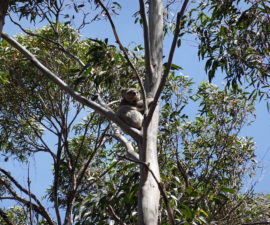
Koalas live in urban areas where there are trees for feeding and resting.

Koalas live in urban areas where there are trees for feeding and resting.anted to focus my research on animals in zoos. Now I have the best of both worlds!

Since I was a kid, I have wanted to work with animals. I initially focused on what most young people think of as the coolest animal job to have and started to pursue becoming a veterinarian. As an undergraduate at Franklin and Marshall College, I was exposed to another field, animal behavior. It didn’t take long for my academic focus to change. I majored in Psychology and Biology and geared my training to study animal behavior. I started my work as an undergraduate focusing on non-human primates, rhesus macaques to be exact, and did a study on environmental enrichment with them. Enrichment is a buzzword you have probably heard already, but back then it was not as common and all the “toys” for animals were just starting to hit the market. With dreams of working out in the wilds of nature, I graduated and went to work with acorn woodpeckers in the rolling hills of Northern California.Actually, doing fieldwork made me decide that, although I liked being in the great outdoors, I really wanted to focus my research on animals in zoos. Now I have the best of both worlds!

Colony Life with Koalas

For the past 10 years, I have studied mate choice with our colony of koalas. This species is not always as entertaining as the primates, but just as interesting. The work started at the San Diego Zoo, but since then has expanded into various research projects in Australia. This means that I get to play field researcher without having to make the long-term commitment that I originally thought I was going to have to make. My work has expanded into field research that focuses on the plight of the koalas in Australia.

Over the past ten years, koala numbers in Queensland (Northern) have plummeted while Victoria (Southern) has concerns about over population. The Australian government finally listed the koala as vulnerable under national law, but only for Queensland, New South Wales and the Australian Capital Territory. The growing concern in Australia from the koala researcher perspective, no matter where, is that this still doesn’t do enough and that the other populations of koalas need just as much protection. Unfortunately, the Northern koalas (Queensland and New South Wales) like to make their homes in beachfront property, which humans covet as well. Between human encroachment and global climate change, the koalas face an uncertain future. This does not mean that we should lose hope—I have worked with koala field researchers doing fantastic work at the forefront of this challenge and they are making a difference when it comes to policies and laws concerning koalas. I am also excited (like all of you) to see how the koalas at the San Diego Zoo adapt to their new home opening soon. The Conrad Prebys Australian Outback will be the source of new and upcoming research for me with our koalas.

Still Monkeying Around

Not to leave the primates out, I have also started doing behavioral research again with our great apes and other monkeys around the Zoo. Those studies harken back to my roots of enrichment and take a look at husbandry and care issues.

I am an avid gardener with two children at home. Watching the monarch caterpillars transform into butterflies or planting new flowers that hummingbirds can use as food, are a couple of ways I love bringing joy of the natural world to my kids.

Jennifer Tobey is a behavioral biologist in the Behavioral Biology Division of the San Diego Zoo Institute for Conservation Research.

39

What Do Primates Do?

Primate volunteers help us collect data on orangutan behavior.

Primate volunteers help us collect data on orangutan behavior.

Much of my time has been spent focusing on koala research both at the San Diego Zoo and overseas in koala habitats in Australia. However, that is not all that I do or am interested in! A few years ago, I decided to go back to focusing some of my efforts on primate research. Most of my previous work with koalas focused upon mate choice and factors that influence it, but with primates, the research opportunities at the Zoo are more focused on the social interactions within groups of different primates. Specifically, this entails undertaking a lot of behavioral observation work, otherwise known as standing in front of exhibits and recording behaviors for many hours.

As I’m involved with several different research projects, time for me is not always plentiful, as I am sure you can all relate to. In order for me to accomplish this expansion of my work, I either needed to clone myself or enlist the help of a dedicated group of individuals. For me, the choice was easy: I decided on the latter! Who are these people, you ask? They are our very own primate observation volunteers. They all come with unique backgrounds and personalities but share a singular goal: to watch primates and record their behaviors to help expand the behavioral knowledge we need to maximize welfare and bolster breeding success.

This incredible team of volunteers has helped to reach this goal by tirelessly collecting data, sometimes in the rain, and, in return, they have seen some wonderful animal behavior. Any one of them can tell you who likes to hang out with whom in the bonobo world, which, they can tell you, changes daily and sometimes even hourly! They also can tell you about the orangutan soap opera that continues day to day with Satu’s ladies vying with each other for his attention. They can even tell you which capuchins will gladly come to the front of the exhibit for a chance that someone walking by will give them attention!

These volunteers get to do what is one of my favorite things about my work: really focus upon what animals do on a daily basis. And for me, it’s particularly exciting, as I get to expand my ability to collect more data on more species of primates. Without their help, these studies would not be possible, and for that I am grateful to all of them.

If you’re at the Zoo or the Safari Park and you see someone in front of any of these exhibits with a clipboard and stopwatch, they might be one of these primate volunteers.

Jennifer Tobey is a behavioral biologist in the Behavioral Biology Division of the San Diego Zoo Institute for Conservation Research. Read her previous post, Koala Headlines.

0

Koala Headlines

“Koalas no more in our bush”
“Koala listing another example of government ‘greentape’…”
“Koala listing offers no protection from logging”
“The vulnerable koala: are we in time to save our national icon?”
“Koalas get some protection in parts of Australia”

These are just some of the headlines coming out of Australia these days. And for good reason: Environment Minister Tony Burke announced on April 30 that the federal government decided to list the koala as vulnerable in New South Wales, Queensland, and Australian Capital Territory. However, there are two other states that are part of the koalas’ home range, Victoria and South Australia, where the federal government did not list the koalas as vulnerable, and this is bringing up some debate and discussion.

While is it is great to see the conservation research of Bill Ellis (former San Diego Zoo Institute for Conservation Research postdoctoral fellow and still a research collaborator of mine) being used in the political arena by helping the federal government come up with the vulnerable determination for koalas, there is always more that could be done. The debate and reason for the lack of protection for southern (Victorian) koalas is that there is a common misconception of the robustness of the southern ranging koala population, since there are high numbers in that region.

More than population numbers need to be taken into account when listing an animal. Kellie Leigh, conservation biologist from the Australian Ecosystems Foundation (and a collaborator with me on koala scent studies), says many of the large koala populations in Victoria have been bred from a small number of individuals that were reintroduced from the French and Phillip islands. “There is evidence that these populations suffer from inbreeding depression, including things like testicular abnormalities,” Dr. Leigh says. “This lack of genetic fitness also means that the populations are much more susceptible to pressures like disease.”

The idea that the Victorian koalas are “eating themselves out of house and home” perpetuates the idea that this population of koalas does not need protection like their northern counterparts. “Looking at numbers alone is just not meaningful in conservation terms. While the listing is welcome and a step in the right direction, we need to conserve the koala right across the species range if we want to hang on to this iconic animal,” says Dr. Leigh. Even with scientific input on the declining numbers of koalas in the northern states, the koala was not listed to the highest level: endangered.

It is wonderful that the San Diego Zoo has a robust colony of Queensland koalas for all Zoo visitors to see. And we will soon have a new home for them, opening in Spring 2013. But in my 10 years of koala research, I didn’t think that there might be a time when I might not see a koala in the wild. As a guest at one of my first talks at the Zoo asked, “Why are you studying koalas if they are not endangered?” My response was that their foothold in Australia could change at any time and could cross that threshold. Unfortunately, I am sorry to say that this is where we are heading. However, all is not lost, and the crusade for preserving the koala in Australia is strong. Although this listing does not cover all the koala populations, it is one more step in the right direction. So the next time you stop in and see our koalas, remember their wild counterparts and that there is reason for hope!

Jennifer Tobey is a research coordinator at the San Diego Zoo Institute for Conservation Research. Read her previous post, Victorians: The Other Koalas.

1

Victorians: The Other Koalas

A wild Victorian koala mother and joey

The San Diego Zoo has long held Queensland koalas in our collection; in fact, we have the largest breeding colony of them outside of Australia. But did you know that there is another koala found in Australia? I thought I might let you know about Victorian koalas, the Queensland koala’s southern “cousin.”

When I was in Australia in October, I visited Dr. Bill Ellis on St. Bees, where there are Queensland koalas (see Koala Fieldwork: Helping Hands), and I also traveled over 1,000 miles south to Cape Otway, Victoria. I stayed at the Great Ocean Ecolodge, which is surrounded by national parks. And to see the koalas, all I had to do was walk out the door! Dr. Kellie Leigh and Lizzie Corke and her family were my wonderful hosts. Lizzie and her husband built the lodge by hand, and Kellie is their resident researcher. I have traveled through much of Australia, but I had not spent any time in this most southern area of the country. I went from a warm tropical climate on St. Bees to a bit cooler and rainier one, but that is part of the reason one finds that the koalas are much larger and furrier here. Victorian koalas look different than the koalas you see at the San Diego Zoo, but we are not sure if that is the only difference.

Unlike their Queensland counterparts, Victorians are not currently viewed as a declining population; rather, there is some debate if they are eating themselves out of their favorite food, manna gum. That was part of the reason that I stopped in this part of the country. Dr. Leigh is in the process of setting up some koala research projects that will examine not only the behaviors of these koalas but their overall health and ecology.

Similar to the Queensland koalas, male Victorians have large sternal scent glands. And yes, I was able to collect some samples from males at the Ecolodge in order to have my organic chemist run them and compare them to the Queensland samples. As part of this sampling, I will be working with Kellie to see if we can come up with some possible bio-fencing methods using scent samples.

The cool part of this study is that we will end up creating our own artificial koala scent, similar to how companies create perfumes and colognes. If you have ever smelled koala scent, you will know that we won’t be stocking it for sale in our gift shops! And if you haven’t ever smelled a koala, just ask one of the volunteers at the Zoo’s koala cart to let you have a smell.

The next time you see our koalas, you can know that they are doing their part to help their wild Queensland counterparts and even their southern Victorian “cousins.”

Jennifer Tobey is a research coordinator at the San Diego Zoo Institute for Conservation Research. Read her previous post, Koala Valentines.

0

Koala Valentines

It’s that time of year again: love is in the air, and it’s also koala breeding season! So at the same time that you’re running around getting flowers, chocolate, and gifts for your Valentine, male koalas are trying to woo the female koalas, too!

It’s also a particularly hectic time of year for me, since it is when I collect more mate-choice data from the San Diego Zoo’s colony of koalas. I say more because I’ve collected a lot of data on these animals already! As we tackle each research question about a koala’s choice in mates, there is always a new question that comes from our answers. Sometimes I feel like research is a little like being on the TV show “Lost”; each new answer brings three more interesting questions.

Koalas are initially matched up by their genetics, but it seems they don’t always like to be paired up that way.  Some or all of you may know what a male bellow sounds like (see Koalas of St. Bees Use Cell Phones) but may not know that females also vocalize if they are not happy about a certain male approaching them. This sound isn’t very feminine (not that a bellow is melodious!). Females appear to have some  say in whether they will mate with the male.

Listen to a female koala discouraging a male’s advances:

Audio clip: Adobe Flash Player (version 9 or above) is required to play this audio clip. Download the latest version here. You also need to have JavaScript enabled in your browser.

To expand on my previous work, I am still continuing to record both male and female bellows and also collect scent from male koalas in order to examine potential individual differences (or similarities).  This includes recording bellowing activity throughout the night using an auto-recorder (you may see the nondescript green box pictured at left mounted out in the Zoo’s koala exhibits) and collecting scent samples for chemical analysis. I am also still actively working with Dr. Bill Ellis and the population of Queensland koalas he is studying on St. Bees Island.

In addition, we are about to embark upon some exciting new fieldwork with Victorian koalas. Did you know there was more than one kind of koala? I don’t want to spill all the beans yet, but if you catch up with me at this year’s San Diego Zoo Discovery Days: Koalapalooza, I can answer all of your questions in person. And, of course, you will be able to listen, track, and smell koalas at Koalapalooza, too!

Jennifer Tobey is a  research coordinator at the San Diego Zoo Institute for Conservation Research. Read her previous post, Koala Field Project: Meet Jackaroo.